










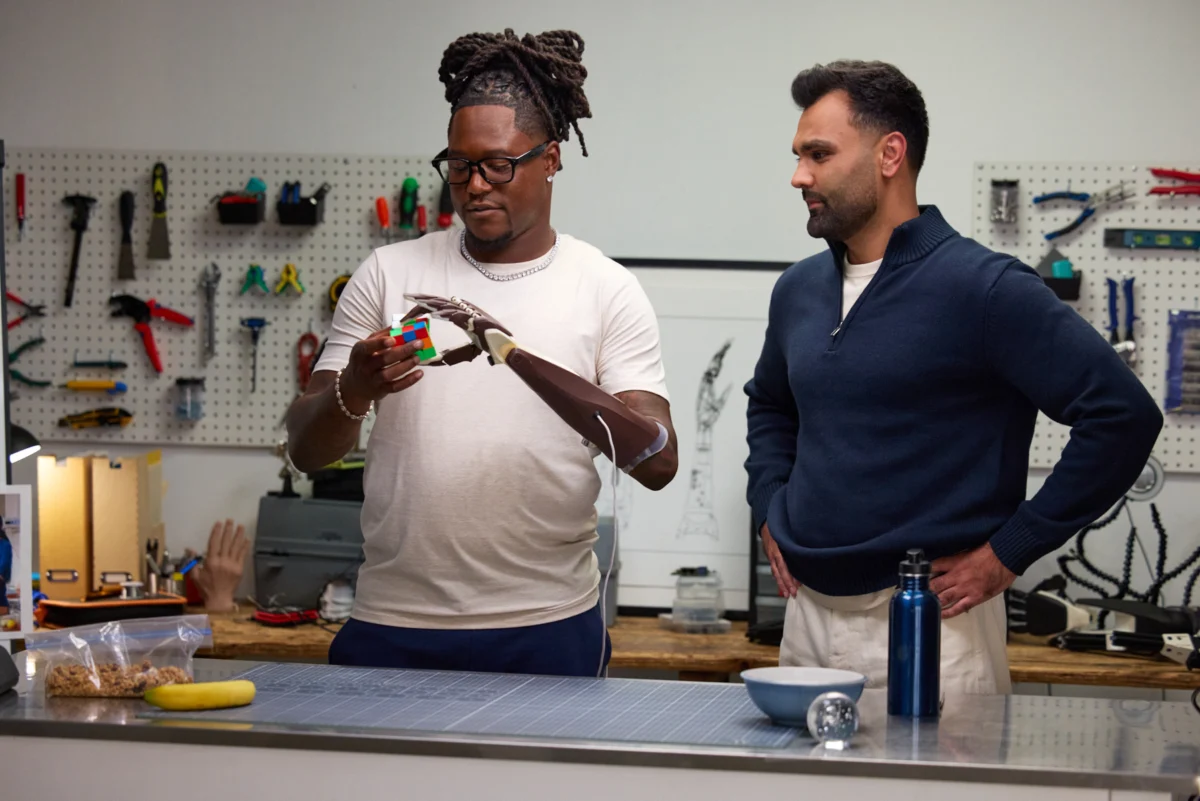
TORONTO — Across the globe, the convergence of artificial intelligence, advanced hardware, and open-source ecosystems is fundamentally reshaping what it means to live with a disability. For decades, individuals with upper-limb differences have navigated a world built for two hands using prosthetic technology that, while mechanically sophisticated, often demands tedious, cognitive-heavy operation. Today, a new paradigm is emerging at the intersection of computer vision and robotics.
At the forefront of this movement is smartARM, an innovative Toronto-based startup pioneering a vision-first bionic arm prototype. By integrating open-source software with advanced machine learning architectures—and incorporating Meta AI glasses as an optional, high-context wearable add-on—smartARM is dramatically shrinking the gap between human intent and robotic execution. The result is a prosthetic limb that does not merely mimic human movement, but actively perceives and adapts to its environment in real time.
Main Facts
The core innovation behind the smartARM prototype lies in its ability to automate decision-making processes that traditionally required heavy user intervention.
- Vision-First Architecture: Unlike conventional bionics that rely entirely on electromyographic (EMG) signals from residual muscles to switch between grip modes, smartARM features an integrated camera embedded directly in the palm of the prosthetic hand.
- Open-Source AI Integration: The startup leverages DINOv2, Meta’s powerful open-source computer vision model. This enables the prosthetic to recognize and categorize everyday objects rapidly, drawing from as few as a handful of reference photographs.
- Contextual Wearable Extension: Users can optionally pair the bionic arm with Meta AI glasses. Utilizing the Meta Wearables Device Access Toolkit, the glasses capture an egocentric (first-person) point of view, streaming rich visual context to help the arm better understand user intent and target objects.
- Zero-Training Adaptation: Because the AI reads direct visual features rather than requiring extensive pre-programming or weeks of physical therapy, the arm can adapt to new items almost instantaneously.
- Community Personalization: Through a companion smartphone app, users can easily scan and add new personal items to their device’s recognition database, automatically contributing those objects to the broader smartARM user community.
Chronology: The Evolution of Accessible Bionics
To understand the magnitude of smartARM’s breakthrough, it is necessary to examine how prosthetic technology has evolved from static mechanical hooks to cognitive-assisting robotics.
The Mechanical Era and Early Myelectrics
For centuries, upper-limb prosthetics were largely passive mechanical tools—hooks, split-hooks, or rigid cosmetic hands operated by body harnesses and cables. While durable, they offered limited dexterity and required exhausting physical effort to manipulate.
The late 20th century introduced myoelectric prosthetics, which utilized electrical signals generated by surface muscles in the residual limb. When a user flexed a specific muscle, electrodes picked up the signal to open or close a mechanical hand. While this represented a massive leap forward, it introduced a significant bottleneck: human anatomy only provides a limited number of distinct muscle signals. Consequently, users had to perform unnatural, multistep sequences—such as co-contracting muscles or holding a switch—to cycle through a menu of grip patterns (e.g., switching from a pinch grip to a power fist).
The Rise of Smart Robotics
Over the past decade, advanced bionic hands entered the market featuring individually articulated fingers and multiple pre-programmed grips. However, the cognitive load remained high. Picking up a sequence of everyday items—such as lifting a ceramic coffee mug followed immediately by a delicate spoon—forced the user to constantly toggle settings manually. The technology was physically capable, but it lacked contextual awareness.
The Vision-First Revolution
Recognizing that the true bottleneck was not mechanical execution but user-interface friction, smartARM shifted the paradigm toward computer vision. By moving the "brain" of the operation from manual user toggles to autonomous visual recognition, the startup bypassed the traditional limitations of muscle-signal routing. The integration of foundational open-source vision models like DINOv2 in the mid-2020s allowed the Toronto startup to leapfrog the slow, data-starved training pipelines of the past, setting the stage for consumer-ready, plug-and-play bionics.
Supporting Data & Technological Breakdown
The technical architecture powering the smartARM prototype relies on a seamless symphony of edge computing, computer vision, and wearable hardware.
The Power of DINOv2
In traditional machine learning workflows, training a computer vision model to recognize new objects requires thousands of labeled images and days or weeks of compute-heavy training. smartARM circumvents this by utilizing Meta’s DINOv2.
DINOv2 is a self-supervised vision transformer model that learns rich visual features without requiring human-annotated labels. Because the model already possesses a generalized understanding of depth, geometry, and texture, the smartARM system can learn to recognize a brand-new object—say, a specific brand of water bottle or a unique kitchen tool—using as few as three to five reference photos. Once the visual features are registered, the software calculates the optimal geometric grasp configuration and instructs the bionic hand’s actuators accordingly.
Egocentric Perception via Meta AI Glasses
While the camera in the palm of the hand provides crucial close-range data for gripping, it has a limited field of view when an object is outside the immediate grasping zone. This is where the Meta AI glasses enter the ecosystem.
By tapping into the Meta Wearables Device Access Toolkit, the smartARM system gains a continuous, high-definition egocentric data stream. The glasses observe the user’s gaze and the broader scene before the hand even reaches out. This extra layer of context allows the AI to anticipate what the user intends to interact with—distinguishing, for instance, whether a user is reaching past a set of keys to grab a smartphone.
Furthermore, the companion smartphone application acts as a decentralized hub. If a user encounters an unindexed household item, they can photograph it via the app, instantly updating their personal profile and optionally sharing the object profile with the broader smartARM ecosystem. This crowdsourced scalability ensures that the bionic arm becomes smarter and more versatile with every user added to the network.
Official Responses and Perspectives
The real-world validation of any assistive technology ultimately rests with those who design it and those who live with it every day.
Hamayal Choudhry, Founder and CEO of smartARM, emphasizes that the primary metric of success is not just mechanical complexity, but cognitive relief.
"Building a capable hand is only part of the challenge. Making it intuitive to use matters just as much," said Choudhry. "By helping the arm recognize everyday objects and select a suitable grip, we’re working toward an experience where people can focus more on what they want to do and less on how to operate their prosthetic."
For individuals navigating life with limb differences, the difference between manual operation and AI-driven autonomy is transformative. Shaquem Griffin, a long-time smartARM user and former NFL linebacker who made history as the first one-handed player drafted into the league, highlights the broader societal and economic implications of the technology:
"Of all the tech packed into it, scalability and accessibility matter most to me," Griffin noted after testing the prototype. "This is the future of consumer prosthetics."
Griffin’s perspective underscores a vital industry challenge: historically, advanced bionic limbs have carried prohibitive price tags and steep learning curves, restricting access to a privileged few. By building on open-source frameworks and leveraging widely available consumer hardware (such as AI glasses and smartphone apps), smartARM is laying the groundwork for a future where high-end assistive tech can be democratized.
Implications for the Future of Accessibility and AI
The development of vision-first, AI-integrated prosthetics carries profound implications that extend far beyond the field of bionics.
1. Reducing Cognitive Fatigue
Assistive technology should reduce friction, not introduce new layers of mental exhaustion. By automating routine decisions—such as determining whether a cylindrical object requires a three-jaw chuck or a cylindrical power wrap—smartARM reduces the cognitive load on the user. This allows amputees and individuals with congenital limb differences to expend their mental energy on daily life, professional pursuits, and creative expression rather than micro-managing their assistive devices.
2. The Power of Open-Source Collaboration
The collaboration between independent startups like smartARM and tech giants providing open-source models (such as Meta’s release of DINOv2 and developer toolkits) points to a sustainable blueprint for technological progress. Rather than building proprietary, walled-garden ecosystems that isolate users, open-source AI allows smaller innovators to build sophisticated capabilities rapidly. This accelerates research and development cycles, bringing life-changing solutions to market faster and at a lower cost.
3. Redefining Wearables as Assistive Infrastructure
For years, smart glasses and consumer wearables were marketed primarily as lifestyle gadgets or augmented reality novelties. The integration of Meta AI glasses into a medical and assistive workflow demonstrates a profound shift: consumer electronics are increasingly serving as vital infrastructure for accessibility. By opening device access toolkits to developers, technology companies are enabling use cases that enhance human agency in deeply meaningful ways.
4. A Horizon of Zero-Training Accessibility
Perhaps the most exciting implication of smartARM’s work is the realization of true plug-and-play accessibility. The transition from weeks of occupational therapy and manual calibration to an arm that "works from the first try" signals a cultural and functional turning point. As computer vision models become faster, cheaper, and more accurate, the expectation for assistive devices will permanently shift: users will no longer adapt themselves to machines; machines will instantly adapt themselves to users.
Conclusion
The work being done in Toronto by smartARM, fueled by open-source vision models and wearable technology, offers a compelling glimpse into tomorrow. It is a future where physical differences are met not with cumbersome workarounds, but with seamless, intelligent companions that understand the world the moment they look at it. For millions of people worldwide living with limb differences, that future is arriving not decades from now, but today.



