As modern consumers increasingly turn to generative artificial intelligence tools—such as ChatGPT, Perplexity, Gemini, and Google’s AI Overviews—to find information, a profound structural shift is occurring in the digital marketplace. Historically, a brand’s digital visibility depended on securing a top-ten spot on a traditional search engine results page (SERP), driving traffic via clickable links. Today, users often ask complex, multi-layered questions and act directly on synthesized, conversational replies without ever clicking through to an external website.
This behavior has given birth to a new discipline: Answer Engine Optimization (AEO). Unlike traditional Search Engine Optimization (SEO), which aims to rank web pages in a list of links, AEO focuses on getting a brand mentioned and its content cited directly within the AI-generated answers themselves.
To navigate this zero-click reality, digital marketers and enterprises are rapidly adopting AEO checkers—specialized software designed to audit, measure, and improve how generative engines perceive and present a brand.
![AEO checker tools that measure answer engine visibility [2026]](https://53.fs1.hubspotusercontent-na1.net/hubfs/53/aeo-checker-1-20260903-3858273.webp)
What Is Answer Engine Optimization and Why Does It Matter?
Answer Engine Optimization is the practice of optimizing digital assets to maximize the frequency and accuracy of brand appearances in AI-synthesized responses. When a user asks Perplexity for the "best enterprise accounting software" or queries ChatGPT for a breakdown of lead-qualification strategies, these platforms do not merely point users to a directory of URLs. Instead, they aggregate data across multiple web sources, evaluate credibility, and synthesize a single, authoritative response.
Google introduced a similar summary-first paradigm to its ecosystem with the rollout of AI Overviews in May 2024. These overviews trigger when Google’s systems determine that a summary adds distinct value to a standard query, embedding source links inline next to the supported text.
Crucially, AEO and SEO are not competing strategies; they are complementary halves of a modern visibility framework. Strong SEO continues to supply the foundational crawlability, technical health, and authority signals that answer engines rely on when deciding which sources to trust and cite. However, AEO requires an elevated level of content structuring—delivering direct answers to explicit questions, organizing data with robust schema, and backing claims with verifiable primary sources.
![AEO checker tools that measure answer engine visibility [2026]](https://no-cache.hubspot.com/cta/default/53/9dd5e54b-fbef-4dd0-bc44-1689feb1ea18.png)
Chronology of the Shift: From Blue Links to Conversational Answers
The evolution from traditional search indices to generative answer engines represents one of the fastest technological pivots in internet history.
- The Era of Classic Search (Pre-2023): Search engine optimization was governed by keyword matching, backlink profiles, and technical site performance. Visibility was synonymous with ranking on page one of a search engine results page.
- The Generative Breakthrough (Late 2022 – 2023): The public launch of large language models transformed user habits. Consumers began bypassing traditional search engines for conversational queries, prompting early adopters to experiment with prompt-based visibility.
- Google’s AI Overviews Deployment (May 2024): Google fundamentally altered search behavior at scale by introducing AI Overviews directly into its main search interface, shifting the baseline expectation of internet users toward instant, summarized answers.
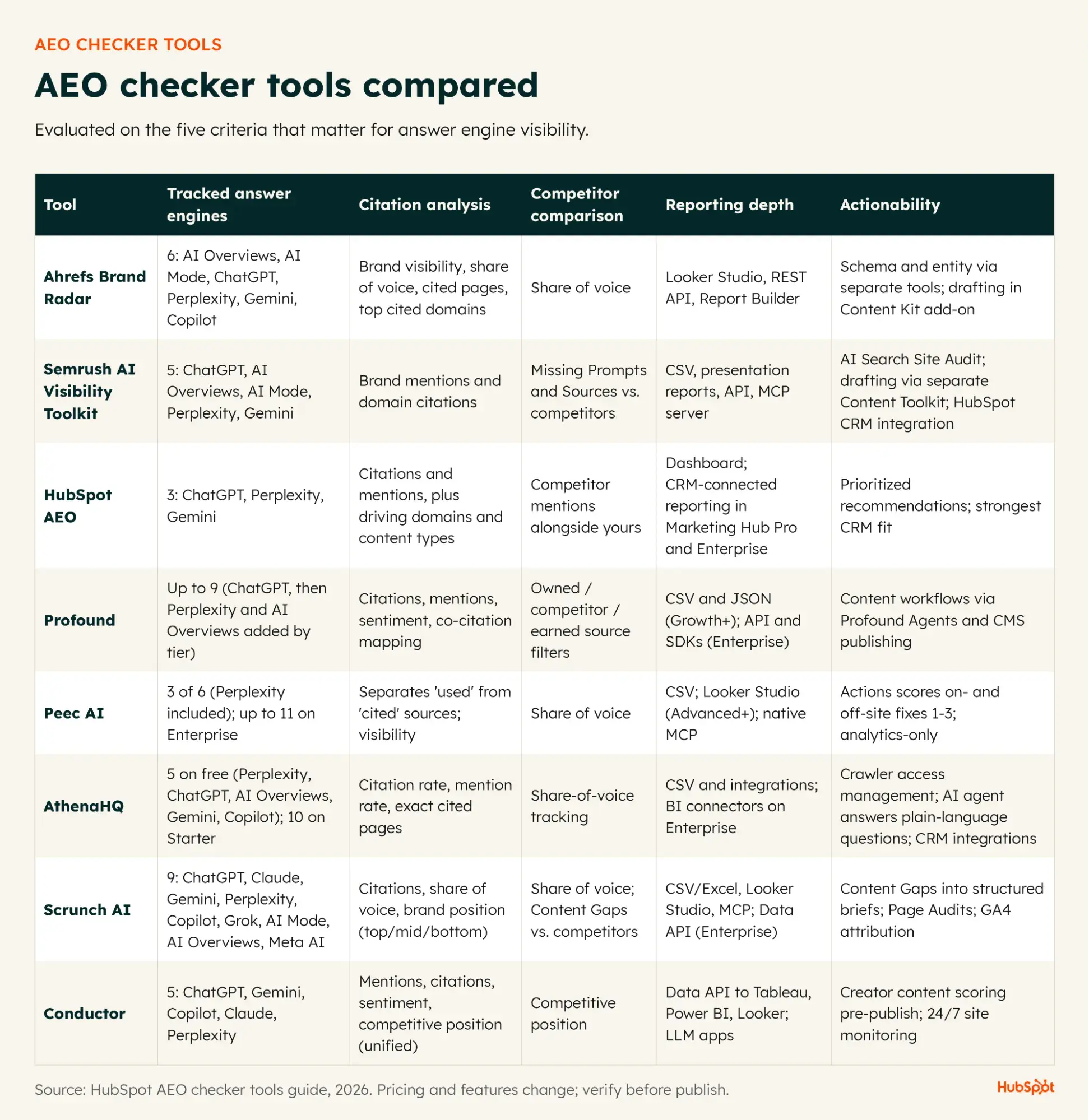
- The Emergence of Dedicated AEO Software (2025–Present): As brands realized that standard analytics tools could no longer capture zero-click impressions, the tech market responded. Software developers introduced specialized AEO checkers—such as HubSpot AEO, Ahrefs Brand Radar, Semrush AI Visibility Toolkit, and Profound—to systematically track brand mentions and citations across generative platforms.
Supporting Data and the Mechanics of AEO Checkers
An AEO checker functions as a diagnostic radar for conversational search. Because AI models are probabilistic and deliver dynamic responses based on live context, measuring visibility requires more than a simple keyword rank tracker.
A high-performing AEO checker typically evaluates:
![AEO checker tools that measure answer engine visibility [2026]](https://53.fs1.hubspotusercontent-na1.net/hubfs/53/aeo-checker-2-20260903-852936.webp)
- Citation Coverage: Whether an answer engine includes your domain as an inline or source-panel link.
- Brand Mentions: Whether your brand is discussed or recommended in the text, even when a direct hyperlink is absent.
- Competitor Benchmarking: Identifying which rival brands capture visibility for your target queries and understanding why the engine favored them.
- Content Accuracy: Detecting instances where an AI model misrepresents your product features, pricing, or value proposition.
- Prioritized Recommendations: Translating raw visibility data into actionable content updates, schema corrections, and entity optimizations.
Without automated tooling, marketers are forced to conduct manual spot-checks. While manual sampling—running incognito queries in Google AI Overviews, ChatGPT, and Perplexity—is useful for early-stage audits, it quickly becomes unmanageable. Generative engines frequently alter their outputs based on user location, session history, and real-time web crawling, making automated tracking essential for enterprise-grade marketing strategies.
Official Industry Responses and Tooling Ecosystem
As the digital marketing sector adapts to generative search, leading software platforms have integrated AEO capabilities into their core offerings.
- HubSpot AEO: Standing out for its deep CRM integration, HubSpot’s AEO tool tracks visibility across ChatGPT, Perplexity, and Gemini. In its Marketing Hub Professional and Enterprise tiers, HubSpot goes beyond mere diagnosis: it connects AI visibility data directly to CRM contacts and deals, utilizing AI agents to turn visibility gaps into research-backed content drafts.
- Ahrefs Brand Radar and Semrush AI Visibility Toolkit: These platforms bridge traditional SEO with generative search, utilizing large keyword indexes to flag which ranking queries actively trigger Google AI Overviews and other conversational engines.
- Profound and Peec AI: Emerging as specialized, pure-play analytics tools, these platforms dive deep into citation context, sentiment scoring, and cross-engine monitoring (particularly for Perplexity and ChatGPT).
- Scrunch AI and Conductor: Focusing on the technical underpinnings of AEO, these tools audit site architecture, schema markup, and entity readiness to ensure that AI web crawlers can easily ingest and render site content.
Implications for Marketers, Brands, and the Future of Web Traffic
The rise of answer engines and AEO checkers carries profound implications for digital strategy:
![AEO checker tools that measure answer engine visibility [2026]](https://53.fs1.hubspotusercontent-na1.net/hubfs/53/aeo-checker-3-20260903-8904553.webp)
1. The Redefinition of ROI and Attribution
Marketers can no longer rely solely on click-through rates (CTR) and session data to measure campaign success. Much of a brand’s influence in the AI era happens at the "zero-click" stage—shaping buyer perception before a user ever visits a website. Organizations must learn to value brand mentions and citation frequency alongside traditional traffic metrics.
2. Content Quality Over Keyword Density
Because answer engines synthesize information to solve user problems directly, low-value, keyword-stuffed content is actively penalized or ignored. Content must be authoritative, logically structured, and enriched with clean metadata and schema so that AI parsers can easily extract factual answers.
3. The Need for Continuous Monitoring
Because generative models update their web-retrieval mechanisms constantly, brand visibility is volatile. What ranks or gets cited today may disappear tomorrow due to a competitor’s content update or a shift in the underlying language model’s training data. Automated AEO checkers are transitioning from nice-to-have utilities to core operational necessities.
![AEO checker tools that measure answer engine visibility [2026]](https://53.fs1.hubspotusercontent-na1.net/hubfs/53/aeo-checker-4-20260903-6212698.webp)
Conclusion
The digital landscape is undergoing its most radical transformation since the invention of the search engine. As users increasingly delegate their research and decision-making to AI answer engines, brands that fail to monitor and optimize their presence in conversational outputs risk becoming entirely invisible. By integrating AEO checkers into their marketing stacks, organizations can reclaim visibility, correct brand inaccuracies, and secure their place in the future of search.