





By Sakshi Sadashiv
Edited by Amulya Hiremath
Introduction: The Human in the Loop
For 26-year-old Saloni, a typical workday in a bustling Delhi call center used to mean navigating the raw, unadulterated fury of stranded commuters, disgruntled riders, and stressed-out drivers. Working for a firm handling customer operations for major ride-hailing aggregators, her routine centered around onboarding new drivers, verifying their credentials, and briefing them on corporate codes of conduct. But until recently, a significant portion of her day was spent firefighting complaints from users of platforms like Uber, Rapido, and Ola over canceled rides, lost luggage, and disputed fares.
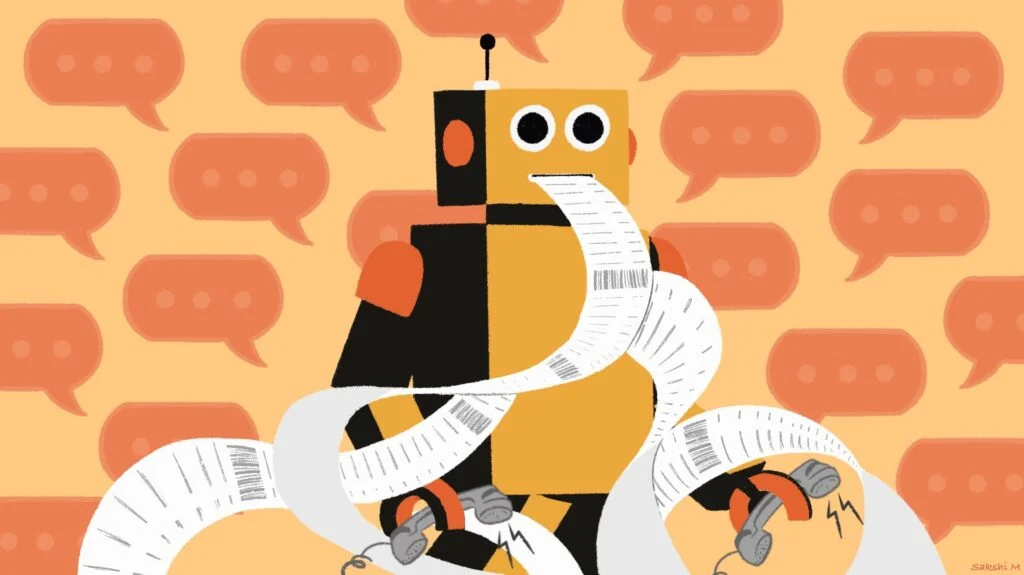
Today, Saloni’s role—and the broader landscape of Indian customer service operations—looks radically different. Most of those initial, high-friction inbound calls are no longer answered by humans. Instead, they are fielded by sophisticated voice-AI bots. For a transitional period, Saloni served as the "human in the loop," stepping in only when these automated systems hit a wall and failed to resolve a customer’s issue.
"By the time the voice bot transferred a call to me, the customer was already so frustrated that they would just start screaming," Saloni recalls, reflecting on the psychological toll of handling the overflow from automated systems designed to absorb the brunt of consumer anger.
Across India’s booming technology hubs, Saloni’s experience is far from unique. The customer service floor—long a foundational pillar of the country’s white-collar BPO (Business Process Outsourcing) economy—is undergoing a quiet, automated eviction. Voice-artificial intelligence is rapidly supplanting human agents, turning the baseline customer support experience into a machine-managed interaction, while direct human access is increasingly being cordoned off as a premium, paid perk.
Yet, even as Indian voice-AI startups rake in hundreds of millions of dollars in venture capital, a new regulatory shift threatens to disrupt the fragile unit economics driving this technological gold rush.
Main Facts: The AI Takeover of India’s Customer Operations
The deployment of voice-AI is no longer a futuristic pilot project; it is the frontline defense for India’s digital economy. Companies across e-commerce, fintech, logistics, and ride-hailing are aggressively cutting human staff in favor of generative voice models that can converse in multiple regional languages with near-human inflection, handling thousands of parallel calls at a fraction of the cost.
Recent industry data underscores this seismic shift. Major ride-hailing and tech platforms have dramatically slashed human-centric customer service operations. For instance, global giants like Uber have cut significant percentages of customer service personnel worldwide as automated voice-AI systems mature. In India, local tech ecosystems are following suit.
Simultaneously, the death of free, immediate human customer support has birthed a new tiered monetization model. Access to a living, breathing customer service agent is being recast as an exclusive luxury good. Major Indian consumer platforms—such as Flipkart with Flipkart Black, Swiggy with Swiggy One BLCK, and Zomato with VIP Mode—now tie priority support and direct human intervention to paid subscriptions or platform fees. If you pay, you skip the bot; if you don’t, you talk to the algorithm.

Behind this operational pivot is a thriving ecosystem of domestic voice-AI developers. Companies like Gnani.ai, Corover, Skit, Bolna, Haptik, Navana, and Ringg AI are providing the foundational software infrastructure that allows businesses to automate voice communication at scale.
Chronology: From Offshore BPO to Autonomous Voice Bots
To understand the magnitude of the current disruption, it is helpful to trace the evolution of customer service in India over the past three decades:
- Late 1990s – 2010s (The Human BPO Boom): India establishes itself as the back-office capital of the world. Call centers sprout across metropolitan hubs like Delhi, Bengaluru, Gurgaon, and Mumbai, employing millions of young graduates to field voice queries for global and domestic corporations. Human labor is cheap, abundant, and viewed as the ultimate competitive advantage.
- 2015 – 2020 (The Chatbot Era): As India’s internet user base explodes via low-cost mobile data, companies introduce text-based chatbots on apps and WhatsApp. While cost-effective, these rule-based bots are universally reviled by consumers for their rigidity and inability to handle nuanced queries.
- 2021 – 2024 (Generative AI Breakthrough): Large Language Models (LLMs) and advanced speech-to-text/text-to-speech architectures mature. Voice-AI startups emerge, capable of real-time conversational intelligence, sentiment analysis, and low-latency audio generation. Automated bots graduate from basic text prompts to fluent, natural-sounding voice calls.
- 2025 – Early 2026 (The Great Replacement & Tiered Support): Ride-hailing firms, food delivery apps, and e-commerce giants aggressively deploy voice-AI as the primary interface for customer complaints. Human agents are relegated to complex escalations or phased out entirely. Concurrently, platforms roll out subscription tiers (e.g., Zomato VIP, Swiggy One BLCK) that gatekeeper human support behind a paywall.
- Late 2026 (Regulatory Intervention): The Telecom Regulatory Authority of India (TRAI) introduces stringent new application-to-person (A2P) communication guidelines, threatening the cost structures and operational viability of automated voice-AI deployments.
Supporting Data: Venture Capital, Market Inflows, and Economic Realities
The pivot toward voice automation has not gone unnoticed by the investor community. Backed by the promise of infinite scalability and plummeting operational expenditures, Indian voice-AI startups have become magnets for venture capital.
According to data compiled by startup intelligence platform Tracxn, Indian voice-AI companies have collectively raised nearly $450 million. This capital influx has been heavily skewed by standout players, most notably Sarvam AI, widely heralded as India’s sovereign AI champion, which has alone secured over $350 million in funding.
International heavyweights are also staking claims in the subcontinental market. London-based voice-AI unicorn ElevenLabs announced ambitious plans to invest "hundreds of millions of dollars" in India, recognizing the country as both a massive talent incubator and a high-volume deployment ground for conversational models optimized for Indic languages and dialects.
The economic math for corporations is starkly in favor of the bots. While maintaining a physical call center requires continuous expenditure on real estate, infrastructure, employee training, retention, and compliance with labor standards, a voice-AI deployment operates on marginal cloud computing costs. A single voice-AI instance can theoretically manage thousands of concurrent calls without experiencing fatigue, taking smoke breaks, or requiring emotional mitigation after an abusive interaction.
However, these financial projections assume an unregulated, frictionless digital highway—an assumption that is now being severely tested.
Regulatory Hurdles: TRAI’s A2P Rules Threaten Unit Economics
Even as billions of venture dollars flow into conversational AI infrastructure, a regulatory storm is brewing on the horizon that could upend the industry’s underlying business models.
Last month, the Telecom Regulatory Authority of India (TRAI) introduced strict new regulations governing application-to-person (A2P) communication. These rules are primarily designed to combat rampant digital fraud, unsolicited commercial communications (spam), and unauthorized automated robocalls that plague Indian mobile subscribers daily.

While TRAI’s intentions are consumer-protection-oriented, the sweeping nature of the A2P compliance framework inadvertently catches legitimate enterprise voice-AI use cases in its net. Automated outbound calls, programmatic customer verifications, and high-volume conversational bots must now navigate rigorous compliance checks, traceability mandates, and potential message-origination fees.
For voice-AI providers and their corporate clients, these regulatory friction points threaten to erode the very unit economics that make automation attractive. If every automated verification call or AI-driven customer service outreach incurs heavy compliance overheads, tracking requirements, or carrier penalties, the cost arbitrage over human labor shrinks dramatically.
Industry stakeholders are currently scrambling to lobby regulators, seeking carve-outs or clearer definitions that distinguish between malicious robocalling rings and legitimate, consented enterprise voice-AI workflows. Until a middle ground is found, the operational expansion of voice-AI in India faces an unexpected, highly formidable bottleneck.
Implications: The Future of Work and Customer Experience
The intersection of aggressive corporate automation, venture capital hyper-scaling, and sudden regulatory tightening has profound implications for the Indian economy across multiple dimensions:
1. The Transformation (and Evacuation) of the BPO Sector
India’s identity as the world’s back office is undergoing a structural mutation. The entry-level call center job—which historically served as an economic on-ramp for millions of Tier-2 and Tier-3 city youth entering the formal white-collar workforce—is contracting. As routine tasks are absorbed by bots, the remaining human roles require higher cognitive skills, emotional resilience for extreme escalation handling, or specialized technical oversight. For workers like Saloni, career mobility requires upskilling away from frontline execution into roles involving AI training, prompt engineering, or compliance monitoring.
2. The Degradation of Consumer Experience
While businesses champion voice-AI for its efficiency, the consumer experience is increasingly characterized by friction and frustration. The democratization of customer service is effectively ending; frictionless, empathetic problem resolution is becoming a luxury item reserved for those willing to pay subscription fees for premium support tiers. For the average consumer, navigating an automated voice tree that fails to understand regional accents or complex grievances risks breeding widespread digital alienation.
3. The Test of Sovereign AI Resilience
For homegrown pioneers like Sarvam AI and global entrants like ElevenLabs, the TRAI regulatory test will serve as a baptism by fire. The ability of these firms to build adaptive, compliant architectures that satisfy stringent telecom guidelines without breaking corporate balance sheets will determine whether India’s voice-AI revolution matures into a permanent infrastructural shift or stumbles under bureaucratic friction.
Conclusion
The quiet eviction playing out in India’s call centers marks a critical milestone in the nation’s technological evolution. Voice-AI has successfully transitioned from a speculative tech trend into the primary operating system for customer engagement. Yet, as startups celebrate hundreds of millions in funding and corporations pivot toward automated bottom-line optimization, reality is biting back.
Between the human cost borne by workers dealing with automated overflow, the consumer fatigue of walled-off human support, and the looming compliance pressures of TRAI’s A2P mandates, the road ahead for India’s voice-AI industry is paved with complex regulatory and social hurdles. Whether these intelligent bots can successfully navigate the red tape just as smoothly as they handle angry customers remains the defining question for the country’s digital economy.