











In the rapidly evolving landscape of web development, a fundamental shift is occurring. For decades, the primary interface for managing digital infrastructure has been the graphical user interface (GUI)—the dashboard. From cPanel to modern cloud consoles, these visual environments were designed for human eyes and mouse clicks. However, as agentic AI begins to permeate the professional developer’s toolkit, the limitations of the "point-and-click" paradigm are becoming increasingly apparent.
If you task an AI agent with provisioning a WordPress website, the success of that operation depends entirely on the tools at its disposal. If the agent is forced to rely on browser automation to navigate a dashboard, it is effectively playing a game of "blindfolded chess," hoping that UI elements match its script. Conversely, an API-first approach provides a predictable, repeatable, and machine-readable path to execution. In the era of autonomous agents, the API is no longer just a technical utility—it is the primary interface.
The Architecture of Automation: Why Human Dashboards Fail Agents
The internet is, by design, a visual medium intended for human consumption. Dashboards leverage CSS, JavaScript, and complex DOM structures to present information in a way that is intuitive to a person. However, an AI agent cannot "see" a dashboard. It lacks the biological context to interpret a layout or understand the nuance of a modal window.
When no API is available, developers often turn to browser automation tools like Playwright or Puppeteer to "fake" interaction with a dashboard. These tools scrape the DOM structure to locate buttons and forms. This approach, while ingenious, is inherently fragile. A single CSS class change or a shift in the site’s navigation structure can break the entire automation pipeline.
In contrast, a structured API call—such as a POST request—remains consistent regardless of how the underlying dashboard looks or behaves. According to the Postman State of the API Report 2025, nearly 90% of developers are integrating generative AI into their workflows. Yet, a critical disconnect remains: only 25% of developers are currently designing their APIs specifically for agentic use. This leaves a massive opportunity for platforms that prioritize machine-readable, stable, and well-documented API architectures.

The Chronology of API Evolution: From Human-Centric to Agent-Ready
The history of web management can be viewed through three distinct eras:
- The Manual Era: Infrastructure management was performed exclusively via GUI dashboards. Every task—from database creation to plugin updates—required human intervention.
- The Scripting Era: Developers began using CLI tools and basic shell scripts to automate repetitive tasks. This was the precursor to modern DevOps, but it still required a high degree of manual oversight and maintenance.
- The Agentic Era: We are now entering a phase where LLM-powered agents can plan, execute, and monitor complex workflows. These agents require "API-first" environments where the entire lifecycle of a site—from birth to decommissioning—is accessible via code.
As we move deeper into the Agentic Era, the "entry point" for an agent is exclusively the API. Unlike a human developer who can navigate ambiguous documentation or manually troubleshoot a failed UI interaction, an AI agent takes data at face value. If an endpoint is undocumented or its schema changes unexpectedly, the agent will fail silently. This places the burden of reliability squarely on the platform provider.
Supporting Data: The Risks and Rewards of Excessive Agency
The transition to agentic workflows is not without risk. The OWASP Top 10 for LLM Security (2026) explicitly lists "Excessive Agency" as a top-tier security concern. When an agent is given the power to make architectural changes, the potential for error is compounded by the speed at which it operates.
Furthermore, Salt Labs’ 2025 State of API Security report indicates that 95% of API attacks originate from authenticated sources. This underscores a vital reality: reliability in the age of AI is not just about uptime; it is about rigorous access control and authentication protocols.
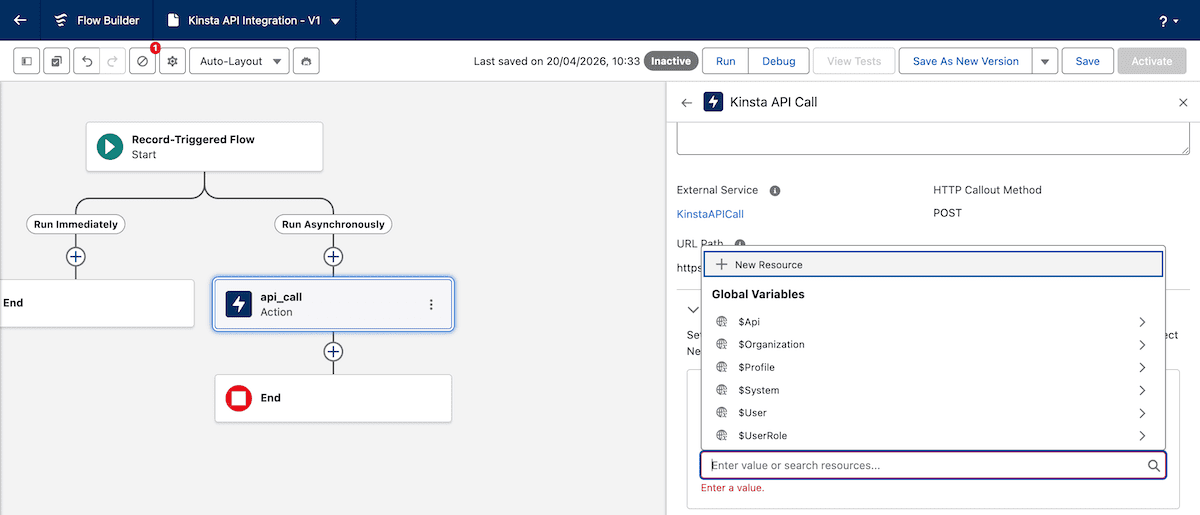
For the modern agency, the math is compelling. By integrating platforms like the Kinsta API with CRM tools like HubSpot or Salesforce, developers are removing the manual bottlenecks that have historically plagued site provisioning. As noted in industry benchmarks, agencies that successfully automate their "go-live" checklists—including backups, domain mapping, and caching configuration—can scale their operations by orders of magnitude compared to those relying on manual dashboard management.
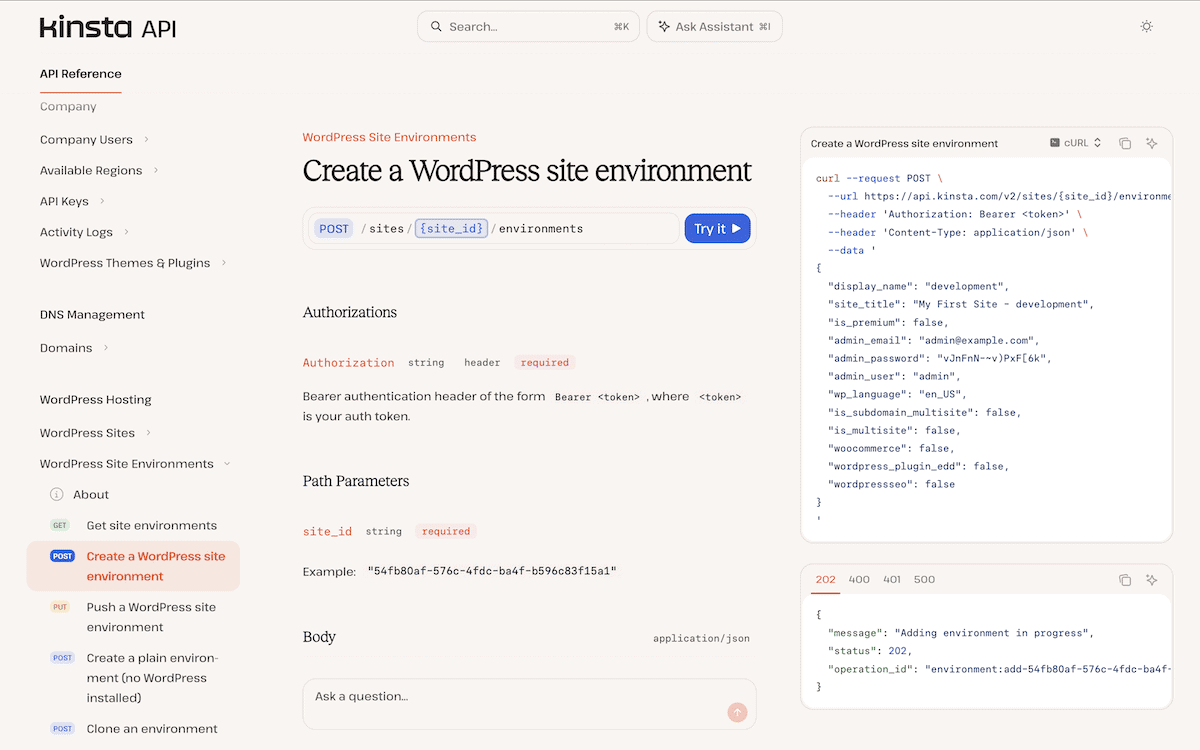
Official Perspectives: The Kinsta API as a Blueprint for Agents
Kinsta has positioned itself at the forefront of this shift by exposing its entire architecture to the API. This includes environment management, database access, and even granular analytics.
"The Kinsta API offers a comprehensive way to work with our infrastructure programmatically," notes Jeremy Holcombe, Senior Editor at Kinsta. "By providing endpoints that allow for the monitoring of HTTP response codes, agencies can now proactively handle site errors. For example, an agent can poll the GET /sites/environments/env_id/analytics/response-codes endpoint to detect a spike in 500-level errors and automatically open a support ticket or notify a Slack channel before a human even notices a problem."
This level of proactive management is a hallmark of the new developer experience. By chaining third-party webhooks—such as Slack or Salesforce—with Kinsta’s infrastructure, a developer can build an end-to-end deployment pipeline that requires zero manual intervention.
Implications for the Future: MCP and the Standardized Web
Perhaps the most significant development in this space is the emergence of the Model Context Protocol (MCP). If APIs are the language, MCP is the grammar that allows AI models to communicate with those APIs consistently.
Many WordPress solutions are already embracing this standard. The WordPress.com MCP server, for instance, allows AI agents to interact with site management tools without the need for cumbersome plugins or custom-coded wrappers. Even more impressive are community-driven projects, such as the Kinsta MCP, which provides over 80 discrete tools for site management, including PHP allocation and IP blocklist management.
The implication for developers is clear: the future of web hosting will be determined by the quality of documentation. An API is only as good as the agent’s ability to read it. To this end, Kinsta has implemented llms.txt files—a standardized way for LLMs to ingest API documentation, similar to how robots.txt informs search engine crawlers.
Preparing Your Workflow for Agentic Integration
As you evaluate your hosting provider for an AI-first future, there are four fundamental questions you must ask:
- Is the API comprehensive? Can every function performable in the dashboard also be performed via an API call?
- Is the documentation machine-readable? Does the provider offer
llms.txtor clear, structured API references that an agent can parse without hallucinating? - Is there robust authentication? Does the API support granular, token-based access that limits the "agency" of an AI to only the necessary tasks?
- Does it support industry standards? Is there support for the Model Context Protocol (MCP) or similar interoperability standards?
Conclusion: The Dashboard as a Presentation Layer
It is important to emphasize that dashboards will not disappear. Human judgment remains the final arbiter in any high-stakes project. We still need humans to handle client communication, perform visual regression analysis, and make the final "go/no-go" decisions on deployments.
However, the nature of the developer’s role is changing. We are moving from being "dashboard operators" to "infrastructure architects." By leveraging APIs to handle the repeatable, deterministic, and scalable parts of web development, we free ourselves to focus on the creative and strategic work that requires human insight.
The Kinsta API, with its deep integration into the WordPress ecosystem and support for modern protocols like MCP, represents the new standard for hosting. It acknowledges that in a world of AI agents, the API is the true interface, and everything else is merely a presentation layer. As we look toward the future, the teams that embrace this programmable infrastructure will be the ones that define the next generation of web excellence.



