










In the rapidly evolving landscape of Large Language Model (LLM) integration, developers are hitting an unexpected wall: the "Token Tax." As AI agents become more autonomous, their tendency to ingest massive volumes of search results, file retrievals, and log data has turned context windows into a premium resource. Every token consumed is a direct hit to the bottom line and a potential bottleneck for performance.
For developers building agentic workflows, the issue is no longer just about the intelligence of the model, but the efficiency of the data pipeline. A new shift toward Markdown-based data delivery—spearheaded by platforms like SerpApi—is proving that the way we format information for AI is just as important as the information itself.
The Problem: Why AI Agents Are "Token-Hungry"
Modern AI agents are designed to be exhaustive. When tasked with a simple search—for instance, "Find the best-rated coffee shops in Seattle"—the agent doesn’t just pull the name of a shop. It often triggers a recursive process that scrapes metadata, tracking links, nested JSON objects, and redundant code blocks.
In a standard JSON (JavaScript Object Notation) output, a single search result might contain dozens of keys that are essential for a web browser or a database but are entirely irrelevant to an LLM’s reasoning process. These extra characters, brackets, and metadata fields still count toward the context window. When an agent runs multiple loops to refine its search, these tokens compound, leading to "context bloat."
This bloat results in three critical issues:
- Direct Financial Cost: LLM providers charge by the token. Unnecessary data is effectively a tax on every query.
- Context Window Exhaustion: Even with massive context windows (like those offered by Gemini or GPT-4o), filling them with "noise" pushes out vital information, leading to degraded performance or "lost" instructions.
- Latency: Processing larger payloads takes longer, which slows down the responsiveness of the agent, particularly in real-time applications.
A Chronology of the Token Efficiency Crisis
The realization that token usage was becoming an unsustainable variable in AI development did not happen overnight.
- 2022–2023: The Wild West of Prompt Engineering. Early developers focused almost exclusively on the prompt itself. The belief was that if the prompt was "good enough," the model would perform. The data sources remained largely ignored.
- Early 2024: The Rise of Agentic Workflows. As autonomous agents (like AutoGPT or LangChain-based systems) became mainstream, developers noticed that their bills were spiking. The culprit was identified as "recursive retrieval"—agents were pulling back more data than they could effectively reason over.
- Mid-2024: The Optimization Wave. Developers began experimenting with custom parsing layers. They started writing scripts to strip JSON down to its bare essentials before feeding it into the model. This was effective but labor-intensive and error-prone.
- Late 2024–Present: The "Native Format" Solution. Platforms began to recognize that the responsibility for data efficiency lies at the source. By offering native Markdown support, search APIs began to bridge the gap between structured machine data and human-readable LLM context.
Supporting Data: The Case for Markdown
The performance metrics provided by SerpApi serve as a compelling case study in data optimization. In a benchmark test comparing standard JSON output to Markdown, the results were stark.
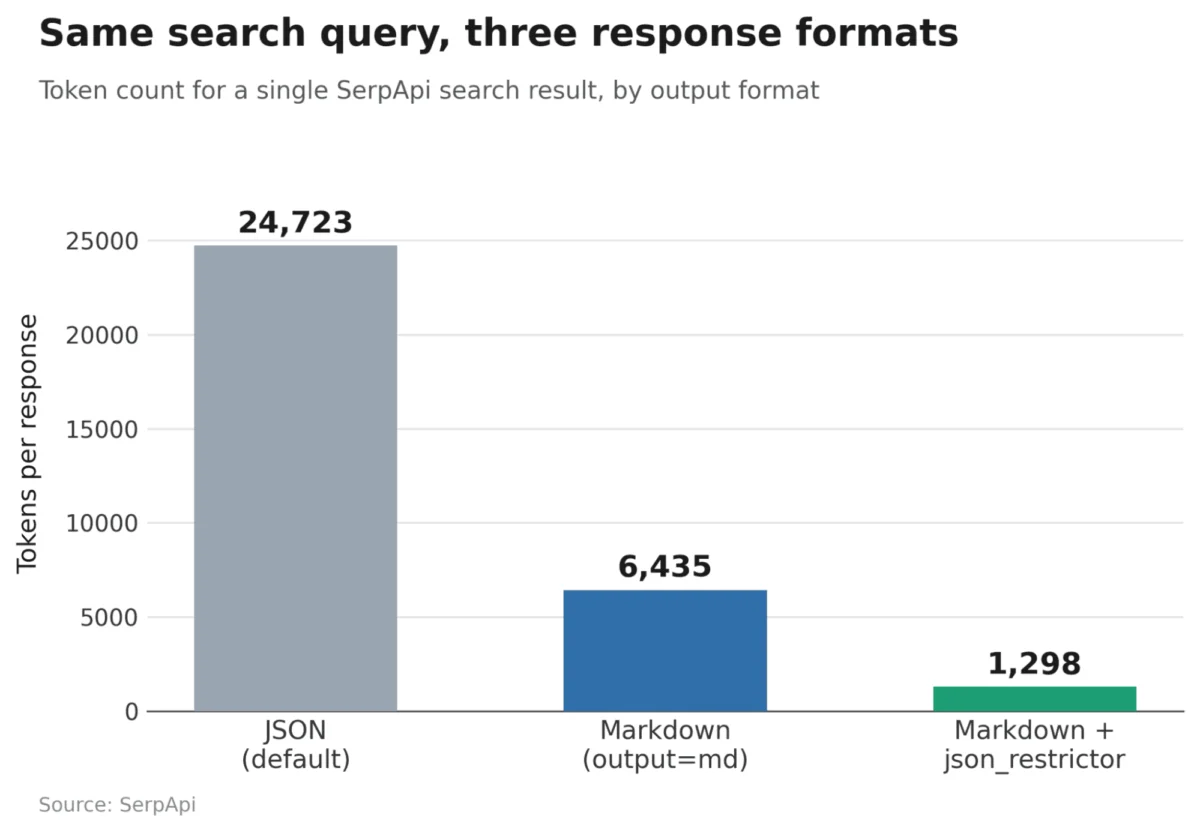
A search query for "coffee" in standard JSON format consumed 24,723 tokens. By switching the output format to Markdown, the exact same search query was condensed to just 6,435 tokens. This represents a 74% reduction in token usage.
When applying further filtering—restricting the fields to only the most relevant information—that number dropped to just 1,298 tokens.
Comparative Breakdown
| Format | Token Count | Efficiency Gain |
|---|---|---|
| Standard JSON | 24,723 | Baseline |
| Markdown Output | 6,435 | ~74% Reduction |
| Restricted Markdown | 1,298 | ~95% Reduction |
These numbers are authoritative, illustrating that the "shape" of the data is a primary driver of cost. By stripping away UI-rendering instructions and non-essential tracking metadata, developers can retain the "signal" while discarding the "noise."
Why JSON isn’t Always the Villain
While Markdown is a clear winner for LLM context, it is important to understand when to stick with tradition. JSON remains the gold standard for downstream processing.
If a pipeline requires strict data types—such as price as a float, geographic coordinates, or structured arrays for a SQL database—Markdown is insufficient. Markdown is a presentation layer; it is designed for reading. JSON is a data-interchange layer; it is designed for computing.
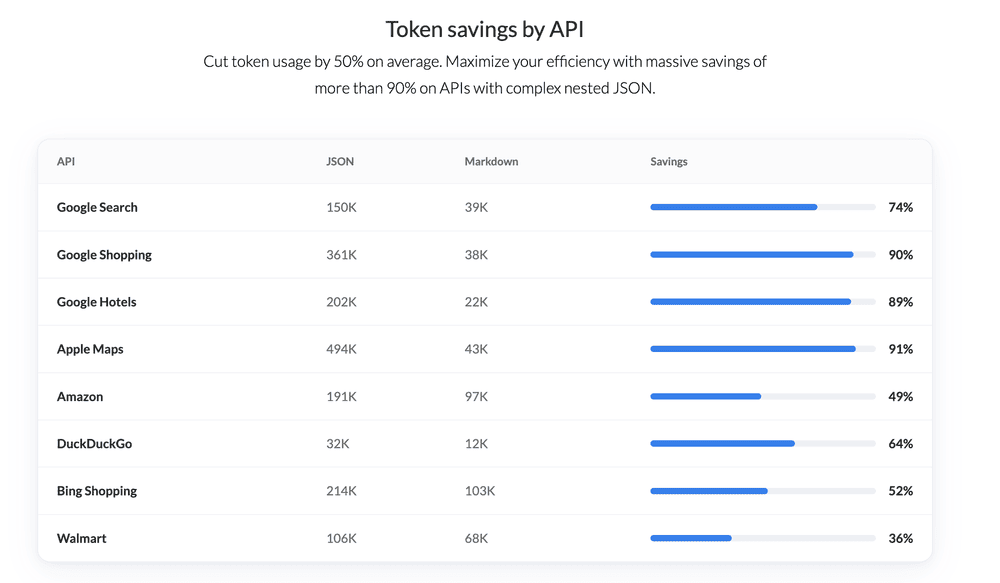
For instance, a pricing engine that needs to compare coupon_price vs old_price mathematically needs the rigid structure of JSON. However, an agent tasked with simply summarizing the best deals for a user doesn’t need to perform arithmetic; it only needs to read the information. In that case, Markdown’s table rows and inline links provide the perfect, low-cost summary.
The Technical Implementation: A Single Switch
The most significant barrier to optimizing AI data pipelines has historically been the complexity of re-engineering how data is fetched. SerpApi has addressed this by integrating Markdown support directly into their query parameters.
By simply appending output=md to a request, developers can transform the entire payload structure. This allows for:
- YAML Frontmatter: For structured metadata at the top of the result.
- Markdown Tables: For clean, readable tabular data.
- Automatic Stripping: Removal of internal tracking noise and redundant, machine-only fields.
Furthermore, for developers who need even more granular control, the json_restrictor feature allows for server-side filtering. This means the data is trimmed before it travels across the network, reducing both bandwidth usage and token overhead simultaneously.
The Broader Implications for AI Architecture
The shift toward Markdown-optimized data feeds signals a maturing AI industry. We are moving away from the "more data is better" mindset toward a "precision data" philosophy.
1. Sustainability of Agentic Systems
As AI agents move from experimental "chatbots" to core business automation tools, their cost-per-call must be predictable. Excessive token usage is not just a nuisance; it is a scalability blocker. By reducing the "token tax," businesses can deploy agents at scale without the fear of exponential cost growth.
2. Context Window Optimization
We are currently in a race to see who can provide the largest context window. However, a larger window is not a substitute for efficiency. If your 128k context window is filled with 100k of "junk" metadata, your model is essentially working with a 28k window. Markdown-formatted data ensures that every token inside the context window is relevant, high-signal information, which objectively improves the reasoning capabilities of the model.
3. The Future of API Design
Expect to see more API providers follow this trend. APIs that offer "LLM-native" endpoints—data specifically formatted to be consumed by Large Language Models—will become the industry standard. This marks a shift where API documentation will no longer just include JSON schemas, but also "LLM-ready" Markdown templates.
Conclusion: The Path Forward
The "token tax" is an avoidable expense, provided developers take the time to audit their data pipelines. Markdown is not a universal panacea—it cannot replace the rigid requirements of structured data in traditional programming—but for the growing world of agentic AI, it is an essential tool.
If you are currently building an AI-powered search, analysis, or summarization engine, the first step is to measure. Take one of your high-volume queries, observe the token usage in your standard JSON output, and compare it against a Markdown-formatted result. The delta between those two numbers is the amount of capital you are currently wasting.
In the world of AI, efficiency is the new currency. By reshaping the data we feed our models, we aren’t just saving on costs—we are building smarter, faster, and more effective autonomous agents. It is time to look beyond the prompt and start optimizing the data itself.



