









The era of the "simple chatbot" is officially over. As enterprise AI transitions from experimental pilots and single-turn FAQ responders to complex, agentic workforces, the infrastructure required to manage them must undergo a fundamental transformation. Modern production agents are no longer just answering questions; they are orchestrating workflows across teams of specialized subagents, retrieving context from disparate knowledge silos, and executing multi-step operations—all within a single session.
Recognizing that the current state of AI monitoring has failed to keep pace with this technological leap, Salesforce has announced a major overhaul of its Agentforce Observability stack. By shifting the focus from surface-level signals to deep, context-aware analytics, Salesforce is providing businesses with the tools needed to understand not just if an agent is working, but why it is performing the way it is.
The Chronology of the Shift: From Basic Metrics to Intelligent Oversight
In the early days of enterprise AI, the primary goal was deflection: "Did the bot stop the human from calling support?" Metrics were binary and rudimentary. A customer typing "thank you" was counted as a successful deflection, regardless of whether the agent actually resolved the underlying issue. This "proxy signal" approach worked for simple Q&A bots, but it is proving disastrous for today’s sophisticated autonomous agents.
As these agents began to coordinate with other agents and reason across vast knowledge bases, the gap between "signal" and "reality" widened. Salesforce’s response to this evolution has been a multi-phase development cycle:
- Phase 1: The Recognition of the Context Gap. Internal audits by Salesforce revealed that as agents took on more complex, multi-turn reasoning tasks, standard dashboards were providing a false sense of security.
- Phase 2: Developing the Session Tracing Data Model (STDM). Understanding that raw JSON logs were too cumbersome for human analysis, Salesforce built the STDM. This framework structures every logged event—from initial user intent to the final action taken—into a readable, actionable data model.
- Phase 3: Deep Integration and UI Overhaul. Moving through 2025 and into mid-2026, the team consolidated fragmented dashboards into a single, cohesive view, preparing for the August 2026 rollout of advanced, inline citation features.
- Phase 4: The Democratization of Data. Recognizing that observability is a team sport, Salesforce made the strategic decision to remove the cost barrier, unmetering the observability stack to ensure that every stakeholder in an organization has access to these insights.
Supporting Data: Why "Signal" No Longer Suffices
The fundamental problem with legacy observability is the reliance on lagging indicators. In a modern Agentforce environment, an agent might pull data from a Salesforce knowledge article, verify it against a Google Drive file, and then trigger a workflow in Confluence. If the agent fails at the "reasoning" step, a simple dashboard showing a 95% deflection rate tells the developer absolutely nothing about the failure point.

The new Agentforce Observability platform addresses this by surfacing:
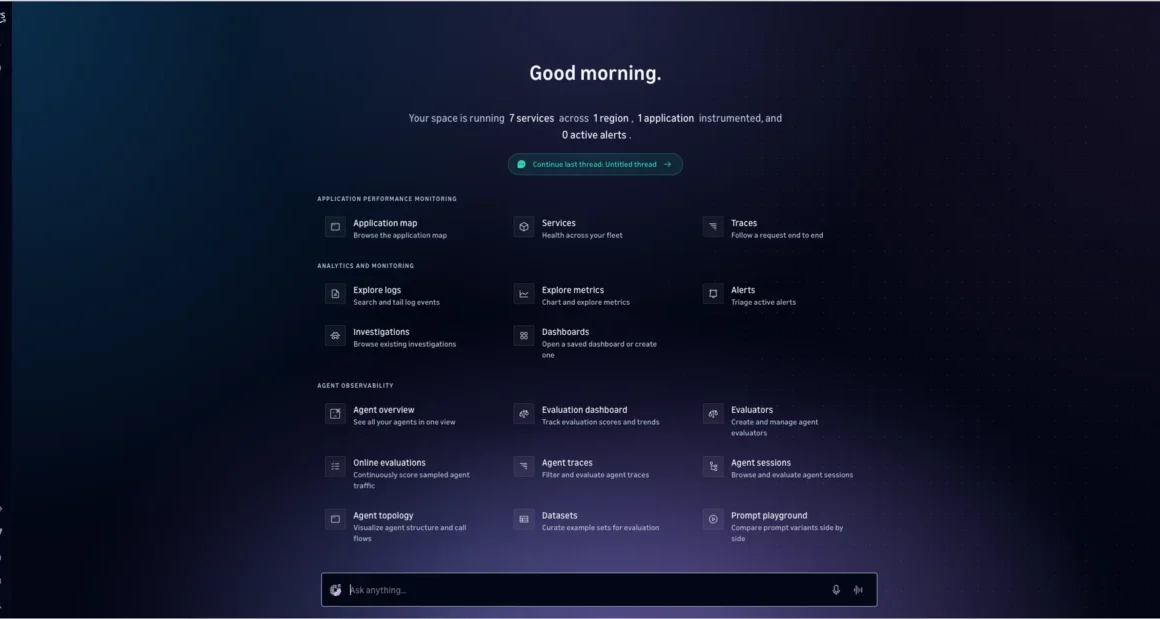
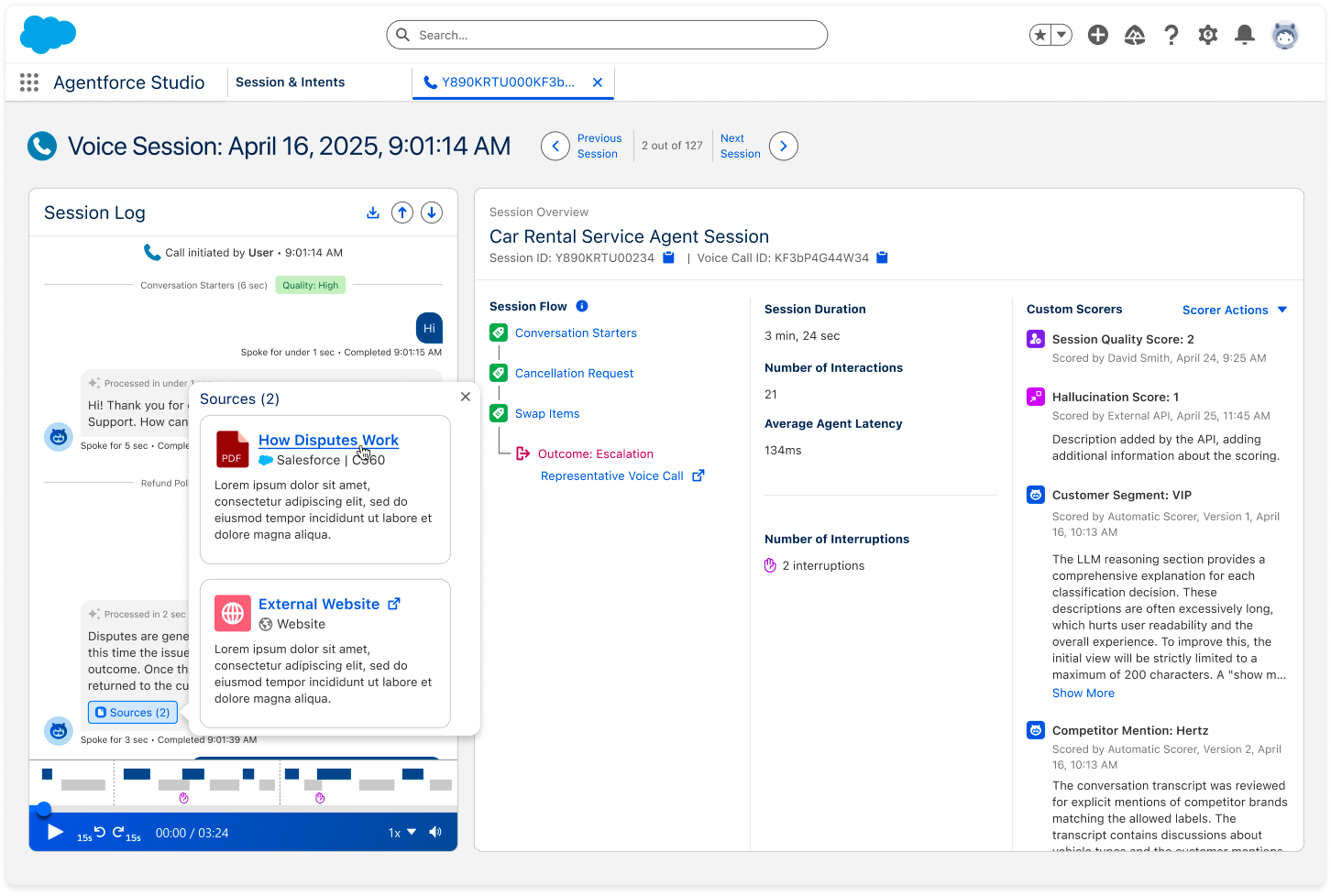
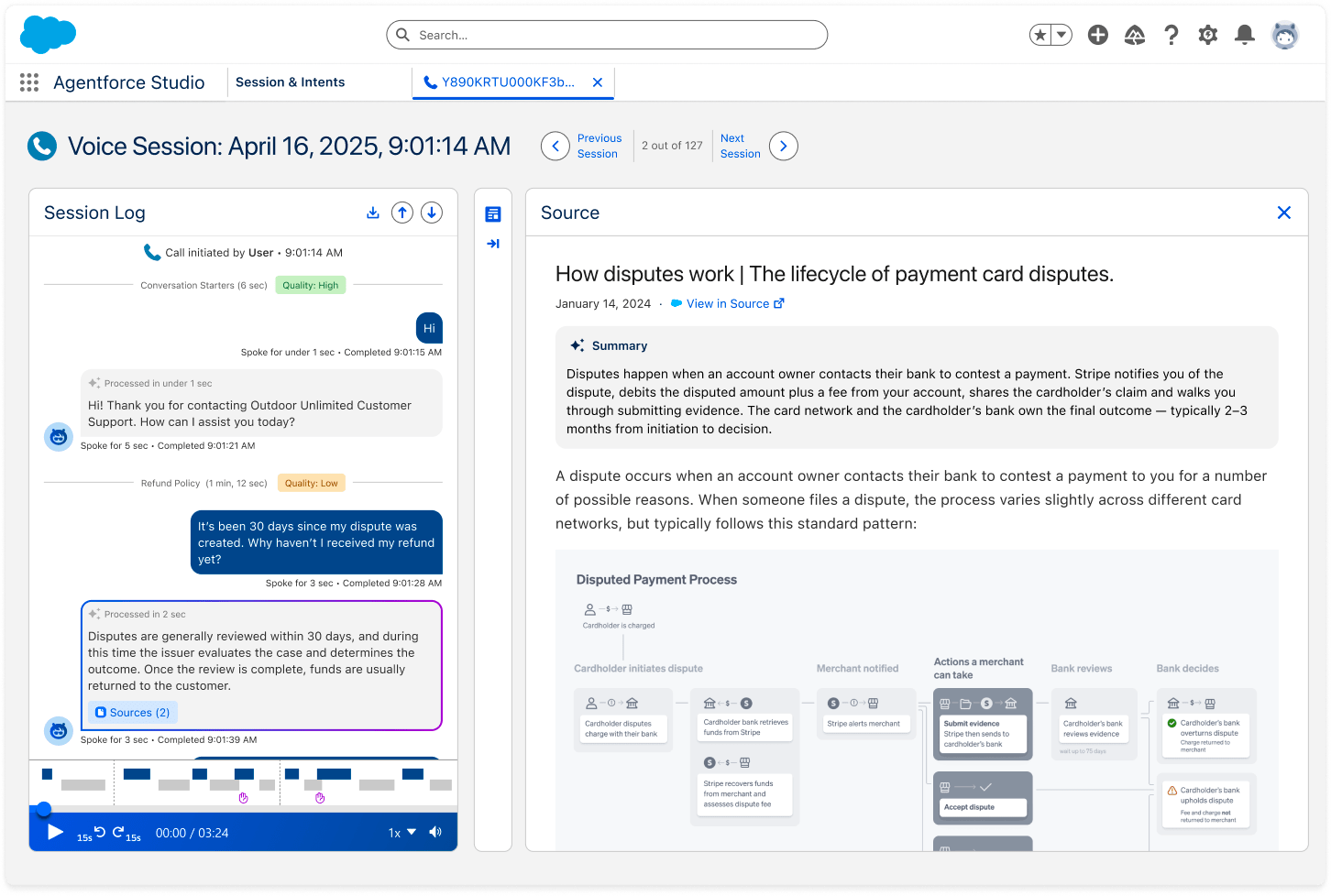
- Reasoning Traces: Visualizing the internal logic of the agent, showing which knowledge sources were queried and why they were chosen.
- Waterfall Traces: A mapping of multi-agent workflows, allowing users to see exactly where a subagent may have failed to hand off information correctly.
- Custom "LLM-as-a-Judge" Scores: Moving beyond sentiment, teams can now define custom metrics—such as "accuracy of product recommendation" or "adherence to pricing policy"—using editable prompts that allow the LLM to evaluate the session based on the specific business rules of the user.
By replacing inferred outcomes with context-based evaluation, Salesforce is effectively moving AI management from a "black box" model to a "glass box" model.
Official Perspective: The Vision for Agentforce
"The complexity of what happens inside that session has grown significantly," says the product leadership team at Salesforce. "While agents have advanced by leaps and bounds, most teams’ observability stacks haven’t kept pace."
The official stance from the company is that trust is the primary currency of enterprise AI. If a business cannot audit its agents with the same rigor it uses for human employees, it cannot scale. By consolidating Trust, RAG (Retrieval-Augmented Generation), health, and quality metrics into a single, unified view, Salesforce aims to minimize the "time-to-insight" for developers and operations managers.
Crucially, the company has emphasized that this is not just an update for the technical elite. By allowing users to define their own definitions of success—editing the prompts that drive evaluation—Salesforce is empowering domain experts, not just data scientists, to manage the performance of their AI fleets.
The Economic Implication: Observability Without the Meter
Perhaps the most significant news for the industry is the removal of the "meter" on observability. Historically, enterprise software providers have charged based on data ingestion, creating a "monitoring tax" that forced companies to sample their data rather than analyze it in full.
Salesforce is breaking this cycle for all Agentforce customers. Effective immediately, the following are included at no additional Data Cloud cost:
- Session Tracing and Telemetry Ingestion: The foundational data of every agent interaction.
- Out-of-the-Box Dashboards: Including the new consolidated views for health and quality.
- Alert Evaluation: The ability to trigger notifications based on performance dips.
While custom integrations—such as connecting external data from platforms like Snowflake or building entirely new semantic data models—remain metered, the core operational visibility is now "free." This is a bold strategic move designed to encourage massive, organization-wide adoption. When an observability tool is free, companies no longer have to limit access to one or two people; they can give every builder, product manager, and compliance officer access to the "truth" of their AI performance.
Implications for the Future of Enterprise AI
The shift toward deep observability has profound implications for the industry at large.
1. The Death of "Set it and Forget it" AI
The days of deploying an agent and hoping for the best are over. With inline citations—which will highlight the exact text from a source document that triggered an AI response—human supervisors can perform rapid "trust audits." This transparency will likely accelerate the adoption of AI in highly regulated sectors like finance and healthcare, where "hallucination" has previously been a deal-breaker.
2. A New Feedback Loop
When builders can see exactly where a session fails, the feedback loop shortens from weeks to minutes. If a bot consistently fails to answer a specific type of query, the developer can trace the failure to a specific intent, adjust the knowledge source, and immediately validate the fix. This brings a "DevOps" mentality to the world of generative AI.
3. Voice-First AI Maturity
With the inclusion of dedicated surfaces for voice agents, Salesforce is signaling that the next wave of automation will not be limited to text. As voice agents take on more sophisticated roles in customer service centers, the ability to monitor audio-to-text accuracy and reasoning paths in real-time will be a key differentiator for enterprise platforms.
4. The Rise of "Agentic Governance"
As companies deploy hundreds of specialized agents, they will need a way to govern them. The new dashboarding capabilities allow teams to slice and dice data across intents, actions, and subagents. This enables a level of "Agentic Governance" where businesses can manage their AI workforce with the same granularity they apply to their human workforce.
Conclusion
The release of these enhanced observability features marks a maturation point for the enterprise AI market. Salesforce is essentially telling the market that the "experimental" phase is over. By providing the tools to measure, debug, and optimize complex, multi-agent workflows, and by removing the financial friction of monitoring, they are setting a new standard for AI reliability.
For organizations currently running agents in production, the message is clear: the visibility you have today is likely insufficient for the complexity of tomorrow. With these updates, the ability to see deep into the "brain" of the agent is no longer an optional luxury; it is a fundamental requirement for any business that intends to lead in the AI-first economy. To learn more about how these changes can be implemented within your current infrastructure, visit the Salesforce Agentforce Observability portal.