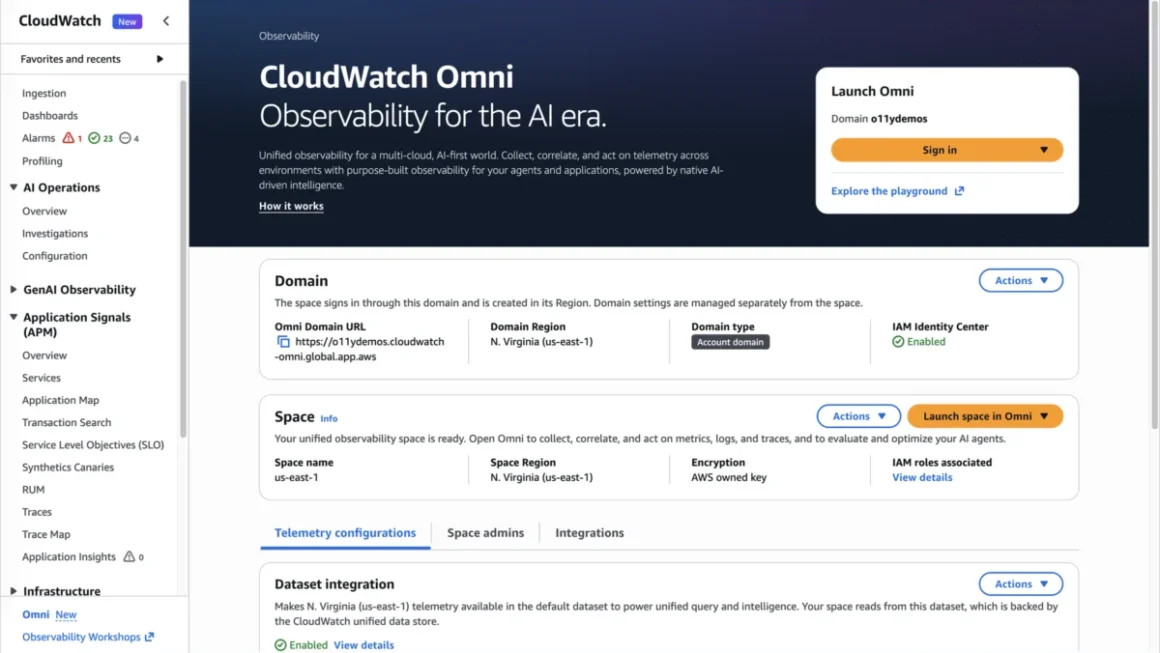







SEATTLE — In a major expansion of its cloud management portfolio, Amazon Web Services (AWS) has officially launched Amazon CloudWatch Omni, a unified, app-centric, and AI-powered observability solution designed explicitly for the complex, non-deterministic nature of modern applications and autonomous AI agents.
Available immediately worldwide, CloudWatch Omni bridges a critical gap in the software development lifecycle (SDLC). By decoupling deep operational insights from the traditional AWS Management Console and embedding them directly into developer workflows—such as integrated development environments (IDEs) and standalone web portals—AWS aims to eliminate the friction that engineering teams face when trying to debug, evaluate, and scale agentic AI systems.
1. Main Facts: What is Amazon CloudWatch Omni?
At its core, CloudWatch Omni is a purpose-built observability, evaluation, and experimentation platform tailored for AI agents, multi-turn conversational systems, and distributed cloud applications. Unlike traditional monitoring tools that rely exclusively on static metrics like CPU utilization, memory thresholds, and HTTP error codes, CloudWatch Omni evaluates generative AI performance by peering directly into model logic, tool invocation sequences, prompt variations, and reasoning loops.
Key Architectural Pillars:
- App-Centric and Open Standards: Built on OpenTelemetry (OTel), OpenInference, and AWS Distro for OpenTelemetry (ADOT), Omni works across diverse runtimes (AWS Lambda, Amazon ECS, Amazon EKS, and multi-cloud environments) without requiring proprietary lock-in or re-platforming.
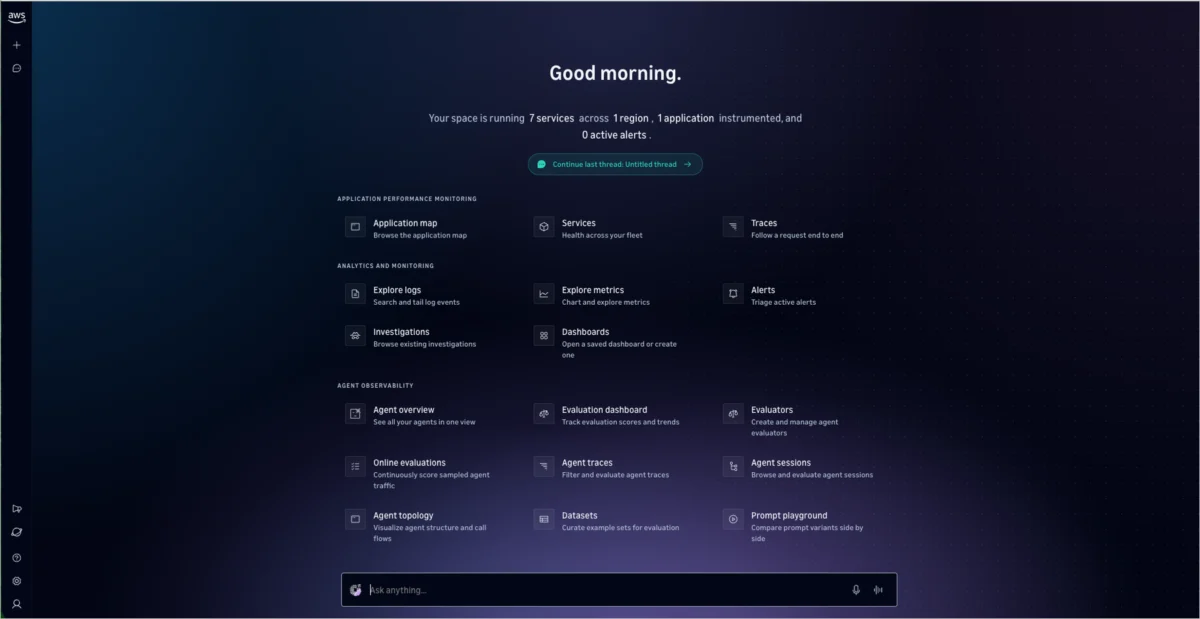
- Dual-Surface Delivery: The platform operates across two primary interfaces: a native extension for modern IDEs (initially supporting VS Code and Kiro) and a secure, standalone web experience accessible via Single Sign-On (SSO) independent of the AWS Management Console.
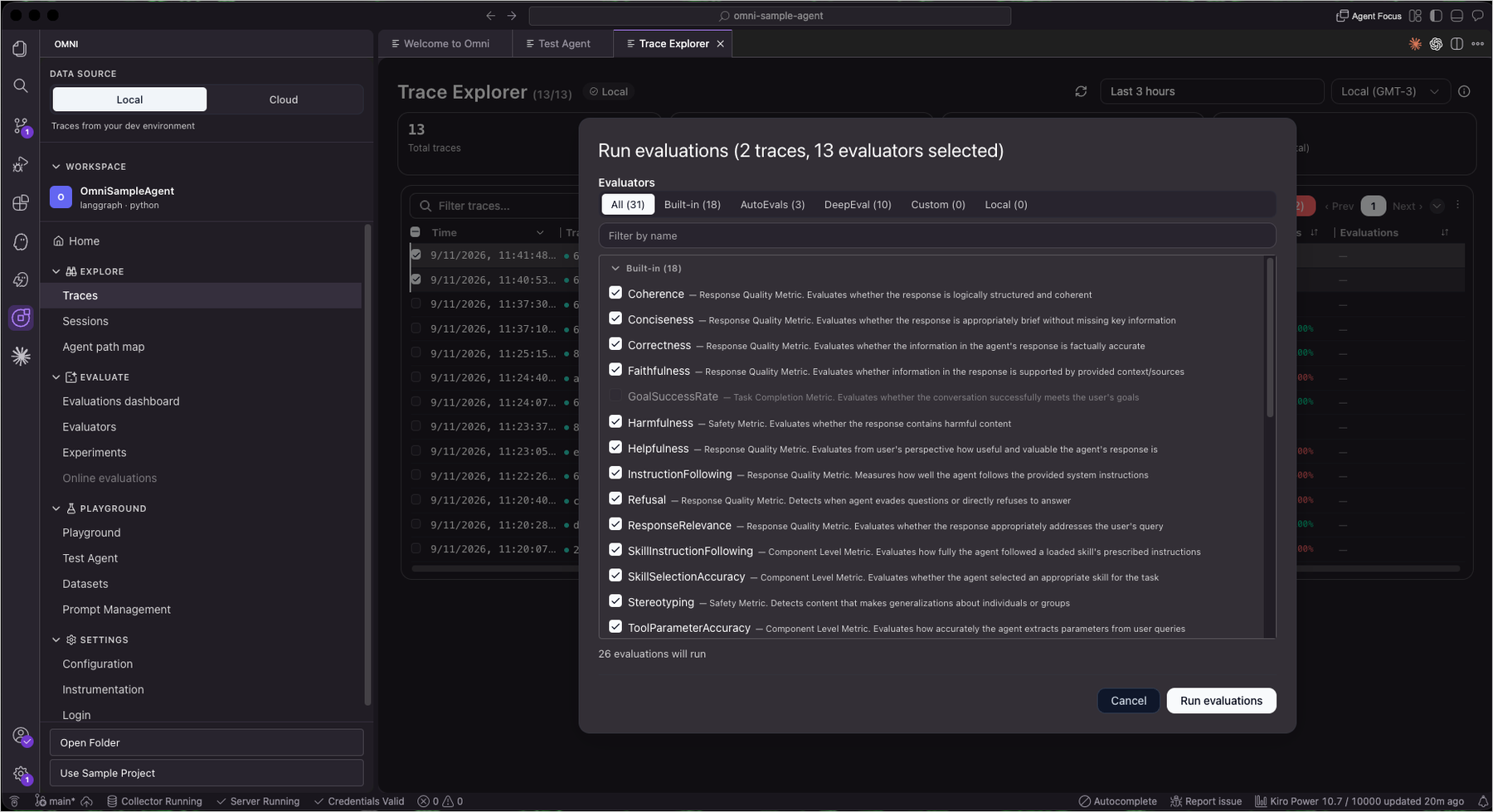
- Comprehensive AI Evaluation: Includes 17 built-in evaluators measuring correctness, coherence, helpfulness, faithfulness, and routing accuracy. It also supports third-party evaluation frameworks like DeepEval and AutoEval.
- Flexible Deployment: Developers can build, test, and trace applications entirely locally without an AWS account, connecting to the cloud only when telemetry data, team collaboration, or production monitoring is required.
2. Chronology: The Evolution of Agentic AI Observability
The journey toward CloudWatch Omni reflects the rapid maturation of generative artificial intelligence over recent years.

- The Shift from Chatbots to Autonomous Agents (2023–2024): As organizations transitioned from simple prompt-response wrappers to autonomous AI agents capable of multi-step reasoning, calling external APIs, and chaining sub-tasks, traditional monitoring tools fell short. A minor prompt change could cause catastrophic reasoning failures while standard application metrics reported a healthy "200 OK" status.
- The Siloed Monitoring Era (2024–2025): Engineering teams were forced to adopt fragmented point solutions for LLM logging, leading to constant context-switching between code editors, terminal windows, and browser-based AI dashboards. Debugging regressions often meant manually combing through raw text logs across disparate systems.
- Development and Internal Testing (Late 2025–Early 2026): AWS engineers and early preview partners recognized the need for an integrated evaluation-driven workflow. The goal was to unify local development tracing with production fleet operations.
- General Availability (September 2026): AWS officially launches CloudWatch Omni, bringing together application monitoring, analytics, agent topology mapping, and prompt management into a single, cohesive ecosystem.
3. Supporting Data and Technical Capabilities
To understand the scope of CloudWatch Omni, one must examine its core feature sets designed for both developers in the trenches and operations teams managing enterprise-scale fleets.
The Developer Experience (IDE Integration)
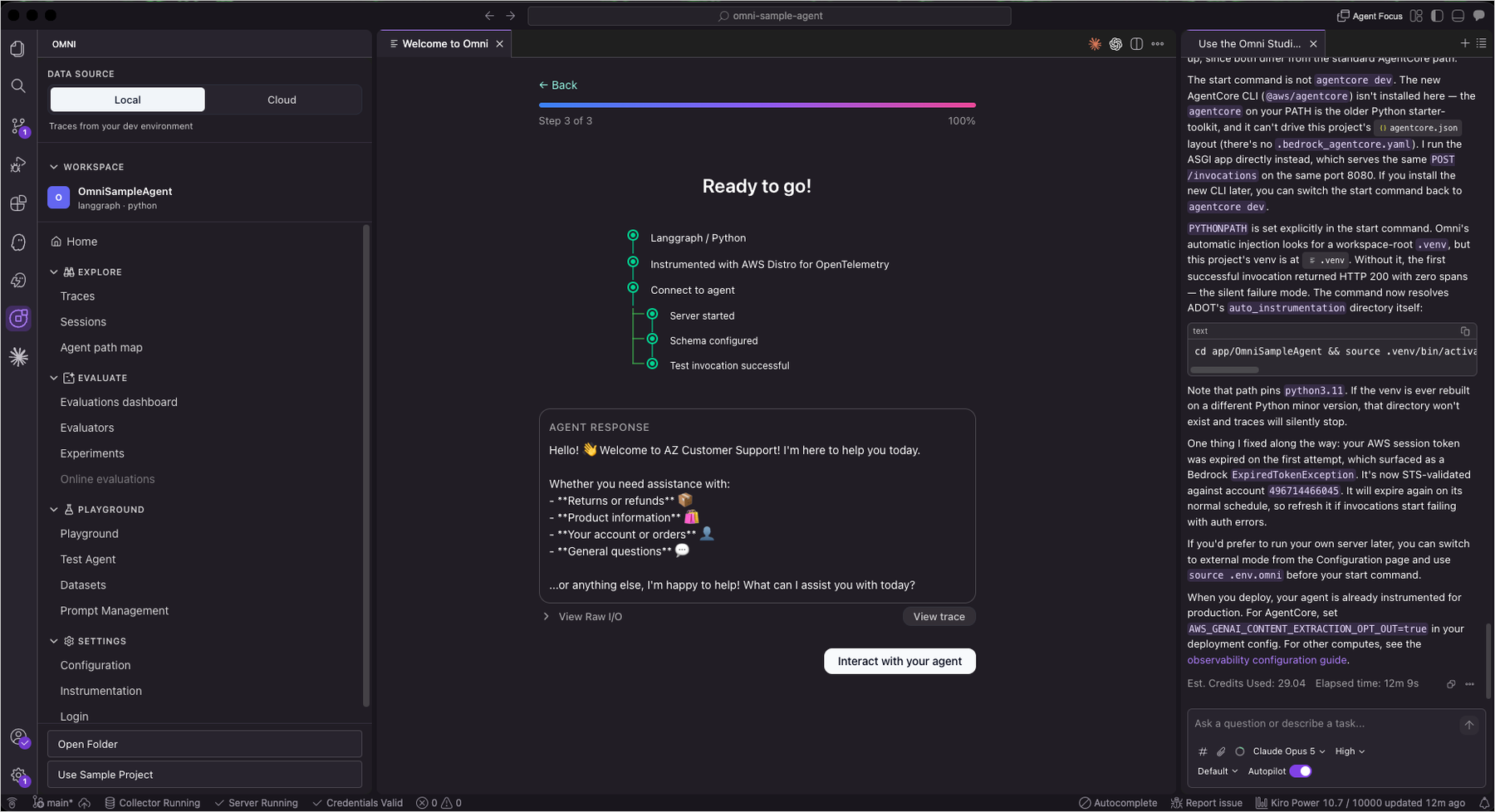
Installed directly from the VS Code Marketplace, the CloudWatch Omni extension integrates natively with AI code assistants such as Kiro, Claude Code, and Codex. Developers can instantly provision a sample project or spin up an agent from scratch via an interactive configuration chat.
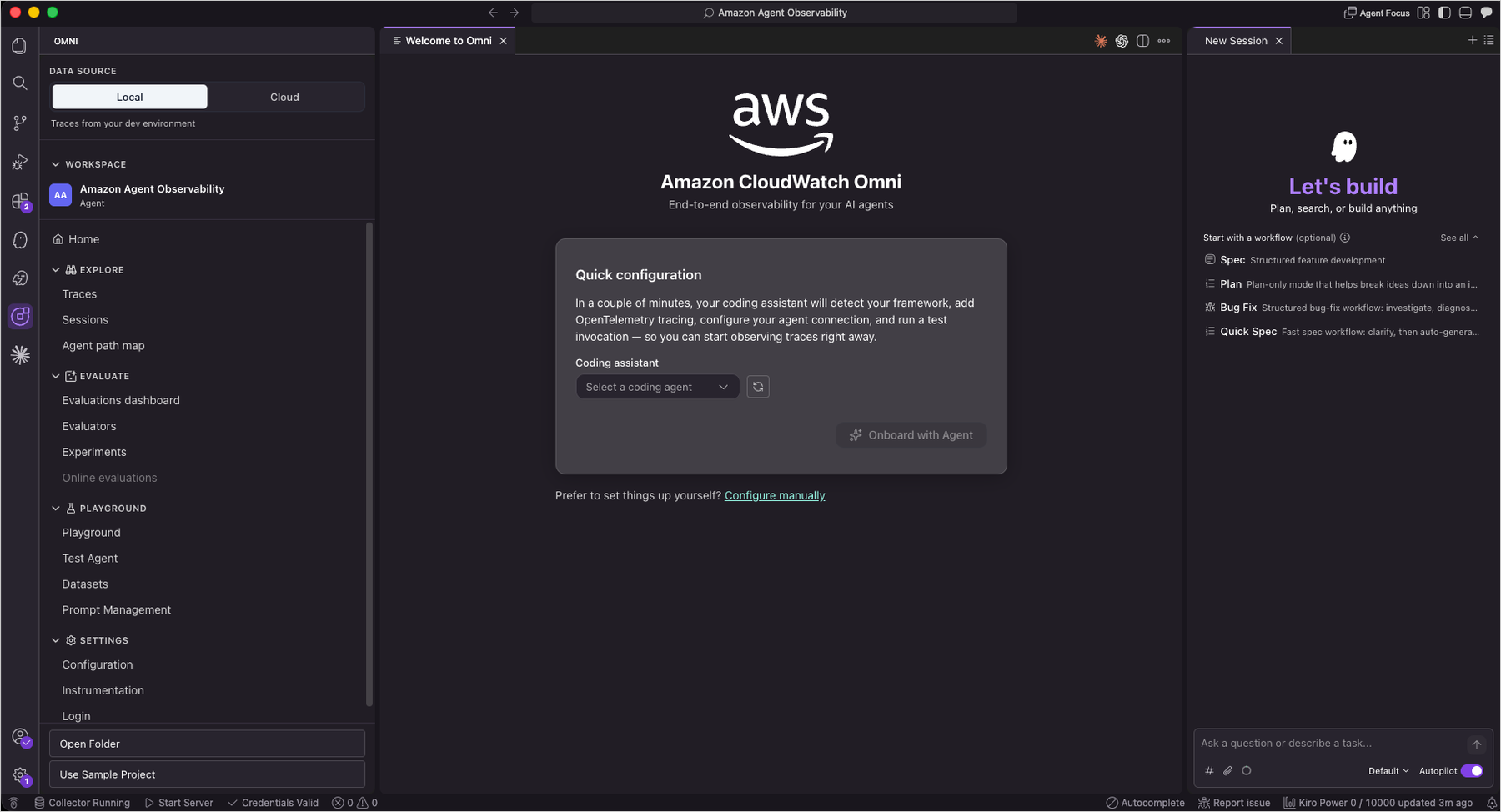
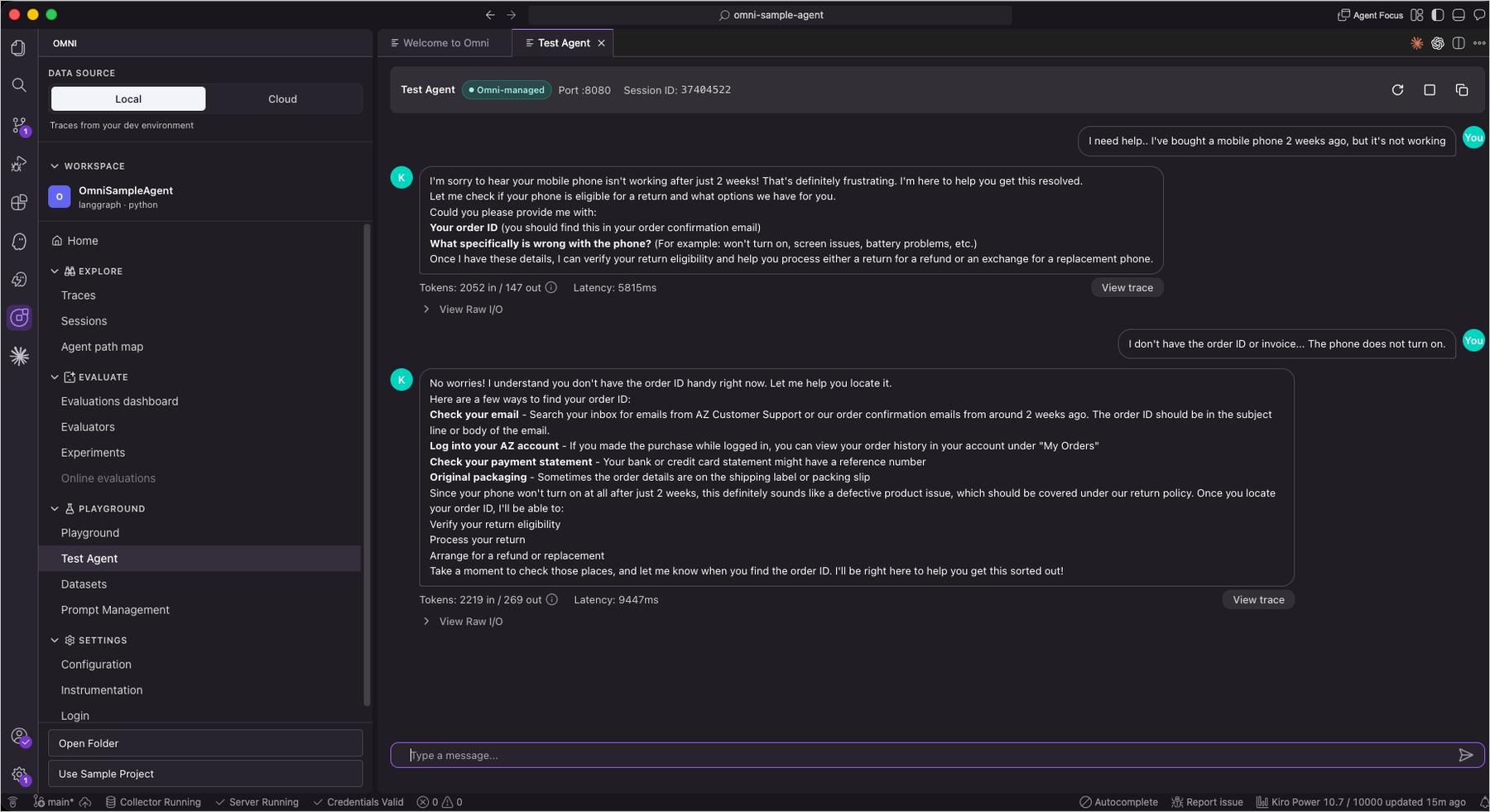
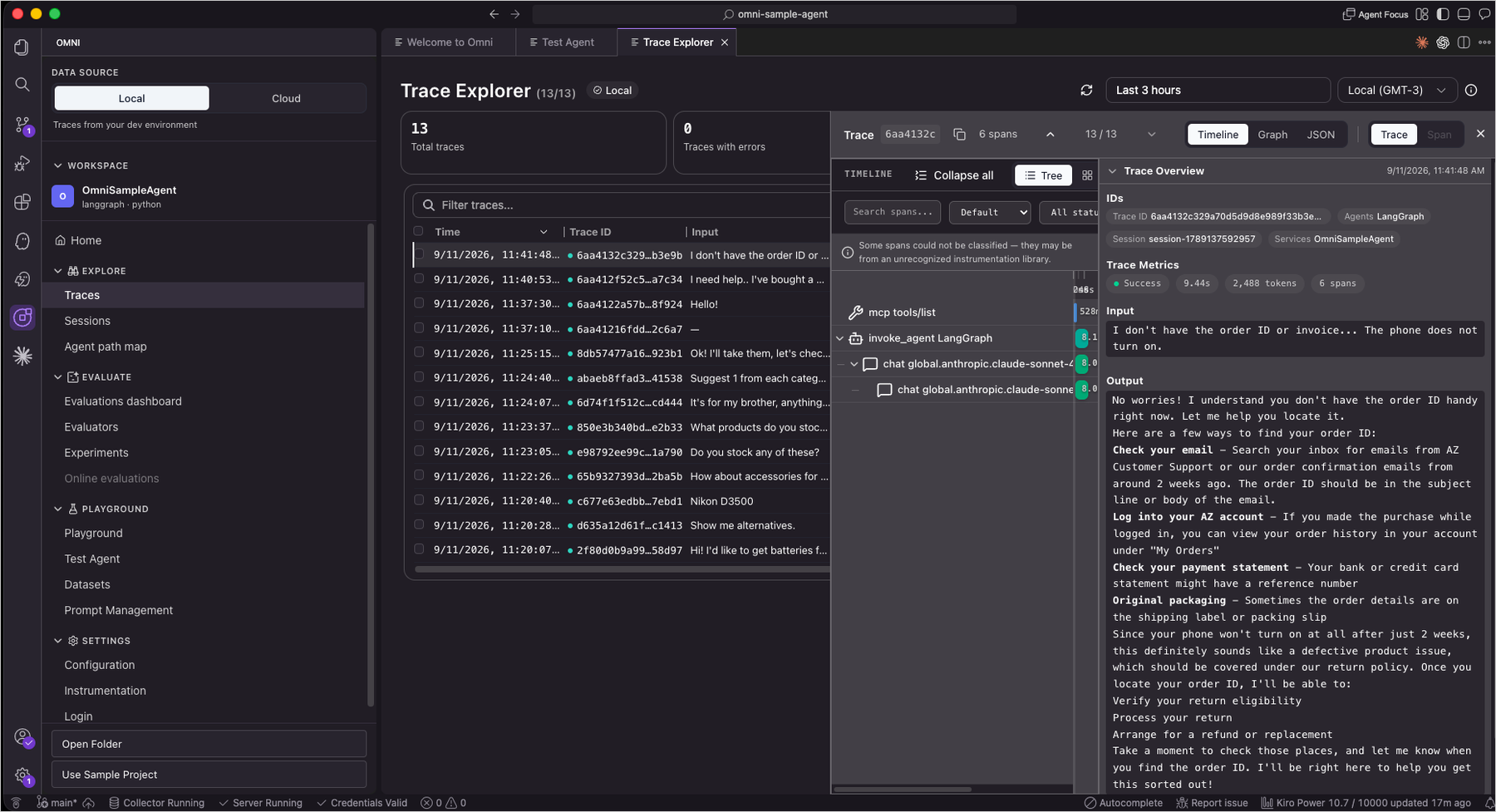
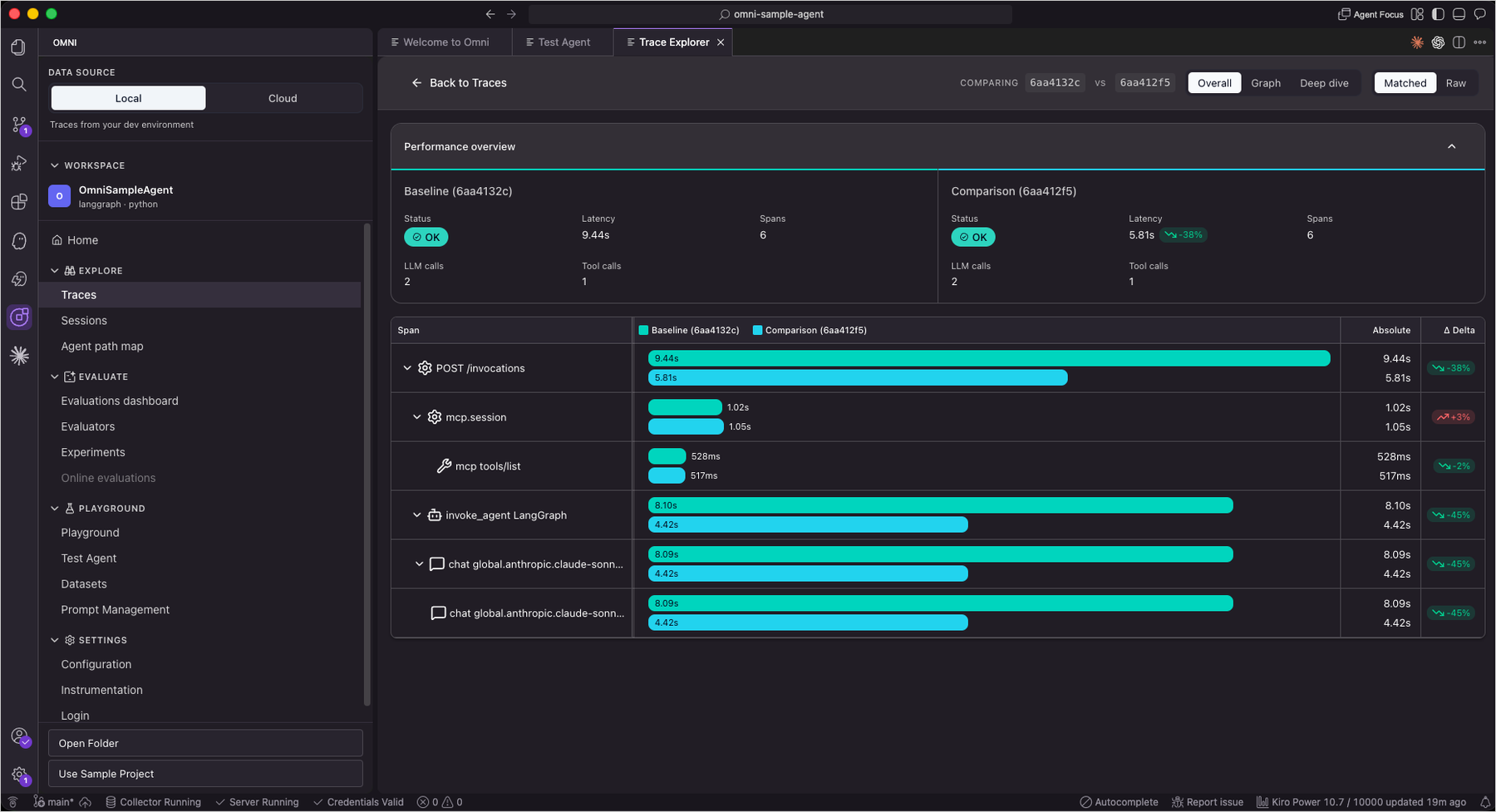
When an agent runs locally, the Trace Explorer captures a structured, hierarchical timeline of every single decision point. Developers can inspect:
- LLM Calls & Token Usage: Granular visibility into latency, input/output tokens, and model choices.
- Tool Invocations: Exact payloads sent to and received from external APIs and databases.
- Reasoning Steps: The logical path taken by the agent to arrive at a conclusion.
Advanced Experimentation and Playground Features
Observability without action is merely noise. Omni addresses this by turning telemetry into quality improvements:
- Compare Mode: Allows engineers to view two distinct traces side by side, evaluating how a prompt adjustment or model swap alters behavior.
- Ask Assistant: An embedded AI analytical tool that answers diagnostic questions in plain English, such as "Why did the agent call this specific tool twice during the session?"
- Playground & Batch Experiments: Teams can run live comparative tests against "golden datasets" derived from production traffic, automatically grading variants using built-in or custom evaluators before pushing changes to production.
The Operations Experience (Standalone Web Portal)
For SREs and platform operators, CloudWatch Omni offers a secure web interface accessible via corporate SSO. Crucially, operators do not need an AWS console login to monitor the health of an agentic fleet. Utilizing the same underlying trace data generated by developers, operators can view the Agent Topology—a visual map illustrating how sub-agents and tools interconnect—and quickly identify latency bottlenecks or runtime degradation.
4. Official Responses and Industry Context
According to internal AWS product announcements led by engineering leads such as Daniel Abib, the impetus behind Omni was the realization that generative AI systems demand an entirely new class of instrumentation.
"Organizations deploying agentic AI systems face observability challenges that traditional monitoring simply cannot address," engineering representatives noted during the rollout. "Because agent behavior is non-deterministic, a minor prompt tweak can degrade response quality even when standard metrics register zero errors. CloudWatch Omni provides the eval-driven workflow and native IDE integration necessary to catch regressions before they ever impact end users."
Industry analysts have echoed these sentiments, pointing out that as enterprises move AI agents out of sandbox environments and into mission-critical workflows (such as automated customer service, financial auditing, and automated software engineering), the demand for rigorous evaluation and tracing tools has skyrocketed. By integrating deeply with popular frameworks like LangChain, LangGraph, CrewAI, Vercel AI SDK, and Amazon Bedrock AgentCore, AWS has positioned Omni as an open, framework-agnostic safety net for the broader AI ecosystem.
5. Implications: What This Means for Enterprises and Developers
The launch of Amazon CloudWatch Omni carries profound implications for the software engineering and cloud operations landscapes:
Lowering the Barrier to AI Governance
Historically, setting up robust evaluation pipelines required building custom Python scripts, managing separate vector databases for log analysis, or purchasing expensive standalone SaaS monitoring platforms. By baking 17 evaluation dimensions—including faithfulness, coherence, and routing correctness—directly into an open-standards framework, AWS democratizes enterprise-grade AI quality assurance.
Bridging the Dev-Ops Chasm for AI
One of the most persistent hurdles in modern AI deployment has been the disconnect between how data scientists/developers test models locally and how operations teams monitor them globally. By ensuring that the exact trace a developer debugs in VS Code is the identical trace an operator investigates in the web portal, CloudWatch Omni establishes a single source of truth across the entire organizational hierarchy.
Flexible Adoption and Pricing Dynamics
Crucially, AWS has removed financial and administrative barriers to entry. The CloudWatch Omni IDE extension is entirely free to use, and developers do not need an active AWS account to begin building and tracing locally. Teams only require standard API keys for model providers (such as OpenAI, Anthropic, or Amazon Bedrock credentials) to start experimenting.
For organizations already embedded in the AWS ecosystem, Omni represents a natural evolution of cloud management—transforming CloudWatch from a passive reactive dashboard into an active, intelligent partner in the creation and maintenance of autonomous systems.
Getting Started
Developers and engineering managers can install the Amazon CloudWatch Omni extension directly from the VS Code Marketplace, explore pre-configured sample projects, or consult the official documentation on the AWS Builder Center to begin instrumenting Python and TypeScript workloads today.