











In the high-stakes world of enterprise retail, the difference between a market leader and a laggard often comes down to the speed and accuracy of decision-making. As companies navigate increasingly complex digital landscapes, the traditional approach to A/B testing—often siloed, manual, and vanity-metric driven—is proving insufficient.
In the 25th edition of our CRO Perspectives series, we sat down with Apurva Sandbhor, Manager of Platform & Product Experimentation at The Home Depot. Based in Atlanta, Sandbhor is at the forefront of a paradigm shift, moving beyond the "tool-first" mentality to build a scalable, AI-integrated experimentation ecosystem that treats testing as a core business infrastructure rather than a tactical afterthought.
The Core Philosophy: Moving Beyond Volume
Most organizations fall into the trap of equating "experimentation velocity" with the sheer number of tests deployed. Sandbhor argues that this is a dangerous misconception. "If your core OKRs focus heavily on raw test volume or ‘win rates,’ you will inadvertently incentivize your team to test low-risk, low-reward ideas just to hit a number," she notes.

Instead, Sandbhor advocates for a culture of "Learning Value." By anchoring organizational goals to decision integrity rather than surface-level victories, companies can foster an environment where engineers, data scientists, and business stakeholders are aligned on a single objective: unlocking high-integrity insights that shape corporate strategy.
Structural Frameworks: The "Dual-Lane" Strategy
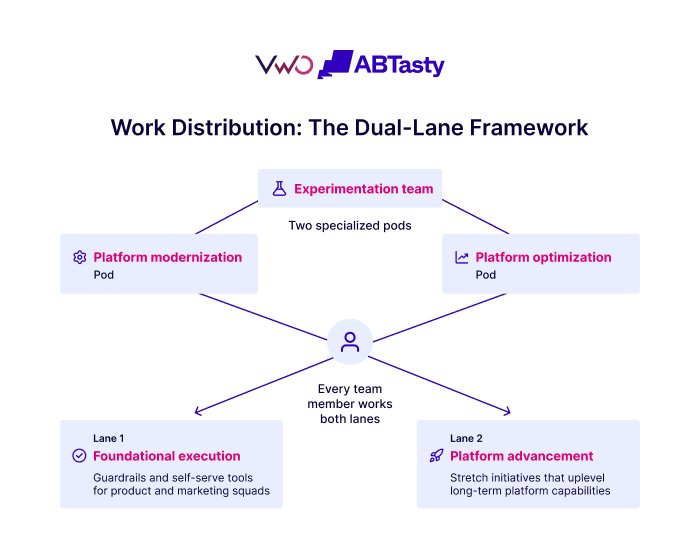
Scaling an experimentation team often leads to "compounding friction." When organizations simply add headcount without upgrading their architecture, they inadvertently create silos and operational noise. To combat this, Sandbhor utilizes a "Dual-Lane" framework designed to decouple day-to-day enablement from core product innovation.
1. Enabling vs. Innovating
The Dual-Lane framework separates reactive testing requests from strategic R&D. By establishing a platform-first strategy, the central team provides the infrastructure and guardrails, allowing autonomous squads to run their own experiments safely. This prevents the core experimentation team from becoming a bottleneck, ensuring that scaling human capital acts as a "force multiplier" rather than a temporary band-aid.

2. The "Force Multiplier" Hiring Test
Before expanding her team, Sandbhor poses a critical question to leadership: "Are we hiring people to manually run more tests, or are we hiring people to build a platform that acts as a force multiplier?" If the operating model relies on manual QA and analysis, headcount growth is a sign of an architectural failure, not a scaling success.
Engineering Velocity Without Risk
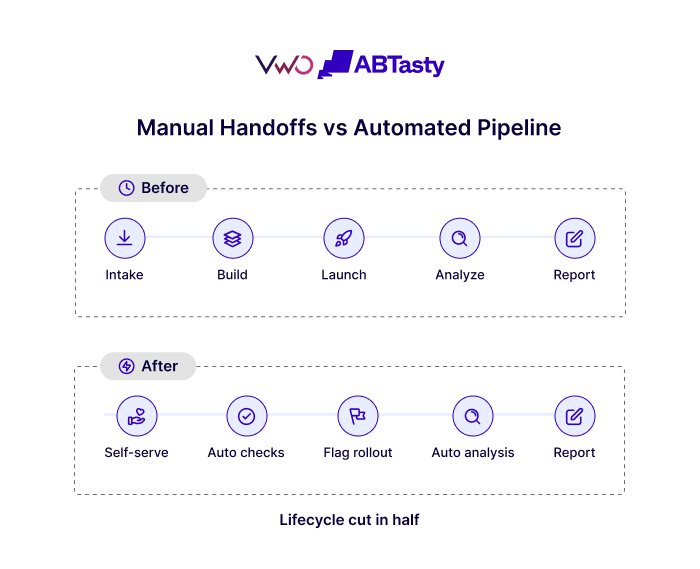
True velocity in an enterprise setting is not about moving fast; it is about "safe speed." Sandbhor’s team has halved their end-to-end testing lifecycle by integrating automated statistical and operational guardrails directly into their ingestion pipeline.
Architectural Pillars of Reliability
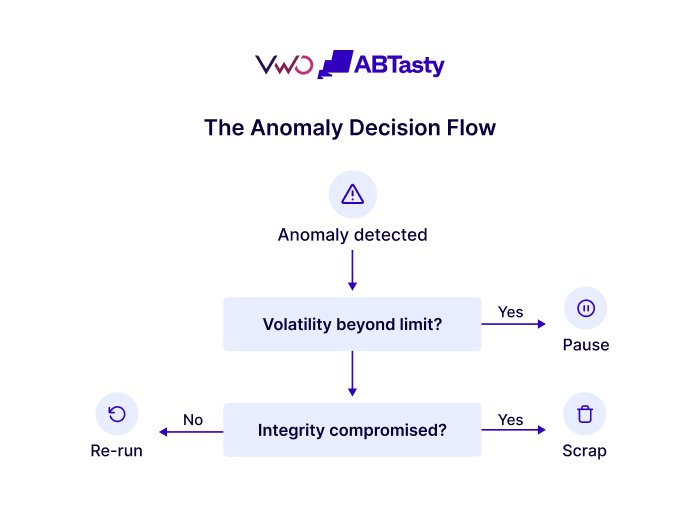
- Embedded Statistical Guardrails: By integrating a proprietary statistical engine, the platform flags sample ratio mismatches (SRM) and traffic anomalies in real-time. If a guardrail metric turns negative, the variation is disabled instantly, protecting user experience and data integrity.
- End-to-End Pipeline Automation: By eliminating manual handoffs between product squads, QA, and data analysts, the organization has created a seamless, programmatic workflow.
- Modernized Hybrid Architecture: The team employs a blend of client-side and server-side models. This decoupling of deployment from activation allows for rapid iteration without the performance degradation typically associated with heavy client-side scripts.
Case Study: From Failure to Insight
The power of this system was highlighted during a high-visibility checkout optimization project. The team implemented an algorithmic recommendation engine designed to cross-sell accessories. Initially, the feature caused an aggregate drop in conversion rates—a result that, in a less rigorous environment, might have been labeled a "failure" and abandoned.
Instead, Sandbhor’s team utilized deep-dive segment analysis to uncover the underlying behavioral truth: the algorithm worked beautifully on product discovery pages, but the high-intent environment of the checkout page made the multi-choice layout a source of "decision paralysis."
By pivoting the hypothesis to a single-bundle recommendation, the team turned a negative result into a net revenue lift. This success underscores the importance of treating experimentation as a continuous loop: launch, learn, iterate, and refine.
The Role of AI in Experimentation
As AI begins to commoditize the execution layer—automating test variant creation, data pulls, and basic analysis—the role of the experimentation leader is evolving. Sandbhor asserts that human judgment remains irreplaceable in three specific domains:
- Defining Strategic Boundaries: Setting the ethical and risk-appetite parameters for the entire organization.
- Psychological Synthesis: Translating complex human behaviors into novel, non-obvious hypotheses.
- Cross-Functional Alignment: Ensuring that experimentation findings are woven into the long-term vision of stakeholders.
"AI can optimize the path, but humans must choose the mountain," Sandbhor emphasizes.
Implications for Executive Leadership
Perhaps the most significant challenge in scaling experimentation is maintaining executive buy-in, particularly when tests fail. Sandbhor advocates for a "Strategic Risk Avoidance" reporting model. By demonstrating the millions of dollars in potential revenue loss saved by stopping a flawed feature from going live, experimentation becomes an "insurance policy" for the enterprise.
When tests are inconclusive, they are not framed as losses but as "risk-mitigation insights." This shifts the narrative from "What did we win?" to "What did we protect?"
Conclusion: The Path Forward
The overarching lesson from Sandbhor’s work at The Home Depot is that experimentation is not a linear project—it is a continuous, self-improving engine. Organizations that treat it as such, prioritizing architecture over volume and learning over win rates, position themselves to lead their respective markets.
As we look toward the future, the integration of AI-driven insights and enterprise-grade governance will be the dividing line between those who simply test and those who truly innovate. For organizations ready to build that foundation, the journey begins by moving away from vanity metrics and toward a culture of rigorous, data-driven truth.
Summary of Strategic Metrics
| Metric Type | Focus Area | Goal |
|---|---|---|
| Input Metrics | Resource efficiency, platform uptime | Velocity without friction |
| Outcome Metrics | Decision integrity, risk mitigation | Protecting shareholder value |
| Learning Metrics | Behavioral insights, hypothesis validation | Long-term competitive advantage |
To learn more about how to bring this level of statistical rigor and automated governance to your own organization, explore the latest tools available through VWO, which provide the enterprise-grade infrastructure necessary to scale your testing program.