By Industry Analysis Desk
The multi-billion-dollar online education industry has long operated on a silent, dirty secret: most people who buy digital courses never actually finish them. While marketing funnels promise easy riches through automated webinars and pre-recorded video modules, the grim reality of the marketplace reveals a starkly different picture. Industry averages routinely peg online course completion rates at a dismal 3 percent.
For creators, this translates into stagnant businesses, abysmal testimonial collection, negligible referral rates, and a complete lack of repeat sales. Enter Marisa Murgatroyd and her flagship program, the Experience Product Masterclass (EPM). Rather than focusing on the conventional triad of digital marketing—pick a niche, record videos, and host a webinar—EPM shifts the entire paradigm to a fundamental, yet frequently ignored question: Why do students abandon online courses, and how can we fix it?
This comprehensive review investigates the mechanics of EPM, examining its core philosophy, structured curriculum, coaching framework, financial guarantees, and overall implications for the digital creator economy.
Main Facts: The Anatomy of the EPM Framework
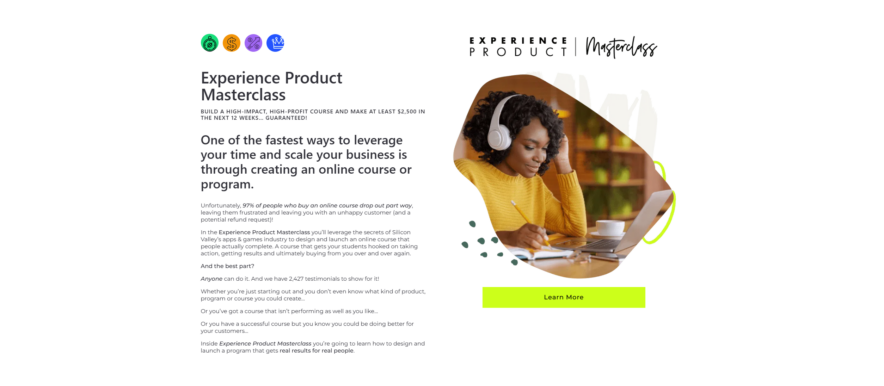
At its core, the Experience Product Masterclass is a 10- to 12-week live educational program engineered to solve the chronic student drop-off rate that plagues digital publishing. Developed by Marisa Murgatroyd, the founder of Live Your Message, the program approaches course creation not as a content-delivery exercise, but as a behavioral design challenge.
The Experience Formula
The foundational philosophy of EPM borrows heavily from psychological principles found in game design. Murgatroyd conceptualizes the "Experience Formula," which restructures traditional linear learning into an interactive journey complete with:
- Clear, progressive milestones
- Unlockable content modules
- Points and quantifiable metrics of success
- A definitive "win state" for the student, replacing open-ended piles of video lessons.
Program Delivery and Infrastructure
Unlike static, self-paced courses that leave students stranded on their own time, EPM operates via live cohorts. The curriculum spans five distinct modules:
- Profitable Idea Unlock: Validating concepts and defining clear student outcomes before recording a single piece of media.
- Experience Design: Restructuring content into an engaging roadmap featuring quick wins to maintain momentum.
- Content Creation: Utilizing standardized templates to build structured training materials efficiently.
- Marketing and Launch: Deploying proven launch sequences derived from historical cohort data rather than generic copywriting templates.
- Scale and Delivery: Implementing the necessary technology stack, support systems, and coaching cadences for long-term sustainability.
Furthermore, students are granted access to Xperiencify, Murgatroyd’s proprietary course delivery platform built entirely around gamification, point systems, and unlock mechanics.
Chronology: Evolution of an Alternative Course-Creation Paradigm
To understand how EPM carved out its unique niche, it is essential to trace the trajectory of the online info-product space over the past decade.
Phase 1: The Wild West of Information Marketing (Early 2010s)
During the early boom of digital courses, the prevailing wisdom dictated that volume equaled value. Creators were encouraged to pack hard drives with dozens of hours of video content. The focus was heavily weighted toward the front-end sale—getting the credit card swipe—with little institutional concern for what happened post-purchase.
Phase 2: The Completion Crisis and Fatigue (Mid-to-Late 2010s)
As the market saturated, consumers grew increasingly fatigued by unused courses gathering digital dust. Completion rates stagnated around the 3 percent mark. Trust in traditional "guru-led" webinar funnels began to erode. Creators faced mounting refund requests and a scarcity of authentic success stories.
Phase 3: The Pivot to Behavioral Design and Accountability (Present Day)
Recognizing that satisfied, successful students are the best marketing engine, modern pedagogical experts began integrating gamification and community accountability. EPM positioned itself at the vanguard of this movement. By treating education as an immersive experience rather than a digital library, the program shifted the industry conversation away from how to sell toward how to deliver results.
Supporting Data: What the Metrics and Student Feedback Reveal
An objective analysis of EPM requires looking beyond promotional landing pages to examine independent reviews, financial guarantees, and student outcomes.
The Financial Guarantee
One of the most heavily scrutinized elements of EPM is its unique performance guarantee. While standard courses offer vague money-back policies based on subjective satisfaction, EPM ties its guarantee to measurable output: if a student completes the coursework, executes the marketing steps, launches their product, and fails to generate at least $2,000 within the 12-week timeframe, Murgatroyd personally covers the financial gap.
This mechanism alters the incentive structure. A program contractually obligated to ensure performance must invest heavily in student support and active intervention rather than passive content distribution.
Student Sentiment and Reviews
Aggregated data from independent review platforms place EPM consistently in the 4-star range across more than a hundred verified reviews. A thematic analysis of student feedback highlights several distinct patterns:
- The "I Finally Finished" Phenomenon: The most common praise does not revolve around overnight riches, but rather the psychological relief of completing a complex project from start to finish.
- The Coaching Impact: Reviews frequently single out weekly coaching calls and assigned success coaches as the primary drivers of success, overshadowing the recorded video modules.
- Constructive Criticism: A minority of 1-star and 2-star reviews point toward the premium pricing tag and the reality that the program demands substantial independent labor. EPM does not do the work for the student; it merely provides the roadmap and accountability.
Official Responses and Operational Mechanics: Inside the Support System
The term "coaching" is frequently overused in the digital info-product industry, often manifesting as an impersonal, shared support inbox. EPM attempts to differentiate its delivery model through structured human intervention.
Dedicated Success Coaches
Every student enrolled in EPM is assigned a personal success coach. Unlike generic ticketing systems, these coaches actively monitor milestone progression within the program. When a student falls silent or misses critical deadlines, the coach initiates contact to diagnose bottlenecks and provide personalized guidance before minor roadblocks turn into complete disengagement.
Cohort-Based Group Dynamics
In addition to one-on-one oversight, live group coaching calls led by senior strategists and Murgatroyd herself provide real-time problem-solving. Observing cohort peers navigate similar operational hurdles often resolves blind spots that individual students might not have realized they possessed.
Implications: Who Benefits and What Lies Ahead for Course Creators?
The rise of experience-driven platforms like EPM carries broad implications for the digital creator economy.
Who Is EPM For?
- Experienced Creators: Individuals who have previously launched courses with low completion rates and want to re-engineer their products for higher student retention and better testimonials.
- Subject Matter Experts: Professionals with established domain expertise, an existing audience, and a clear topic ready for packaging.
- Action-Oriented Builders: Creators who require strict accountability, milestone tracking, and a dedicated coach to prevent procrastination.
Who Should Avoid It?
The program is ill-suited for absolute beginners who possess zero niche clarity, no audience, and no foundational concept of what they want to teach. EPM assumes a starting point of refinement, not raw ideation. Furthermore, creators looking for a cheap, hands-off video library will likely find the financial investment and intensive workload misaligned with their expectations.
Future Industry Outlook
As consumers become increasingly sophisticated, the era of the low-retention, high-ticket info-product is facing inevitable decline. Programs that prioritize completion metrics, gamified learning environments, and verified student outcomes are establishing a new baseline of consumer expectation.
For creators looking to future-proof their digital education businesses, the lesson of EPM is clear: the true product is not the information contained within the videos, but the transformation and success experienced by the student.
Frequently Asked Questions
- Is EPM currently open for enrollment?
No. Enrollment operates strictly in cohort cycles and is currently closed. Interested prospective students can join the official waitlist at liveyourmessage.com/epmev/waitlist/ to receive notifications when the next enrollment window opens. - What is the investment cost for the program?
Historically, the complete program has priced in the range of $2,497 for paid-in-full options, with structured multi-month installment plans also available. Pricing is subject to change with each cohort iteration. - Is the $2,000 guarantee unconditional?
No. The guarantee requires active participation, completion of the required coursework, execution of the marketing steps, and the actual launch of the digital product. It rewards execution rather than passive enrollment. - How long does the active cohort run?
The core guided experience spans 10 to 12 weeks, featuring live coaching sessions, milestone tracking, and intensive support checkpoints. - Do participants retain access after the cohort concludes?
Yes. Students receive lifetime access to the core training materials and continued access to the Xperiencify platform ecosystem to manage their ongoing digital businesses.
Affiliate Disclosure: This article may contain affiliate links. If readers choose to utilize these links to complete a purchase, a commission may be earned at absolutely no additional cost to the consumer.