










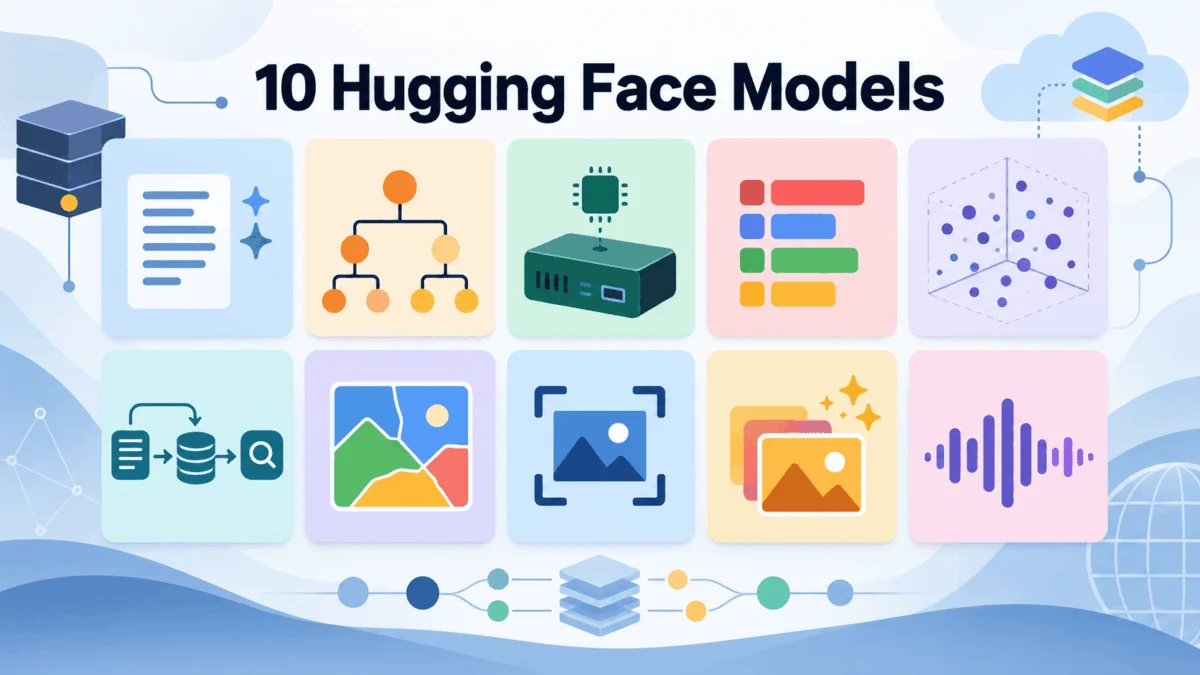
As of mid-2026, the Hugging Face Hub serves as the definitive pulse of the artificial intelligence industry, hosting nearly three million public model repositories. This explosion in volume—up from 2.43 million at the start of the year—signals that the era of "access scarcity" is firmly behind us. For the modern machine learning practitioner, the primary challenge has shifted from finding a capable model to discerning which architectures are truly production-ready, which have been rendered obsolete by rapid innovation, and which provide the most reliable ROI in a corporate environment.
Main Facts: Navigating the Model Explosion
The current landscape is defined by a dichotomy between frontier-scale models and specialized, highly efficient architectures. While industry headlines are often dominated by massive, trillion-parameter models, the reality for enterprise deployment is dictated by licensing, hardware footprints, and the stability of integration APIs.
The ten models curated below were selected based on a rigorous intersection of Hub adoption metrics, benchmark performance, and real-world applicability. This list is not a static leaderboard of "smartest" models; rather, it is a toolkit for the professional engineer tasked with building robust, scalable AI pipelines. Whether you are optimizing a retrieval-augmented generation (RAG) system or deploying computer vision to the edge, these checkpoints represent the current state-of-the-art for practical implementation.
Chronology and Evolution: The Rate of Replacement
The velocity of AI development in 2025 and 2026 has been unprecedented. A critical lesson for any practitioner is the necessity of "model hygiene." Many models that were considered industry standards as recently as eighteen months ago have now been superseded.
The progression from DeepSeek-R1 to V4.1, the transition from FLUX.1 to FLUX.2, and the leap from SAM 2 to SAM 3 are not merely incremental updates. They represent fundamental shifts in how models handle multimodal input, memory-efficient tokenization, and inference latency. The practitioners who succeed are those who treat model selection as a lifecycle management process rather than a one-time decision.
Supporting Data: Infrastructure and Adoption Trends
Data from the Hugging Face Hub reveals a fascinating trend: the "production lag." While researchers flock to the latest, bleeding-edge checkpoints, the most downloaded models—such as all-MiniLM-L6-v2—often date back to 2022. This model alone accounted for over 1.55 billion downloads in the first seven months of 2026.
This creates a dual-track ecosystem:
- The Innovation Track: Models like
DeepSeek-V4.1-FlashandQwen3.8-27Bdominate new development and high-performance applications. - The Stability Track: Legacy models provide the backbone for existing enterprise systems, where the cost of migration often outweighs the incremental gains of a new architecture.
Foundation and Reasoning: The New Multimodal Standard
For generative tasks, the industry has converged on a standardized loading pattern utilizing transformers and diffusers. By applying chat templates, developers can maintain consistency across various model families.
1. Qwen3.8-27B: The Community Standard
With over 151,000 derivatives and monthly GGUF downloads exceeding 39 million, the Qwen family is arguably the most influential open-weight model series of 2026. The 27B variant is natively multimodal, handling image, video, and text inputs through a unified checkpoint, which significantly reduces the complexity of dependency management.
2. DeepSeek-V4.1-Flash: Reasoning at Scale
This 552B parameter Mixture-of-Experts (MoE) model redefines the upper echelon of reasoning. By activating only 8 billion parameters per token during prefill, it achieves a high performance-to-cost ratio. It is a critical tool for coding and logic-intensive tasks, scoring 90.6 on Terminal-Bench 2.1.
3. Gemma 4: Edge-Ready Intelligence
Google’s Gemma 4, released in April 2026, marks a pivotal shift toward Apache 2.0 licensing. Its scalability—ranging from the E2B variant for smartphones to the 31B Dense model—makes it the preferred choice for on-device deployment where latency and privacy are paramount.
Retrieval and Representation: Optimizing the Data Pipeline
Effective RAG systems rely on the quality of their encoders. Modern architectures are moving toward longer context windows and smarter pooling techniques.
4. ModernBERT-base: The Encoder Evolution
ModernBERT-base has revitalized the encoder-only paradigm. By extending the context window to 8,192 tokens and integrating Flash Attention, it offers a robust alternative to generative decoders for tasks like NER and document classification.
5. Qwen3-Embedding-0.6B and BAAI’s BGE-M3
For dense retrieval, the Qwen3-Embedding-0.6B model leads the MTEB leaderboard. Its flexibility in output dimensions (32 to 1,024) allows for optimized storage in vector databases. For more complex, multilingual hybrid search requirements, bge-m3 remains the industry’s versatile workhorse.
6. The Persistence of all-MiniLM-L6-v2
Despite its age, this model is the baseline against which all new embeddings are measured. Its ubiquity in existing codebases makes it an essential model to understand, particularly when troubleshooting legacy retrieval pipelines.
Vision and Multimodal Applications
7. SAM 3: Open-Vocabulary Segmentation
Meta’s SAM 3 has evolved beyond pixel-perfect segmentation to semantic understanding. By accepting text prompts to trigger masks, it drastically lowers the barrier to entry for automated image and video analysis.
8. DINOv3: Visual Feature Extraction
DINOv3 is the current gold standard for self-supervised visual representation. Unlike CLIP, which relies on text-image alignment, DINOv3’s focus on patch-level features makes it superior for dense retrieval and semantic correspondence tasks.
9. FLUX.2 Klein 4B: Image Generation
Black Forest Labs’ FLUX.2 has set a new high bar for open-weight image generation. The 4B Klein variant, with its four-step distillation process, provides high-fidelity generation with a manageable VRAM footprint, provided developers are mindful of the commercial licensing requirements.
Audio Processing
10. Whisper Large-v3-Turbo
While newer models may claim lower word error rates, Whisper remains the pragmatic choice for 90+ languages. Its ease of integration and ability to handle both segment-level and word-level timestamps make it the primary choice for production-grade transcription services.
Implications for the Industry
The 2026 AI landscape teaches us that innovation is not just about parameter count; it is about accessibility, licensing clarity, and architectural efficiency. The gap between the "best" model and the "most useful" model remains significant.
For the professional, the key takeaway is the importance of evaluation. Before deploying any model into a production pipeline, one must weigh the following:
- Licensing Constraints: The distinction between Apache 2.0, MIT, and custom commercial licenses can have massive legal implications for enterprise applications.
- Hardware Overhead: The shift toward quantization and distillation (e.g., FLUX.2 and Qwen3) means that hardware requirements are becoming more flexible, but demand higher technical proficiency in configuration.
- The "Lifecycle" Mindset: Acknowledge that the model you implement today will likely be superseded within 12–18 months. Designing modular pipelines that allow for "drop-in" model upgrades is the hallmark of a resilient AI architecture.
In conclusion, as we move deeper into 2026, the successful machine learning practitioner will be the one who balances the excitement of frontier models with the reliability of established, high-performance tools. By mastering these ten models, you secure a foundation capable of handling the most pressing challenges in the modern data-driven enterprise.



