The landscape of modern cyber warfare is shifting rapidly, marked by a disturbing trend: the democratization of high-end, malicious toolkits. A recent, comprehensive report from Netskope Threat Labs has shed light on the alarming evolution of the XWorm malware, which has transformed from a conventional credential-harvesting infostealer into a sophisticated, multi-functional surveillance platform.
Since September 2024, security researchers have monitored a surge in XWorm activity that shows no signs of slowing down. Driven by the public leaking of its builder and source code, the malware has undergone rapid iteration, with four distinct versions emerging in the wild within a single year. As detections continue to climb—reaching four times the volume observed in 2025—security professionals are being forced to confront a new reality: traditional defenses, including Multi-Factor Authentication (MFA), are proving increasingly ineffective against the surgical precision of modern remote access tools.
The Chronology of an Escalation
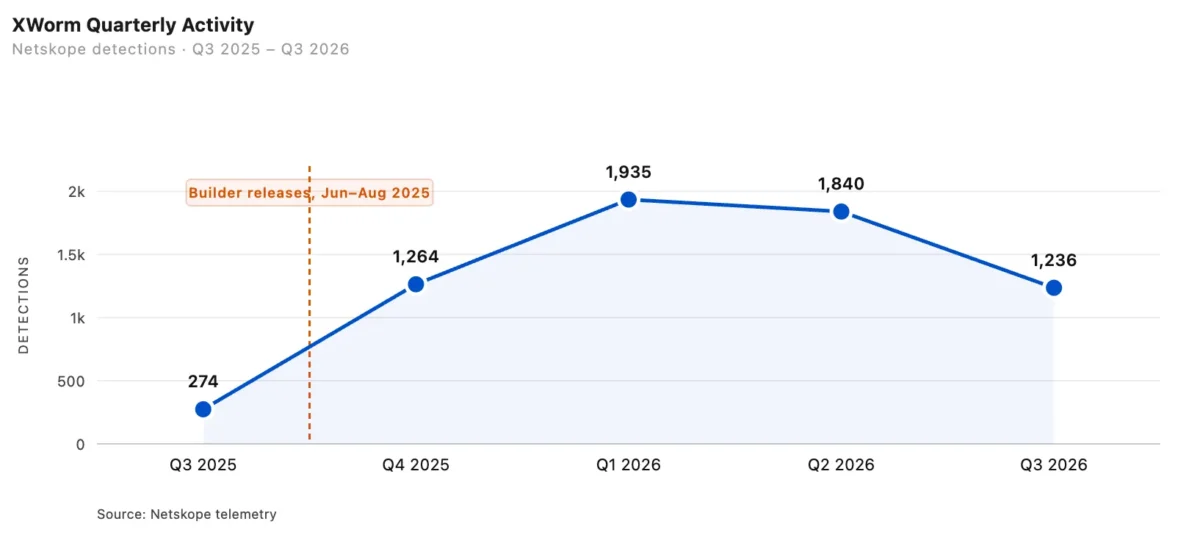
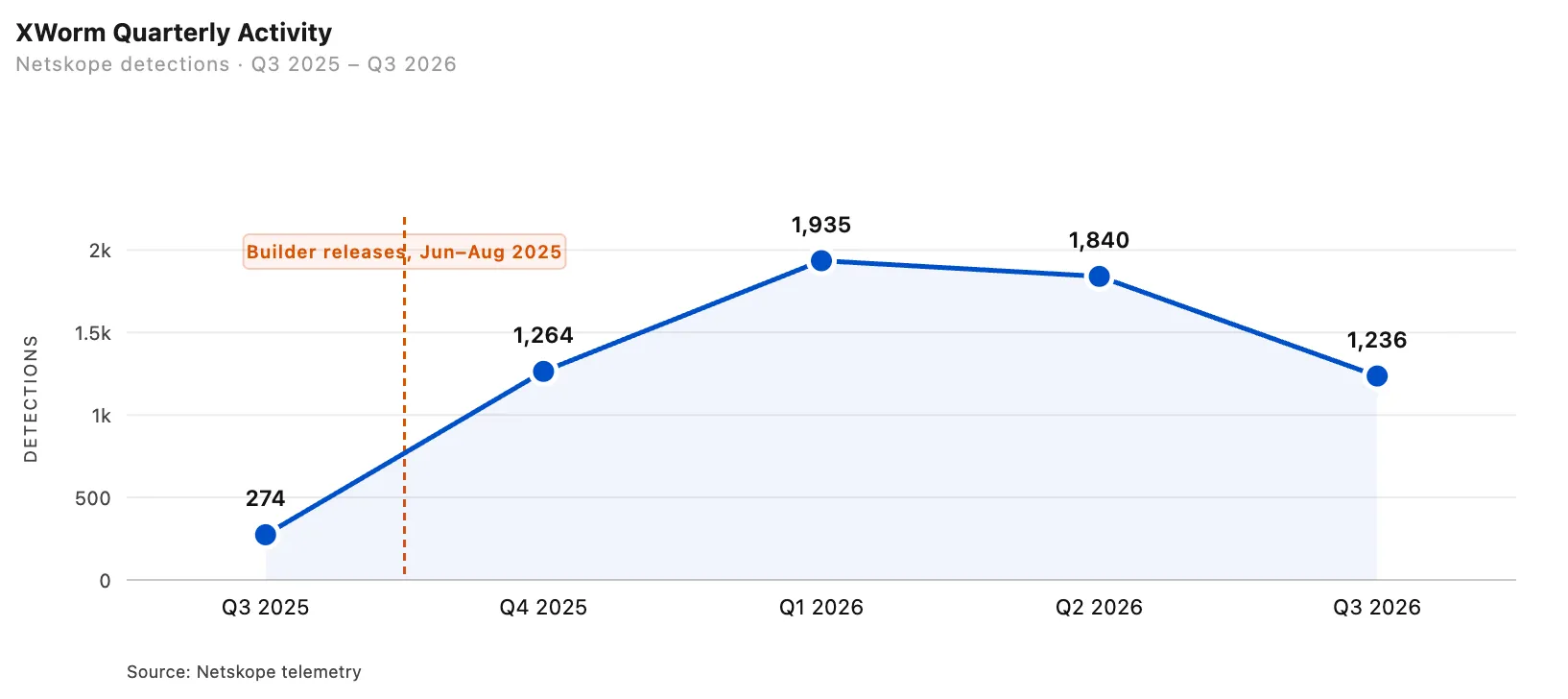
The trajectory of XWorm serves as a textbook example of how leaked source code can destabilize global cybersecurity environments. The malware’s current "golden age" of proliferation began in earnest in June 2025, when a cracked version of the XWorm builder was released to the public. This initial leak significantly lowered the barrier to entry for novice threat actors.
The situation worsened in August 2025, when the source code for version 6.4 was also leaked. This provided sophisticated attackers with the blueprints to modify the malware’s architecture, leading to a cascade of unauthorized versions. According to Netskope’s timeline:
- Mid-2025: The public release of the V6.4 builder marks the catalyst for a sustained surge in global activity.
- Q3–Q4 2025: Detections quadrupled as threat actors integrated the leaked modules into their arsenals.
- Q1 2026: Activity reached an apex, with detection levels seven times higher than pre-leak baselines.
- Q3 2026: While the total count settled at 1,236 events across more than 100 organizations, September 2026 alone accounted for 601 incidents, suggesting that the threat remains highly active and resilient.
Since the publication of the V6.0 analysis in July 2025, researchers have identified a rapid succession of iterations, including V6.4, V6.5 (“XWorm Reborn”), V7.2, and V7.4. Each release has incrementally increased the modular complexity of the malware, now boasting 46 distinct plugins—an increase from the 35 identified just over a year ago.
Supporting Data: A Global Threat Profile
The data surrounding XWorm’s reach provides a sobering look at the motivations of its operators. The malware does not appear to be a broad-spectrum nuisance; rather, it is surgically focused on high-value targets.
Financial services organizations account for approximately 35% of all affected customers. This concentration suggests that the primary motivation behind the deployment of these new XWorm variants is direct monetary theft or corporate espionage. Geographically, the threat is dispersed but highly concentrated in key economic hubs: India, Brazil, Italy, Panama, and the United States.
The sheer volume of these attacks indicates a shift in the "malware-as-a-service" ecosystem. Attackers are no longer merely collecting data; they are using these tools to maintain persistent, long-term access to corporate networks. By monitoring 1,236 events in the third quarter of 2026 alone, Netskope has confirmed that even as older versions of the malware are mitigated, the influx of newer, more modular variants keeps the total threat footprint consistently above historical averages.
The Technological Pivot: Surveillance and Live Control
The most concerning aspect of the recent XWorm updates is the transition from passive data theft to active, real-time surveillance. The developers behind the malware have integrated tools that grant attackers an "over-the-shoulder" view of the victim’s digital life.
The HBrowser Revolution
Perhaps the most dangerous development is the HBrowser plugin. Unlike traditional infostealers that grab saved passwords from browsers, HBrowser allows an operator to interact with a victim’s live browser session. It relays the attacker’s mouse movements, keyboard inputs, and clipboard actions directly into the victim’s machine, while streaming the victim’s screen back to the attacker.
Because the victim is already authenticated in their browser (e.g., logged into a bank portal, a corporate cloud suite, or an internal dashboard), the attacker effectively bypasses the need to know passwords or navigate MFA challenges. The session is already "open," and the attacker is merely hijacking it.
Invisible Surveillance
The malware’s surveillance capabilities extend to hardware control, bypassing standard operating system security prompts:
- Geolocation: XWorm modifies Windows registry settings to suppress location-access permission requests. It then captures GPS coordinates within 15 seconds. If GPS is unavailable, it uses IP-based geolocation. Because the modified settings persist, the attacker retains access to the user’s location indefinitely without further interaction.
- Audio Capture: The microphone plugin allows attackers to stream audio from the victim’s device. The malware compresses and encrypts this data into half-second chunks, providing a near-real-time listening experience for the operator.
- Modular Flexibility: The reintroduction of previously removed plugins, alongside new ones like SteamTokenRecovery, Rootkit, and Cmstp-Bypass, confirms that the developers are actively listening to the feedback loop of the cybercriminal underground to refine the malware’s efficacy.
Official Analysis and Implications
Netskope Threat Labs has been instrumental in documenting these shifts, noting that XWorm now operates as a comprehensive platform for compromise. The implications for cybersecurity teams are profound.
The Death of MFA as a Silver Bullet
The primary lesson from the HBrowser plugin is the obsolescence of MFA as a standalone security measure. If an attacker can interact with a browser session that is already authenticated, the initial MFA token becomes irrelevant. This forces security teams to shift their focus from "perimeter defense" to "session integrity." Organizations must now consider the possibility that a compromised device is not just a leak of data, but a live window into their internal processes.
A Persistent Future
Netskope’s report warns that the threat is unlikely to dissipate. Because the source code is now in the wild, the barrier to entry for creating "custom" versions of XWorm has vanished. We can expect continued, rapid development cycles as different threat actors add their own specialized features to the core toolkit.
"The public leak of the V6.4 builder in mid-2025 drove this initial surge, keeping activity consistently above pre-leak baselines ever since," the Netskope report states. The ability of the malware to hide its actions—by suppressing system alerts for location tracking and microphone access—means that traditional "detect and remediate" workflows may be too slow to stop the damage caused by a live, hands-on-keyboard attacker.
Recommendations for Security Teams
To combat this evolving threat, organizations must adopt a defense-in-depth strategy that goes beyond standard antivirus software. Netskope’s protection mechanisms, which flag these samples as Gen:Variant.Application.Lazy and Trojan.Generic, are only the first line of defense.
Security teams should prioritize the following:
- Endpoint Detection and Response (EDR): Implement monitoring that specifically looks for unexpected changes to Windows system permissions or registry modifications related to hardware access (camera, microphone, location).
- Session Management: Implement stricter timeouts for authenticated browser sessions and consider the use of browser-isolation technologies to prevent malware from hijacking active sessions.
- Behavioral Analysis: Because XWorm is modular, signature-based detection is becoming less effective. Focus on detecting the behavior of the plugins—such as unauthorized streaming of audio or the sudden injection of keyboard events into a browser process.
- Continuous Monitoring: As demonstrated by the spikes in activity in late 2025 and 2026, the threat landscape is highly volatile. Organizations must remain vigilant, regularly updating their Indicators of Compromise (IoCs) and participating in threat-intelligence sharing communities.
The case of XWorm is a stark reminder that in the world of cybercrime, the "shelf life" of a vulnerability is determined by the speed at which developers can adapt to, and iterate upon, existing malicious code. As long as the source code remains accessible, XWorm will continue to be a persistent, evolving, and highly dangerous tool for threat actors globally.