In the ever-expanding universe of online education, prospective students frequently grapple with a singular, pressing dilemma: can a digital learning platform genuinely translate into tangible, workplace-ready tech skills? Among the myriad options available, Udacity has long positioned itself as a premium, career-oriented alternative to casual video-streaming course libraries. Following its acquisition by global professional services giant Accenture, the platform has scaled its operations to support nearly 17 million registered users globally.
Yet, as the online learning landscape grows increasingly crowded and competitive, questions linger regarding the platform’s value proposition. With an individual subscription tier priced at $249 per month, Udacity operates at a significantly higher price point than many of its industry peers.
This deep-dive news and analytical review evaluates Udacity’s curriculum architecture, project-based learning model, pricing strategies, mentor support networks, and overall market positioning to determine whether the platform delivers genuine return on investment for modern learners.
Main Facts: The Current State of Udacity
Udacity’s modern educational framework moves away from transactional, single-course purchases toward a comprehensive subscription model. The key metrics defining the platform include:
- Global Reach: Over 16.9 million registered users across more than 240 countries and territories.
- Curriculum Scope: A curated library of over 500 courses and specialized Nanodegree programs, heavily concentrated in Artificial Intelligence, data science, programming, cloud computing, and digital transformation.
- Expert Network: A dedicated community of over 700 industry mentors providing project feedback and academic support.
- Project Milestones: More than 2.6 million practical student projects submitted and reviewed.
- Pricing Structure: Standard individual access is billed at $249 per month, with a four-month upfront bundle available for $846 (representing a 15% discount, lowering the effective monthly cost to $211.50).
- Overall Rating: 4.5 out of 5 stars based on curriculum depth, project quality, and career support, offset slightly by high pricing tiers.
Chronology: From Stanford Experiment to Accenture Subsidiary
To understand Udacity’s current operational philosophy, it is essential to trace its historical evolution from an experimental academic initiative into an enterprise-backed corporate training hub.
The Academic Genesis (2011–2012)
Udacity’s origins trace back to Stanford University, where instructors Sebastian Thrun and Peter Norvig decided to open their groundbreaking "Introduction to Artificial Intelligence" course to the general public online. The response was unprecedented: more than 160,000 students from over 190 countries enrolled. This massive viral adoption demonstrated the immense global appetite for elite, accessible computer science education, directly inspiring Thrun and Norvig to establish Udacity as an independent commercial venture.
The Nanodegree Era and Curriculum Pivot (2014–2023)
During its middle years, Udacity pioneered the "Nanodegree"—a streamlined, intensive certification program designed in collaboration with tech giants like Google, Amazon, and Meta. These programs were originally sold as standalone products with fixed completion timelines and distinct price tags, positioning the platform as a direct bridge between traditional higher education and the fast-paced demands of Silicon Valley employers.
The Accenture Acquisition and All Access Integration (2023–Present)
Following its acquisition by professional services titan Accenture, Udacity underwent a structural transformation. The platform abandoned the isolated, per-program purchasing model in favor of an All Access subscription. This shift granted members fluid movement across the entire catalog—allowing a data science student, for instance, to seamlessly dip into foundational Python programming or advanced cloud infrastructure modules without incurring additional costs.
Supporting Data: Catalog Evaluation and Performance Metrics
Udacity has deliberately chosen to restrict its catalog breadth. Unlike massive open online course (MOOC) providers that offer everything from creative writing and culinary arts to ancient history, Udacity’s curriculum focuses exclusively on high-demand technical and professional disciplines.
1. Artificial Intelligence (Rating: 4.8/5)
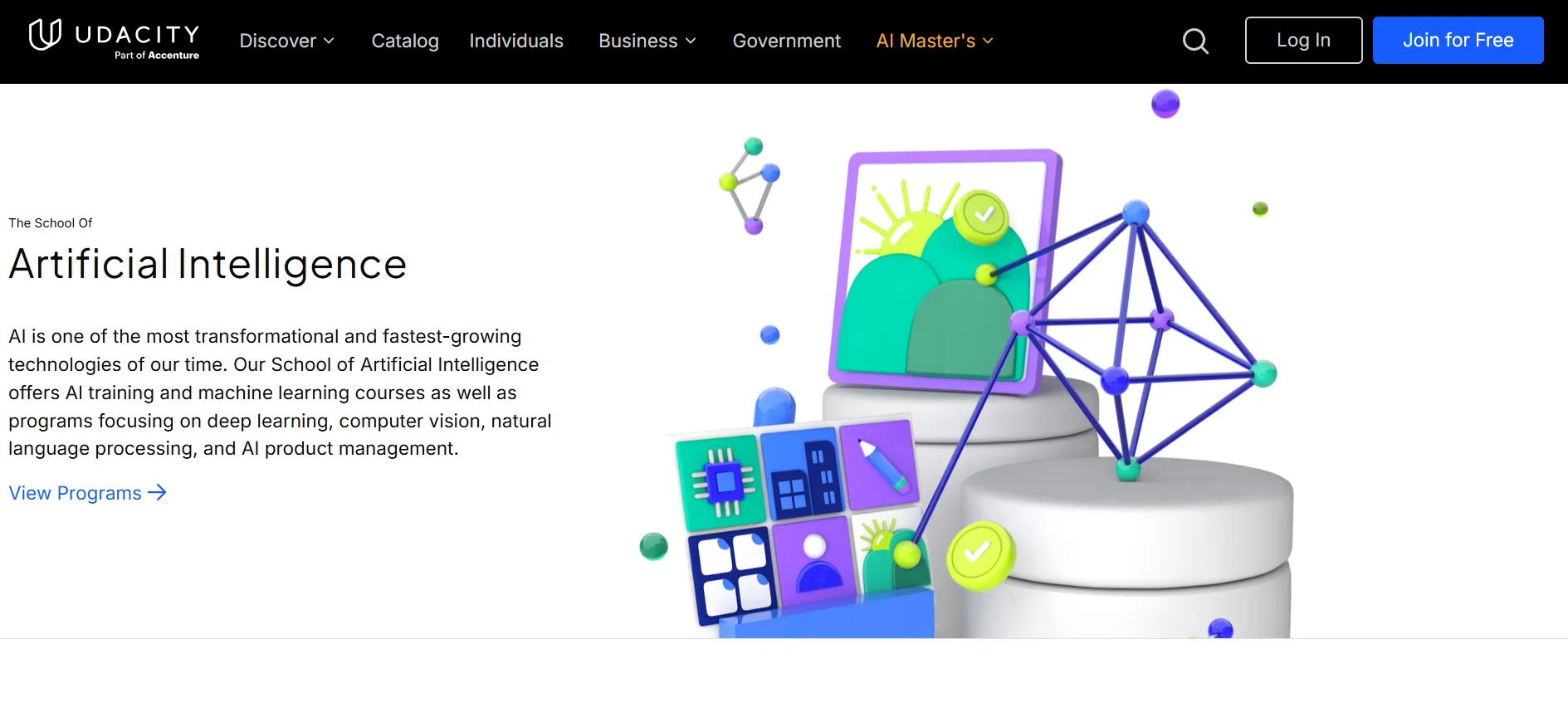
AI represents Udacity’s crown jewel. The platform offers a diverse array of programs tailored to distinct user tiers:
- Foundational Courses: Geared toward beginners and enterprise managers seeking generative AI literacy without writing raw code.
- Technical Nanodegrees: Advanced tracks covering machine learning engineering, deep learning, computer vision, and autonomous systems.
2. Programming and Software Development (Rating: 4.6/5)
Covering foundational languages such as Python, C++, and JavaScript, Udacity’s programming track emphasizes real-world application. Programs like the Introduction to Programming Nanodegree combine approximately 109 hours of instruction with hands-on coding challenges.
3. Data Science and Engineering (Rating: 4.7/5)
This vertical spans data analysis, data engineering, business analytics, and SQL database management. Students regularly interact with complex datasets, replicating enterprise-level analytical tasks.
4. Cloud Computing and DevOps (Rating: 4.6/5)
Featuring AWS-certified pathways and infrastructure operations modules, this sector targets IT professionals looking to migrate legacy systems to scalable cloud architectures.
5. Product Management and Digital Marketing (Rating: 4.4/5)
Recognizing that tech ecosystems require cross-functional leadership, Udacity includes business-adjacent training covering agile product lifecycles, growth marketing, and AI product management.
| Evaluation Feature | Rating | Target Suitability |
|---|---|---|
| Course Selection | 4.6/5 | Tech-focused professionals and career changers |
| AI & Tech Content | 4.8/5 | High-level developers and enterprise learners |
| Project-Based Learning | 4.8/5 | Portfolio builders and hands-on practitioners |
| Mentor Support | 4.6/5 | Independent learners requiring asynchronous guidance |
| Pricing Strategy | 3.7/5 | Serious career investors rather than casual hobbyists |
| Overall Value | 4.5/5 | High value for dedicated job-seekers |
Official Responses and Methodology: The Pedagogical Engine
Udacity’s pedagogical approach relies heavily on two core pillars: project-based learning and asynchronous expert mentorship.
The Project-Based Imperative
Unlike passive video-lecture platforms where students simply consume content, Udacity requires active output. Every Nanodegree module culminates in a comprehensive project that mirrors real-world workplace challenges. Submitted code and analytics reports are evaluated by human industry professionals who provide line-by-line feedback. This mechanism ensures that learners do not just understand theory, but can troubleshoot operational bugs and defend their technical methodologies.
Mentor Network Support
With over 700 active industry experts in its roster, Udacity bridges the gap between self-paced isolation and traditional classroom instruction. While students study independently on their own schedules, they can tap into mentor assistance whenever they encounter roadblocks, ensuring steady momentum without the rigid constraints of live lectures.
Implications: Cost Analysis, Career Coaching, and Market Value
The primary point of friction in any Udacity evaluation remains its financial cost. At $249 per month, or $846 upfront for a four-month bundle (translating to $211.50 per month), the platform is undeniably expensive compared to subscription services priced under $50.
Financial Breakdown
- Monthly Rolling Plan ($249/mo): Best for short-term evaluation, targeted skill acquisition, or learners with unpredictable schedules. Total cost for 4 months would equal $996.
- Four-Month Upfront Bundle ($846 total): Saves $150 compared to the monthly rolling plan. This option is mathematically superior for committed students pursuing an intensive Nanodegree, though it features a strict seven-day refund window with no prorated refunds thereafter.
Career Coaching and Limitations
Paid subscriptions include personalized career coaching, resume reviews, and mock interview preparation. While these tools successfully bridge the gap between technical competency and job market presentation, Udacity explicitly avoids employment guarantees. Ultimately, employment outcomes depend heavily on an applicant’s prior experience, geographic location, interview performance, and broader macroeconomic conditions in the tech sector.
Final Verdict
Udacity earns a strong 4.5 out of 5-star rating for 2026.
The platform is not built for casual browsers seeking inexpensive hobbies or permanent ownership of single courses. Instead, it functions as a high-end professional development accelerator. For career changers, software engineers looking to upskill in generative AI, and professionals dedicated to building a robust portfolio of verified projects, Udacity justifies its premium price tag.
However, budget-conscious learners should thoroughly explore Udacity’s free introductory course offerings before committing capital to ensure the platform’s rigorous, project-driven methodology aligns with their learning style and professional objectives.