In the early days of software development, the "Big Bang" release was the industry standard. Teams would toil for weeks or months, merge massive codebases, and push a single, monolithic update to production. If a bug emerged, the only recourse was a frantic "roll-forward" patch or a full system rollback. Today, that model has been rendered obsolete by the agility of feature flags.
Feature flags—conditional toggles that allow developers to enable or disable functionality at runtime—started as a simple convenience. However, as organizations scale, managing hundreds or thousands of these toggles across fragmented teams and complex environments has become a significant operational hurdle. The challenge has shifted from "how do we use flags?" to "how do we manage them without creating a labyrinth of technical debt and security risks?"
The Shift: From Deployment to Business Strategy
At its core, a feature flag is a bridge between the engineering world and the business world. Traditionally, these two worlds were siloed: engineers managed deployment, while product teams managed the release. Feature flag management effectively decouples these two concepts.
Deployment is now an engineering decision—the code is pushed to production, but it remains dormant. The "release" is a business decision, triggered by a toggle that grants access to specific users, geographies, or cohorts. This separation allows for "dark launches," where features are tested in production environments with zero risk to the general user base.
Mahek Mahendra Shah, Director of Product Management at Wingify, captures this transition perfectly: "Deployment of a feature is an engineering decision. Releasing the feature is a business decision. Rolling back the feature is a business decision. Feature flags give you the simplicity to do all of this and time it exactly how you want."
The Anatomy of Enterprise Experimentation
While feature flags control the delivery of code, they are often confused with A/B testing. In an enterprise context, they are two sides of the same coin. A feature flag provides the infrastructure to route users into different experiences; the experimentation engine provides the statistical rigor to determine which experience yields superior results.
When these are integrated into a single platform, the power is amplified. Without an experimentation layer, a feature flag is just a remote control. With it, every toggle becomes an opportunity to gather data. This allows enterprises to move beyond "gut-feeling" releases toward a culture of evidence-based development.
Key Components of a Robust Management System
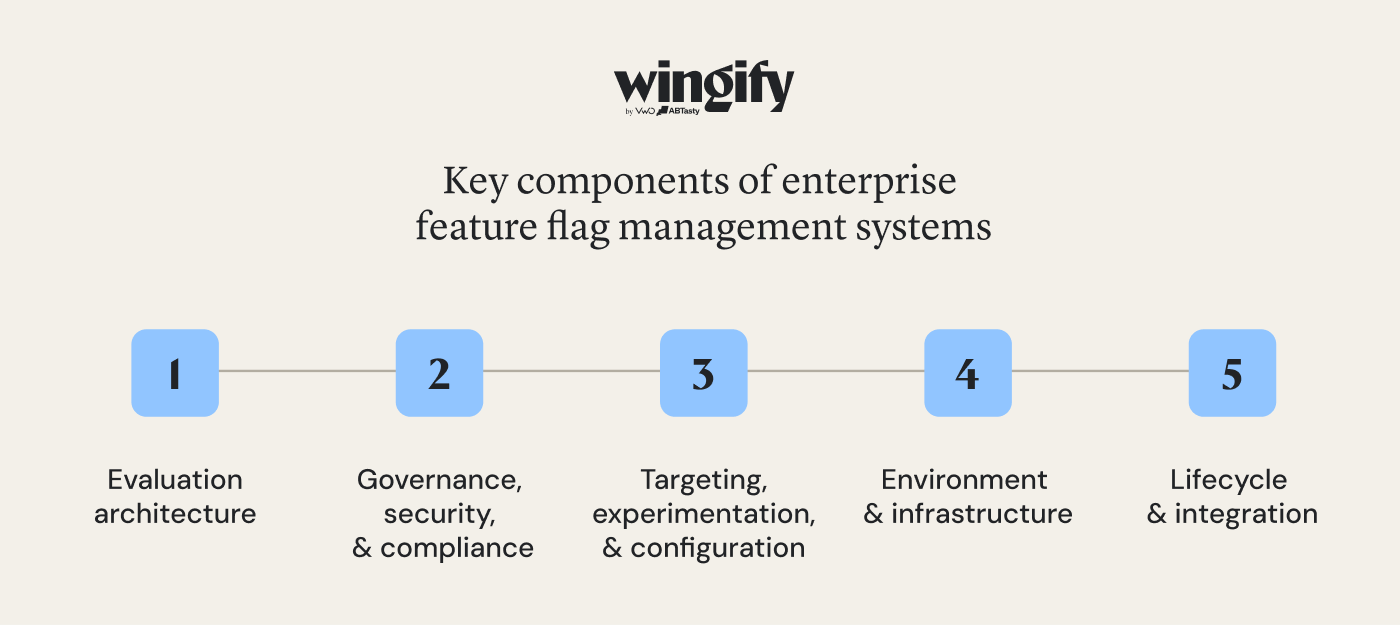
For an enterprise-grade platform, a basic UI toggle is insufficient. To maintain control at scale, organizations must invest in a system that incorporates five critical pillars:
1. Evaluation Architecture
High-scale applications require sub-millisecond evaluation times. The architecture must handle millions of requests without adding latency. Modern systems utilize edge-based SDKs that evaluate flags locally on the user’s device or server, ensuring that the user experience remains snappy regardless of the complexity of the targeting rules.
2. Governance, Security, and Compliance
In regulated industries, who has the power to turn a feature "on" is a matter of compliance. Enterprise platforms must offer Role-Based Access Control (RBAC), audit logs for every toggle action, and approval workflows. This prevents unauthorized personnel from accidentally enabling experimental features in production environments.
3. Targeting and Configuration
Sophisticated targeting goes beyond a simple binary switch. It involves multi-variate testing, percentage-based rollouts, and complex user-segmentation logic (e.g., "Only show this feature to premium users in the EMEA region using iOS 17").
4. Environmental Parity
Enterprise environments are rarely singular. Development, Staging, QA, and Production environments all require flag synchronization. A robust system allows teams to propagate configurations across these environments seamlessly, ensuring that a feature tested in QA behaves identically in Production.
5. Lifecycle and Integration (Technical Debt Management)
The most overlooked aspect of feature management is cleanup. Stale flags—code paths that are no longer in use—are a form of technical debt that can degrade system performance and introduce security vulnerabilities. Advanced platforms like Wingify provide "Technical Debt Recommendations," automatically flagging unused toggles and identifying the exact lines of code where they reside.
The Practical Challenges of Scaling
As feature flagging usage grows, organizations inevitably hit "scaling friction." The most common challenges include:
- Flag Explosion: When teams create thousands of flags without a naming convention or ownership structure, the system becomes unmanageable.
- Dependency Collisions: Two different teams may accidentally create flags that conflict with each other, leading to unpredictable user experiences.
- Visibility Gaps: Without a centralized dashboard, stakeholders often have no idea which features are currently live for which segments of the user base.
- Performance Overhead: Poorly implemented flag evaluation can lead to increased latency and, in worst-case scenarios, cascading failures if the flag server is unreachable.
The goal for any enterprise is not to eliminate these risks entirely—as that would require stifling innovation—but to make them visible. By treating feature flags as "first-class citizens" of the codebase, teams can turn potential liabilities into assets.

Real-World Impact: The Meliá Hotels International Case Study
The transition to sophisticated feature management is not merely a theoretical exercise; it has tangible financial benefits. Meliá Hotels International, for example, leveraged Wingify’s Feature Management to optimize its booking funnel.
By using feature flags to introduce a new booking step to only 5% of their audience, they were able to monitor user behavior in real-time. Finding no increase in drop-offs, they incrementally increased exposure to 100% of users within a week. This surgical precision resulted in a 1.85% uplift in average revenue per visitor (ARPV)—a significant figure for a global hospitality brand.
Choosing the Right Platform: A Buyer’s Guide
When selecting a feature management platform, organizations should look beyond the marketing collateral and focus on three fundamental requirements:
- Integration Ecosystem: Does the platform integrate with your existing CI/CD pipelines, analytics tools (like Google Analytics or Mixpanel), and monitoring systems (like Datadog or New Relic)?
- Embedded Intelligence: Can the platform provide insights into the impact of the flag? The most advanced systems use "intelligence layers" to correlate flag status with business metrics.
- Scalability and Reliability: Does the platform offer a high-availability infrastructure with 99.99% uptime guarantees? Your release process should never be at the mercy of your flag provider’s downtime.
Conclusion: The Unified Future
The future of software development lies in the convergence of delivery and measurement. We are moving toward an era where the boundary between "the code we write" and "the product we offer" is defined by dynamic, data-driven configurations.
By integrating feature flags with experimentation platforms, enterprises can stop guessing and start knowing. As Wingify’s approach demonstrates, when you provide teams with the ability to safely experiment, monitor the impact of their changes, and maintain a clean, organized codebase, you unlock a level of velocity that was previously unattainable.
The enterprise of tomorrow is one where the release is a continuous, safe, and highly-optimized process—powered by the intelligent management of every single toggle.
Frequently Asked Questions (FAQs)
What is the difference between a feature flag and a standard configuration file?
While both control behavior, feature flags are dynamic and evaluated at runtime. A configuration file usually requires a deployment to change, whereas a flag can be toggled instantly via a dashboard without modifying the underlying code.
How do you handle "flag debt"?
Flag debt is managed through automated cleanup tools and strict lifecycle policies. Teams should assign an "owner" and an "expiration date" to every flag at the time of creation.
Is feature management only for engineering teams?
No. While engineering handles the SDK implementation, the management dashboard is designed for product managers, marketers, and data scientists to control rollouts and monitor experiments.