New Delhi — For years, the global smartphone upgrade cycle was driven by a predictable, almost monotonous checklist of promises. Consumers were routinely nudged toward new purchases by the allure of a marginally better camera sensor, a slightly sharper display panel, or a more aesthetically refined chassis. However, as mobile devices have transitioned from luxury communication tools into indispensable hubs for remote work, round-the-clock entertainment, global navigation, and everyday commerce, a fundamental shift has occurred in consumer psychology.
Quietly, and steadily, a new set of priorities has climbed to the top of the buyer’s checklist: how long a device can last on a single charge and how resiliently it can withstand the unpredictable rigors of real-world use.
Today, battery longevity and physical durability are no longer viewed merely as secondary specifications on a spec sheet. Instead, they have transformed into the primary currency of consumer value. For the modern user juggling a demanding lifestyle, a smartphone that can seamlessly survive a grueling 72-hour period without demanding a tether to a wall outlet—while casually shrugging off accidental drops, torrential downpours, or dusty commutes—holds significantly more practical value than any incremental processing bump ever could.
Entering this evolving landscape is the newly unveiled POCO X8 Power. Engineered to place endurance and industrial-grade toughness at the very core of its design philosophy, the device represents a calculated response to a consumer base that is increasingly fatigued by high-maintenance technology.
Main Facts: Unpacking the POCO X8 Power
The POCO X8 Power arrives as a disruptive force in the mid-to-high-tier smartphone segment, challenging traditional design paradigms by refusing to compromise between raw stamina and premium features.
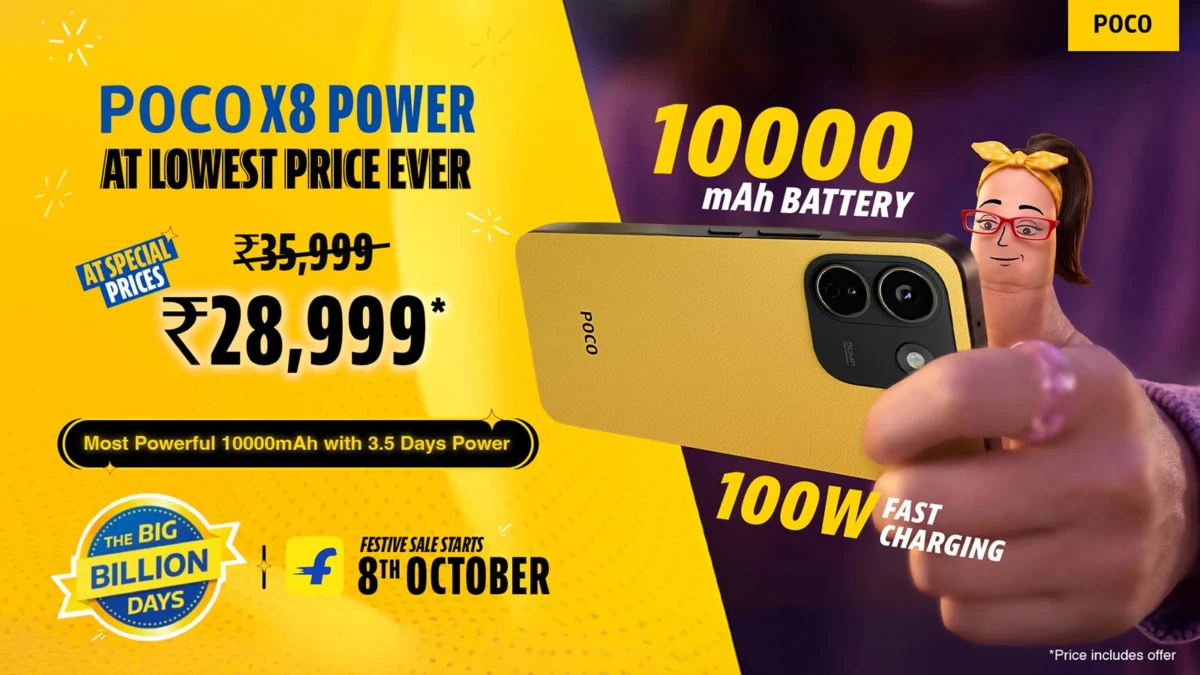
At the center of its value proposition is a massive 10,000mAh silicon-carbon battery, a technological feat that positions the device as the most powerful 10,000mAh smartphone in its class. This colossal power reserve is rated to deliver up to an unprecedented 3.5 days of typical usage on a single charge.
To complement this capacity, POCO has integrated 100W wired Hyper Charge technology, drastically cutting down replenishment times. Furthermore, the device supports 27W wired reverse charging, transforming the smartphone into a functional power bank capable of resuscitating depleted accessories, true wireless earbuds, or even companion phones while on the move.
Beyond its internal power architecture, the POCO X8 Power redefines physical resilience. It features IP66, IP68, and IP69 protections, alongside IP69K industrial-grade durability, shielding the internal components from high-pressure water jets and extreme environmental exposure. Paired with Corning Gorilla Glass Victus 2 and backed by a Double Five-Star Quality Certification from SGS and TÜV—a standard POCO characterizes as "Titan Quality"—the hardware is built to endure the unexpected moments of everyday life.
Crucially, endurance has not come at the expense of multimedia and computing performance. The device features a 6.83-inch 1.5K AMOLED Super Sunlight Display capable of a 120Hz refresh rate and an eye-watering 3,500 nits of peak brightness. Under the hood, it is powered by the Snapdragon 6 Gen 5 platform, paired with high-speed LPDDR5X RAM and UFS 4.1 storage, all running on Xiaomi HyperOS 3 built atop Android 16.
Chronology: The Evolution of the Consumer Priority Shift
To truly understand the market positioning of the POCO X8 Power, it is necessary to examine how consumer expectations have shifted over the past decade.
Phase 1: The Megapixel and Core Race (2015–2019)
During this era, smartphone marketing was dominated by numbers that appealed to novelty. Brands competed fiercely over who could pack the most megapixels into a camera sensor or squeeze the highest number of cores into an unoptimized processor. Battery capacities largely hovered around 3,000mAh to 4,000mAh, forcing users to structure their days around charging schedules. Thinness and lightweight profiles were prioritized above all else, often resulting in fragile glass sandwiches that shattered easily upon impact.
Phase 2: The Streaming and Refresh Rate Boom (2020–2023)
As 5G networks rolled out globally and mobile gaming matured, power consumption skyrocketed. Displays transitioned to 90Hz and 120Hz refresh rates, placing immense strain on aging battery technologies. While fast charging evolved rapidly—moving from 18W standards to blindingly fast 120W systems—overall battery capacities remained bottlenecked by traditional lithium-ion chemistry limitations. Users found themselves with faster-charging phones, but ones that still required daily, sometimes twice-daily, top-ups.
Phase 3: The Endurance Revolution (2024–2026)
By 2026, the law of diminishing returns had firmly taken hold of traditional smartphone features. Incremental camera upgrades and micro-architectural processor gains no longer excited consumers. Instead, fatigue set in regarding battery anxiety and the soaring cost of device repairs resulting from accidental drops. The industry witnessed a breakthrough in silicon-carbon battery chemistry, allowing manufacturers to pack significantly more energy density into thinner profiles without drastically increasing weight. The launch of devices like the POCO X8 Power marks the crystallization of this era—where reliability, multi-day endurance, and rugged build quality have officially superseded superficial design gimmicks.
Supporting Data & Market Analysis
The release of the POCO X8 Power aligns strategically with major retail events, positioning itself as an aggressive value play. During the ongoing Big Billion Days sale on Flipkart, the smartphone is introduced with a starting price of ₹29,999.
Market analysts point out that pricing a device with a 10,000mAh silicon-carbon battery, 100W Hyper Charge, and flagship-tier durability under the ₹30,000 threshold represents a significant disruption in the upper-mid-range market. Historically, rugged or high-battery-capacity niche devices were forced to compromise heavily on performance, display quality, or camera hardware, often resulting in sluggish user experiences or bulky, unattractive designs.
| Feature / Specification | POCO X8 Power Detail | Industry Average (Mid-Range) |
|---|---|---|
| Battery Capacity | 10,000mAh Silicon-Carbon | 4,500mAh – 5,000mAh Lithium-ion |
| Wired Charging Speed | 100W Hyper Charge | 33W – 67W |
| Reverse Charging | 27W Wired Reverse Charging | Usually absent or limited to 5W |
| Durability Ratings | IP66, IP68, IP69, IP69K (Industrial) | Typically IP54 or IP67 |
| Display Peak Brightness | 3,500 Nits (1.5K AMOLED, 120Hz) | 1,000 – 1,500 Nits |
| Glass Protection | Corning Gorilla Glass Victus 2 | Standard Gorilla Glass 5 / Victus |
| Quality Certifications | SGS & TÜV Double Five-Star | Standard manufacturer testing |
As detailed in the specification matrix above, the POCO X8 Power drastically outperforms traditional mid-range benchmarks, particularly in power density, charging versatility, and physical ingress protection.
The integration of Silicon-Carbon (Si-C) battery architecture is a crucial technical milestone. Traditional graphite anodes in lithium-ion batteries have largely reached their theoretical limits regarding energy storage per unit of volume. Silicon-carbon anodes allow for a much higher concentration of lithium ions, enabling manufacturers to house massive energy reserves—such as 10,000mAh—within a chassis that remains structurally manageable and comfortable to hold, rather than turning the device into an unwieldy brick.
Official Perspectives and Strategic Vision
While POCO’s hardware speaks volumes, the conceptual narrative behind the X8 Power touches on a broader philosophy regarding what modern technology should demand of its users.
Industry observers note that consumer technology has long suffered from an "attention tax"—the cognitive load associated with managing device battery percentages, avoiding wet environments, panicking over fragile screens, and carrying external power banks. The design ethos behind "Titan Quality" aims to eliminate this friction.
In promotional and briefing materials, POCO executives have emphasized that the X8 Power is not designed to create a sterile, indestructible bubble around the user. Rather, it is built to absorb the kinetic and environmental chaos of contemporary life without demanding immediate anxiety or costly repairs.
By achieving rigorous certifications—including the elusive IP69K industrial-grade standard, which guarantees resistance to high-pressure, high-temperature washdowns—the device steps outside the comfortable boundaries of office desks and carpeted living rooms. It is intentionally engineered for delivery riders, outdoor field workers, frequent travelers, and adventurous consumers who view their smartphones as working tools rather than fragile ornaments.
Simultaneously, the decision to pair this rugged core with a high-end multimedia package—featuring Dolby Vision, HDR10+, stereo speakers with Dolby Atmos support, and a versatile camera setup comprising a 50MP OIS main sensor, an 8MP secondary unit, and a 32MP front-facing shooter—underscores a vital design principle: endurance should never feel like a punishment. Users are not forced to sacrifice visual fidelity, photographic clarity, or multitasking fluidity in exchange for ruggedness and battery life.
Implications: A Paradigm Shift in Smartphone Value
The debut of the POCO X8 Power carries significant implications for the broader mobile industry, signaling a maturation of consumer values that manufacturers can no longer afford to ignore.
1. The Death of Battery Anxiety as a Design Standard
For over a decade, carrying a portable power bank or hunting for airport charging kiosks has been an accepted part of the modern travel experience. Devices like the X8 Power—offering up to 3.5 days of autonomy—threaten to make daily charging anxiety a relic of the past. If consumers experience a multi-day lifecycle without battery degradation anxiety, future market expectations will inevitably shift, forcing competitors to accelerate their adoption of high-density silicon-carbon technologies.
2. Redefining the "Value Flagship"
By pricing a rugged, multi-day endurance device aggressively at ₹29,999 during major retail windows like the Flipkart Big Billion Days, POCO is redefining what constitutes true value. For budget-conscious buyers, purchasing a phone that can survive physical mishaps and avoid premature battery degradation translates to a lower total cost of ownership over a prolonged 3-to-4-year upgrade cycle.
3. Reliability as the Ultimate Status Symbol
In a market saturated with iterative spec bumps, true luxury is increasingly being defined by peace of mind. When a device seamlessly integrates into high-stress, high-mobility environments without requiring babying, it transcends its status as a mere gadget. As the smartphone ecosystem looks toward the latter half of the decade, the message from the market is loud and clear: performance and design matter, but reliability is the new premium.
Disclaimer: This content is sponsored and does not reflect the views or opinions of IE Online Media Services Pvt Ltd. No journalist is involved in creating sponsored material and it does not imply any endorsement whatsoever by the editorial team. IE Online Media Services takes no responsibility for the content that appears in sponsored articles and the consequences thereof, directly, indirectly or in any manner. Viewer discretion is advised.