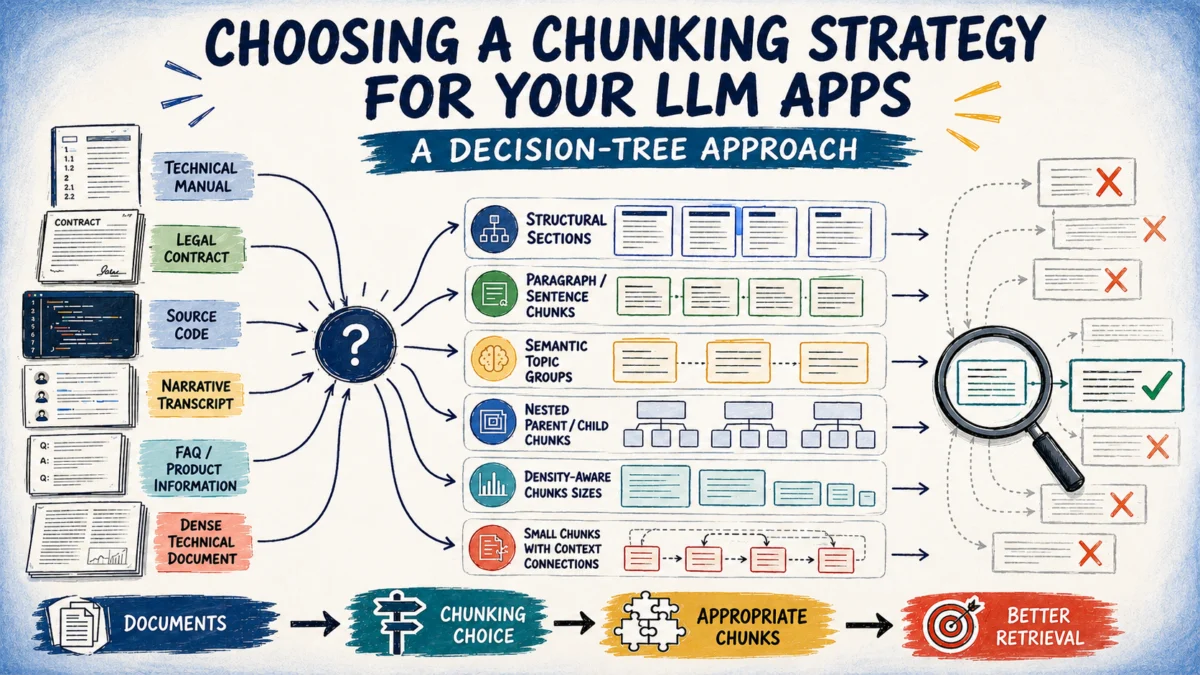
In the rapidly evolving landscape of Retrieval-Augmented Generation (RAG), the efficacy of your AI system is rarely determined solely by the sophistication of your Large Language Model (LLM). Instead, it is frequently decided long before the prompt is ever sent, during the data preprocessing phase. Specifically, the "chunking strategy"—the method by which you partition large documents into manageable segments—acts as the fundamental architecture upon which retrieval success is built.
When a document exceeds the context window of an embedding model or the LLM itself, it must be subdivided. While this may appear to be a trivial exercise in setting character counts and overlap percentages, improper boundaries can lead to catastrophic retrieval failures. A poorly segmented document may result in the system returning a fragment that is technically relevant to a keyword but lacks the semantic context required to synthesize an accurate answer. This article provides a comprehensive decision-tree framework to navigate the complexities of chunking, ensuring your RAG system is optimized for both performance and precision.
Main Facts: The Anatomy of a Chunking Failure
The primary objective of a RAG system is to bridge the gap between user queries and relevant information. If your chunking strategy fails, no amount of prompt engineering or advanced reranking can recover the lost context.
There are two primary failure modes in sub-optimal chunking:
- Semantic Fragmentation: The chunker cuts a sentence or a logical thought in half, stripping the information of its essential nuance.
- Contextual Dilution: The chunker separates a piece of data (e.g., a specific parameter) from the explanatory text (e.g., the function definition) that makes that data understandable.
Each strategy carries implicit assumptions. For instance, fixed-size chunking assumes that the exact location of a split is irrelevant because the overlap will cover the "seam." Conversely, semantic chunking assumes that embedding distance is a reliable proxy for topic shifts. Selecting the wrong strategy introduces unnecessary complexity that can inflate costs and latency without yielding a proportional gain in retrieval quality.
Chronology of the Decision-Making Process
To determine the optimal strategy, architects should follow a six-step decision tree. This flow is designed to move from the most cost-effective, high-speed methods toward more sophisticated, compute-intensive strategies.
Step 1: The Principle of "No-Chunk" Efficiency
Before implementing complex pipelines, evaluate if the document actually requires fragmentation. Short, atomic documents—such as individual FAQ entries, concise product descriptions, or standalone configuration snippets—should be embedded in their entirety. If a document fits comfortably within the model’s context window and maintains a singular focus, splitting it creates unnecessary overhead and risks fragmenting an already cohesive unit of knowledge.
Step 2: Leveraging Internal Structure
If the document is too large for a single embedding, the next step is to look for natural, human-authored boundaries. Most technical documentation is already organized via Markdown headers, HTML tags, or Pythonic function/class definitions. Document-based chunking utilizes these inherent structures to ensure that logical units remain intact. If your documents have high-quality markup, this is the gold standard for maintaining semantic integrity.
Step 3: Addressing Cross-Document Dependencies
Some documents, particularly in legal and technical domains, suffer from "semantic tethering." A definition provided in the preamble of a contract may be referenced multiple times in subsequent clauses. If you chunk such a document linearly, you lose the connection between the definition and its application. Late chunking is the solution here: the entire document is embedded using a long-context model, and then chunk-level embeddings are derived from that global representation, allowing each segment to retain its relationship to the whole.
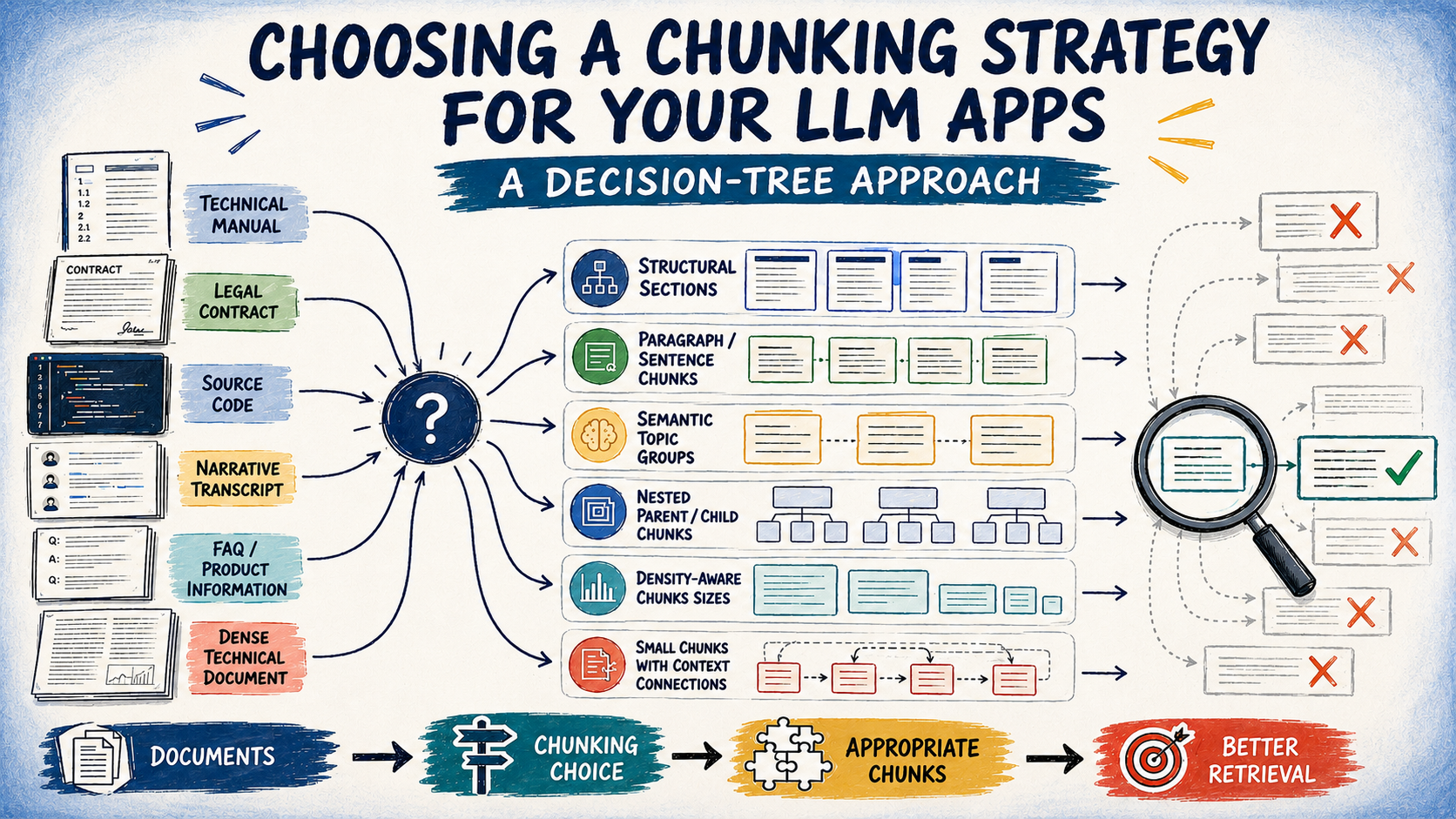
Step 4: Balancing Information Density and Granularity
Information is rarely distributed uniformly. A technical manual might have dense, information-heavy sections followed by sparse, narrative introductions.
- Adaptive Chunking: Used when density varies; it adjusts the window size based on the density of the content.
- Hierarchical Chunking: Used when your system must handle both broad, thematic questions ("How does this system work?") and specific, granular questions ("What is the default port for this service?"). This method creates a multi-layered index of small and large chunks.
Step 5: The Cost-Quality Tradeoff
When the structure is inconsistent and the content is complex, you reach the "Quality Threshold." If your retrieval accuracy is the top priority, LLM-based chunking—where an AI is tasked with identifying logical breakpoints—offers the highest precision but comes with significant computational costs. If you are budget-conscious, semantic chunking, which uses embedding distance to detect topic shifts, serves as a middle ground.
Step 6: Heterogeneous Collections
Finally, consider the variety of your corpus. If you are dealing with a mixture of code, narrative, and tabular data, a one-size-fits-all approach will fail. Agentic chunking uses a small LLM agent to inspect each document individually and select the optimal strategy from the methods above. If the corpus is relatively uniform, recursive chunking remains the most effective, versatile default.
Supporting Data: Comparative Analysis of Strategies
| Strategy | Assumed Document Structure | Primary Benefit | Key Constraint |
|---|---|---|---|
| Fixed-size | Uniform/Structureless | High speed | Lacks semantic awareness |
| Recursive | Natural text | Balanced performance | Risk of splitting clauses |
| Semantic | Variable topics | Context-sensitive | Sensitive to thresholds |
| Agentic | Heterogeneous | High precision | High computational cost |
| Late | High-dependency | Cross-chunk context | Requires long-context models |
Official Perspectives: Implications of Strategy Selection
The consensus among RAG engineers is that preprocessing is a "silent" performance metric. Many teams observe that "garbage in, garbage out" applies directly to chunking. When a system provides consistently wrong answers, the issue is often not the LLM’s reasoning, but the "context pollution" caused by poor chunk boundaries.
The implications of these choices are significant:
- Computational Overhead: Over-engineering the chunking process (e.g., using LLM-based chunking for simple text files) creates massive, unnecessary costs that scale linearly with the document volume.
- Search Latency: Complex indexing strategies, such as hierarchical chunking, increase the time required for vector search.
- Retrieval Precision: Conversely, under-engineering leads to low recall, where the system retrieves the wrong information, ultimately undermining user trust in the AI system.
Troubleshooting Common Pitfalls
Even with a well-planned strategy, developers must remain vigilant. If chunks are consistently cut mid-sentence, the "structure-blind" method (like fixed-size chunking) is likely clashing with the document’s nature; switching to recursive chunking is the standard fix.
If semantic chunking produces highly inconsistent results, it indicates that the similarity threshold is miscalibrated. The most common pitfall, however, is the "Agentic Overload," where the cost of analyzing documents via an agent outweighs the benefits. In such cases, caching the strategy decisions at the collection level—rather than performing per-document analysis—can drastically improve system performance without sacrificing quality.
Conclusion
The path to a high-performing RAG system is paved with thoughtful preparation. By applying a structured, hierarchical approach to chunking, you move away from guesswork and toward an engineering-led architecture. Begin with the simplest method that fits your document’s inherent structure, validate your choices against actual user query performance, and only increase complexity when the data demands it. By aligning your chunking boundaries with the logical structure of your information, you provide your LLM with the clearest possible foundation for accurate, reliable, and intelligent retrieval.