By Global Security Desk
Published: October 2026
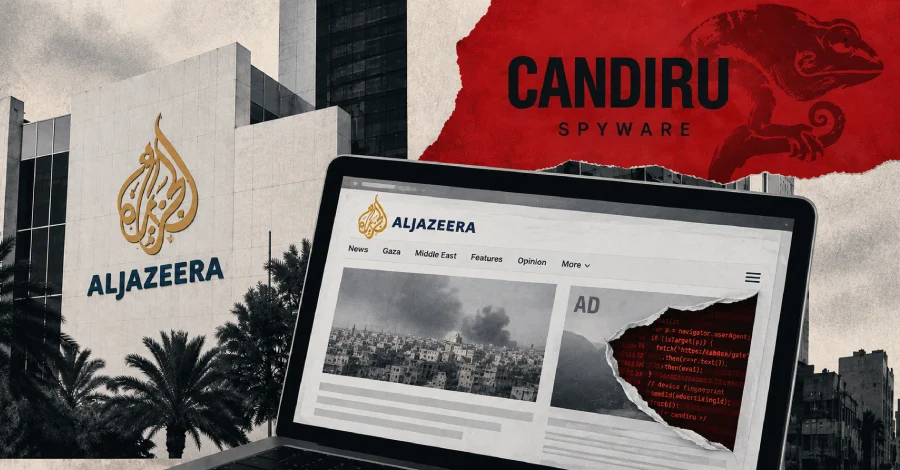
In what cybersecurity experts are calling a watershed moment for digital surveillance, a sophisticated zero-click cyberespionage campaign has been uncovered. Researchers at the Citizen Lab—a specialized laboratory based at the University of Toronto’s Munk School of Global Affairs—have revealed that devices belonging to journalists and staff at the international news network Al Jazeera were covertly infected with mercenary spyware.
The vector of infection? Ordinary online display advertisements.
The operation, attributed with high confidence to the controversial Israeli spyware vendor Candiru, represents the first publicly documented, live confirmation that the multi-billion-dollar programmatic advertising ecosystem can be weaponized into a silent delivery pipeline for government-grade hacking tools. Requiring no interaction, downloads, or accidental clicks from the user, the malicious code executed the moment an advertisement rendered on a screen—or, in some instances, even when loaded invisibly in the background.
This landmark disclosure exposes profound architectural vulnerabilities in the global digital advertising supply chain, raising alarming questions about how corporate advertising platforms can be exploited to bypass traditional perimeter security defenses.
Main Facts: The Anatomy of an Ad-Injected Cyberattack
For years, cybersecurity researchers have warned that the complex, automated world of real-time bidding (RTB) in digital advertising could theoretically be subverted for espionage. Until now, however, such fears were largely confined to theoretical threat models or brief mentions in leaked corporate documents.

The Al Jazeera campaign changes that paradigm entirely. According to technical findings published jointly by the Citizen Lab and ad-security firm Confiant, the campaign leveraged an Israeli front company named Discover-Tech. Operating as an approved digital advertising vendor since 2020 under the leadership of CEO Dekel Boni, Discover-Tech masqueraded as a legitimate programmatic ad network.
Behind the veneer of normal ad-tech operations, however, lay a tightly targeted surveillance infrastructure:
- The Delivery Mechanism: Banners and programmatic ads embedded with a discrete telemetry script were distributed globally.
- The Triage Server: Upon loading in a browser or mobile application, the ad quietly transmitted the victim device’s unique advertising identifier (ID) and IP address back to a Discover-Tech controlled server.
- The Profiling Phase: The server evaluated the incoming telemetry against a target list. If the device belonged to a designated high-value individual (such as an Al Jazeera investigative journalist), the server returned tailored exploit code designed to exploit vulnerabilities in the host application or browser. If the device did not match, the ad served benign content, leaving ad-fraud detectors and standard security systems completely blind.
- The Payload: Once the exploit successfully pierced the browser environment, it established contact with a command-and-control (C2) infrastructure operated by Candiru, deploying heavy-duty, persistent spyware.
While researchers were unable to capture the initial browser exploit code—as it was delivered dynamically only upon positive identification—they successfully recovered the Windows payload from a compromised device. Analysis of the binary revealed unmistakable code signatures, operational techniques, and structural patterns identical to a Candiru tool dissected by the Citizen Lab during a previous 2021 investigation.
Chronology of an Espionage Campaign
The exposure of the Candiru-Discover-Tech pipeline is the culmination of extensive digital forensics and traffic log analysis spanning multiple years. The timeline of events underscores the persistent targeting of media organizations, particularly those operating in geopolitically sensitive regions.
2020: The Precedent
Al Jazeera personnel are no strangers to state-sponsored surveillance. In December 2020, security researchers revealed that dozens of iPhones belonging to Al Jazeera journalists, producers, and anchors had been compromised using Pegasus spyware—a zero-click tool developed by another prominent Israeli cyber-arms manufacturer, NSO Group. However, that historical operation utilized vulnerabilities in Apple’s iMessage protocol rather than the web-advertising apparatus.
2020–2026: The Expansion of Discover-Tech
Registered in Israel in 2020, Discover-Tech successfully integrated itself into the mainstream digital advertising economy. By complying with basic industry standards and registering with major exchange platforms, the firm gained official vendor status with tech giants like Google and industry trade bodies like IAB Europe. Between March and June 2026 alone, Discover-Tech placed nearly 4 billion ad bids across approximately 75,000 mobile applications and 120,000 websites.

2024–2025: The Al Jazeera Incursions
During this window, the Citizen Lab recorded at least 45 distinct devices belonging to Al Jazeera personnel being actively targeted and infected. Traffic logs provided by the media network revealed a distinct, repeatable triad of connections on compromised workstations:
- Initial contact with a Discover-Tech ad-delivery server.
- A subsequent query to a Candiru screening server to validate the target’s identity.
- Handshake communication with a dedicated command-and-control server executing the spyware payload.
October 2026: Public Disclosure and Immediate Fallout
Following exhaustive investigations and coordination with major tech platforms, the Citizen Lab published its findings. The disclosure triggered swift remedial action across the ad-tech industry. Google, IAB Europe, and other ad exchanges moved rapidly to strip Discover-Tech of its vendor accreditations and cut off its access to programmatic ad streams.
Supporting Data: The Scale of the Infrastructure
While the targeted attacks against Al Jazeera involved a relatively small, highly focused cohort of roughly 45 devices, the operational footprint of Discover-Tech was gargantuan. This highlights a terrifying reality of modern ad-tech weaponization: the infrastructure built for precision strikes possesses massive, indiscriminate collateral reach.
- 10 Million Ads Per Day: According to ad-security firm Confiant, Discover-Tech’s traffic averaged roughly 10 million ad impressions daily at the height of its operations.
- Billions of Bids: Between March and June 2026, the company injected its telemetry-gathering code into nearly 4 billion ad bids.
- Global Institutional Footprint: Because Discover-Tech ads were distributed through standard programmatic auctions, they naturally bled into high-security corporate and governmental networks. The Citizen Lab identified ad impressions originating from the internal networks of NATO, the United Nations, European Union bodies, government offices across approximately two dozen countries, major semiconductor manufacturers, and international news agencies.
Crucially, security experts emphasize that an ad appearing on a sensitive network does not prove that a device on that network was infected. The spyware operators exercised rigorous discipline, utilizing the Discover-Tech filtering mechanism to ensure that expensive, volatile zero-click exploits were only deployed against pre-vetted targets. Confiant noted that the vast majority of traffic tied directly to Candiru malware activity remained low-volume, targeting specific home and mobile connections rather than broadcasting blindly into corporate intranets.
Official Responses and Industry Reactions
The revelation that the multi-billion-dollar programmatic advertising market can be easily subverted to bypass network perimeters has sent shockwaves through the cybersecurity and advertising industries. Yet, the corporate entities at the center of the storm have offered starkly contrasting reactions.
Big Tech and Ad Networks Move to Quarantine
Upon receiving advance briefings from the Citizen Lab, major technology firms and programmatic exchanges moved decisively to sever ties with Discover-Tech:

- Google: Confirmed that it worked closely with researchers to purge Discover-Tech from its ad exchanges, stating that the company was permanently banned for "systematically violating our policies."
- IAB Europe: Announced the immediate suspension of Discover-Tech following an internal audit that uncovered flagrant breaches of advertising standards.
- Comcast-owned Beeswax and Vungle: Beeswax acted immediately upon noticing anomalous activity, while Vungle temporarily paused Discover-Tech’s access pending comprehensive security reviews. Eskimi also blocked all associated accounts.
Silence from the Perpetrators
True to the shadowy nature of the mercenary spyware industry, the primary actors involved maintained a wall of silence. Discover-Tech, Candiru, and Al Jazeera declined requests for comment from major news agencies like Reuters. Discover-Tech’s corporate website remained online following the disclosures, offering no official statement or acknowledgment regarding the allegations.
The Corporate Evolution of Candiru
Candiru itself has long operated under intense international scrutiny. In November 2021, the United States Department of Commerce placed Candiru on its official trade Entity List, citing activities contrary to U.S. national security interests after its tools were found targeting dissidents, human rights activists, and journalists.
Despite these sanctions, the corporate shell of the spyware vendor has mutated. Reports from 2025 indicated that Candiru’s assets were acquired by a U.S. investment firm, Integrity Partners, and transferred into a newly minted corporate entity reportedly named Integrity Labs—a maneuver designed to skirt legacy sanctions and maintain operations under a reorganized corporate structure.
Implications for Global Cybersecurity
The discovery of the Candiru-Discover-Tech ad-injection pipeline fundamentally alters how organizations must approach threat modeling, network defense, and browser security.
1. The Death of the Perimeter
Historically, organizations relied on firewalls, secure web gateways, and endpoint protection to filter malicious traffic, block known phishing links, and prevent users from navigating to dangerous websites. However, ad-based zero-click attacks render traditional URL filtering obsolete. Employees do not need to visit a compromised website or click a malicious link; simply browsing a legitimate news site, opening a weather app, or checking a stock ticker can load an ad frame that executes code locally.
2. The Weaponization of Programmatic Advertising
The incident demonstrates a terrifying evolution in cyber warfare: the outsourcing of exploit delivery to automated market structures. Because programmatic advertising is designed to be frictionless, fast, and opaque—relying on lightning-fast auctions across thousands of intermediary servers—it provides an ideal cover for threat actors to mask command-and-control traffic as routine commercial telemetry.

3. Convergence with Previous Threats
This campaign is part of a broader, deeply concerning trend of mercenary spyware firms innovating beyond traditional messaging vulnerabilities (such as WhatsApp or iMessage zero-clicks). In December 2025, leaked internal documents revealed that another major spyware vendor, Intellexa, had developed a nearly identical ad-based tool designated as "Aladdin." The confirmation of Candiru successfully deploying this method in the wild proves that ad-tech weaponization has moved past the drawing board and into active operational deployment.
Recommendations for Defenders and IT Administrators
To help organizations detect and mitigate potential compromises stemming from this campaign, the Citizen Lab and Confiant have published extensive Indicators of Compromise (IoCs), including suspicious domains, file hashes, and infrastructural metadata.
Security teams and network administrators are advised to take the following steps:
- Analyze Traffic Logs: Organizations—particularly those in government, defense, journalism, and critical infrastructure—should audit historical web and firewall logs for the distinct connection sequence: a device communicating with an ad-delivery server, immediately followed by a triage/screening server, culminating in a persistent command-and-control connection.
- Harness Ad-Blocking and Content Filtering: Deploying enterprise-grade ad-blockers, network-level sinkholes, and advanced script-blocking extensions can drastically reduce the attack surface by preventing banner ads and third-party telemetry scripts from executing within browser contexts.
- Endpoint Detection and Response (EDR): Ensure that EDR solutions are configured to monitor anomalous process-spawning behavior originating from web browsers, media players, and mobile applications.
As nation-states and private mercenary firms continue to professionalize cyberespionage, the discovery at Al Jazeera serves as a stark warning. The invisible machinery that funds the modern internet has been turned inward, transforming the ads we view every day into silent sentinels of surveillance.