The STEM-Humanities Divide: Inside the Culture Wars Boiling Over at India’s Premier Engineering Institutes
By Vishnu Prakash Edited by Sumit Chakraborty Lede Illustration by Kashvi Bansal
Introduction: A Campus Divided
"Leave IITs for the top brains of India, people who excel in STEM and management only," a Reddit user wrote on the Indian Institute of Technology (IIT) Bombay’s community page in September. "We don’t want stupid narrative-pushing socio-drama queens on this campus anymore!"
On campus, the sentiment is expressed with more subtle condescension, though the underlying friction remains palpable.
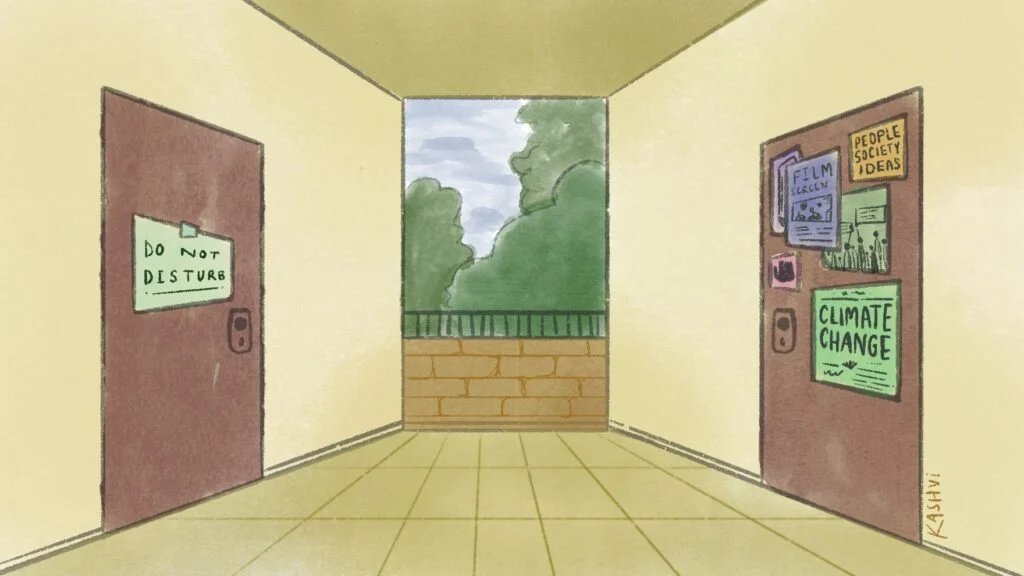
"If someone says something woke, or socially aware, a frequent response would be ‘oh you’re being so HSS’," explained a former development studies student at IIT Madras.
HSS—short for Humanities and Social Sciences—has transformed into a pejorative adjective within the hallowed halls of India’s premier engineering schools. Once viewed as minor, enriching departments designed to round out a technical curriculum, these faculties are now caught in the crossfire of a long-brewing, increasingly bitter culture war.
As ideological fault lines widen across India’s elite technological institutes, the tension between the hardcore engineering majority and the humanities minority has exploded from online forums into real-world polarization.
1. Main Facts: The Flashpoint at IIT Bombay
The latest and most volatile phase of this cultural clash began at IIT Bombay following the tragic death by suicide of student Sahil Wakode. The incident acted as a catalyst, sparking intense protests across the Powai campus.
A significant portion of these demonstrations was led and organized by HSS doctoral students. The rallies centered heavily on institutional accountability, specifically targeting a professor against whom the Scheduled Castes and the Scheduled Tribes (Prevention of Atrocities) Act had been invoked. The protests culminated in high-stakes administrative fallout: the professor was stripped of his deanship and sent on immediate leave.
However, the ripple effects extended far beyond administrative disciplinary actions. Off-campus observers, internet commentators, and disgruntled engineering students increasingly conflated the campus protesters with the broader humanities student body.
Online discourse quickly devolved into a reductive, hostile question: Why do the IITs—bastions of global technological excellence—have humanities departments at all?
Conversations with more than a dozen students and an equal number of professors across multiple IIT campuses reveal a stark reality. Many engineers describe their academic environments as "hyper-apolitical," where engaging in open political discourse is considered the "fastest way to lose friends."
When left-leaning student groups rallied following Wakode’s death, the pushback from the technical student body was swift. In a manifestation of deep ideological alienation, some engineering students staged what can only be described as a "protest in front of the protest."
2. Chronology of Events: From Grievance to Polarization
To understand how elite technological institutions reached this inflection point, one must trace the timeline of escalating tensions through the late summer and fall of this year:
Early September: Tragedy strikes IIT Bombay with the death of Sahil Wakode, setting off immediate, emotionally charged student-led demonstrations on the Powai campus.
Mid-September: HSS doctoral students and external progressive groups mobilize, demanding institutional accountability and targeting a specific faculty member under the SC/ST Act, eventually forcing his removal from his deanship and administrative leave.
Late September: Online backlash intensifies. Anonymous handles on Reddit and X (formerly Twitter) launch targeted tirades against the HSS departments, questioning their very presence within STEM-centric institutes and branding humanities scholars as "socio-drama queens."
Early October: The ideological rift formalizes on the ground. IIT Bombay’s student council issues an official statement distancing itself from the protesting groups. The council argues that the demonstrators do not represent the broader student body and that their active demonstrations are severely disrupting classes, examinations, and critical corporate placement cycles.
Mid-October Onward: The campus atmosphere settles into an uneasy, fractured cold war. Informal social segregation deepens, with engineering and humanities cohorts retreating further into their respective ideological silos.
3. Supporting Data and Structural Realities: Two Roads to the Same Quad
The ideological divide is mirrored by a structural and experiential chasm. The two student cohorts arrive at the exact same campus via radically different intellectual and psychological pathways.
For most engineering students, admission is the culmination of a grueling, high-stakes gauntlet. They spend anywhere from two to four years in intense, isolating preparation for the Joint Entrance Examination (JEE), often living away from home during their most formative adolescent years. The system rewards singular focus, mathematical prowess, and algorithmic problem-solving.
Paradoxically, many of these students leave technical engineering behind upon graduation. According to recent institutional placement data from IIT Bombay, almost as many students gravitate toward consulting, high-frequency trading, and finance as take up core engineering or technical product development roles.
Conversely, humanities and social sciences students arrive through entirely different entrance mechanisms—such as the Humanities and Social Sciences Entrance Examination (HSEE) or doctoral fellowship programs—carrying analytical frameworks rooted in sociology, economics, history, and political science.
When these two populations collide in shared campus spaces, their divergent worldviews create friction. Humanities faculty members interviewed for this piece trace the hostility to "a very myopic, shallow understanding about education."
At the same time, some progressive professors privately concede that their own side has exacerbated the divide. They admit to an insular "obsession with moral purity" that often alienates the pragmatic, career-focused engineering majority, making genuine cross-disciplinary dialogue nearly impossible.
4. Official Responses and Institutional Stance
The administrative leadership of the IITs finds itself caught in an unenviable balancing act. Traditionally viewed as apolitical technocratic breeding grounds, these institutions are increasingly forced to navigate complex socio-political realities that their foundational blueprints never anticipated.
The IIT Bombay Student Council’s early October statement serves as a primary manifestation of the institutional reflex to prioritize normalcy and career outcomes above all else:
"The protesters do not represent the collective voice of the student body. Unchecked demonstrations threaten the academic calendar, disrupt upcoming examinations, and jeopardize high-stakes corporate placements."
While university administrations have taken disciplinary action when legally compelled—such as in the case invoking the SC/ST Act—they have simultaneously sought to suppress public agitation that damages the brand value and operational continuity of the institutes.
Humanities departments, meanwhile, find themselves defending their institutional legitimacy. Long relegated to the periphery of institute funding and prestige, HSS faculty argue that a purely technical education devoid of ethical, sociological, and historical grounding produces capable technicians rather than responsible leaders.
However, caught between defensive engineering cohorts and anxious administrative boards eager to protect corporate placement statistics, the humanities departments struggle to assert their value proposition.
5. Implications: What the Culture War Means for the Future of IITs
The simmering culture war at India’s premier institutes is not merely an isolated campus quarrel; it carries profound implications for the future of Indian higher education, industry leadership, and societal cohesion.
1. The Erosion of Interdisciplinary Synergy
Global technological powerhouses—from Silicon Valley to Bangalore—increasingly demand leaders who combine deep technical competence with a sophisticated understanding of human behavior, ethics, policy, and societal impact. By fostering an environment where humanities are belittled as "woke" or irrelevant, IITs risk producing graduates who are technologically brilliant yet socially illiterate.
2. Widening Social Stratification on Campus
When an institute’s majority population views minority departments with disdain or hostility, marginalized students and those engaging in social advocacy face psychological isolation. This dynamic can exacerbate alienation, worsening mental health crises on campuses that are already grappling with intense academic pressures.
3. The Commodification of Education
The student council’s prioritization of placements and exam schedules over socio-political discourse highlights a deeper commodification of IIT degrees. When an institute is viewed strictly as a pipeline for high-paying finance and consulting jobs rather than a crucible for intellectual awakening, critical thinking inevitably takes a backseat to compliance and careerism.
Conclusion
The culture war boiling over at the IITs is a microcosm of a broader national debate: Should elite educational institutions focus solely on utilitarian nation-building through hard science and economic output, or must they also serve as forums for uncomfortable truths, social justice, and humanistic inquiry?
Until India’s premier technical institutes bridge the chasm between the slide rule and the social sciences, their campuses will remain deeply fractured—boasting some of the brightest technological minds in the world, yet struggling to find a shared language to understand one another.