








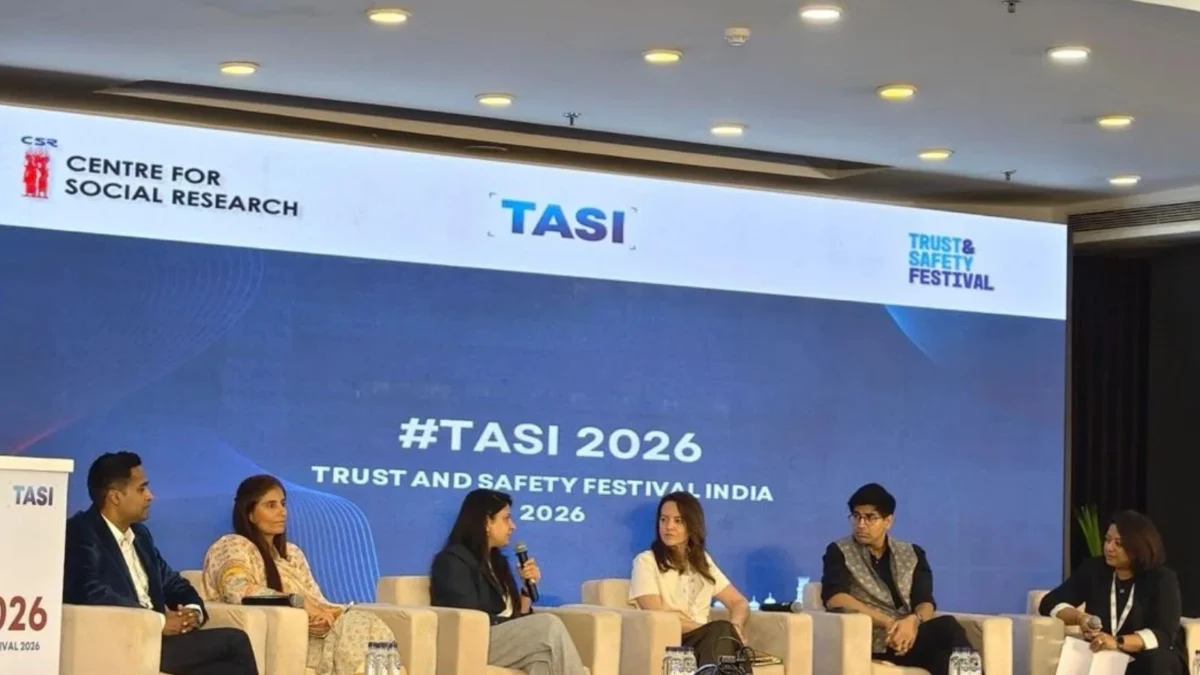
NEW DELHI — As generative artificial intelligence reshapes industries, redefines human interaction, and accelerates into every facet of daily life, a stark warning echoed through the halls of the Trust and Safety India (TASI) Festival. Technology outpaces the guardrails built to protect its users, and the chasm between innovation and governance threatens to widen beyond repair.
This alarming consensus emerged during a high-stakes panel discussion on Wednesday, October 14. Jointly organised by the Centre for Social Research (CSR) and TASI, the two-day conference convened global tech executives, prominent policy researchers, and civil society leaders to grapple with the multifaceted crises of AI governance, online safety, and structural accountability.
Representing the sharp edge of technological development, senior executives from OpenAI, Google, and Roblox took the stage alongside public policy consultants and legal experts. Moderated by veteran journalist Faye D’Souza, the panel dissected the industry’s darkest vulnerabilities: deepfakes, child exploitation, the privacy hazards of emerging hardware like camera-equipped smart glasses, and the complex challenge of fitting global algorithms to India’s deeply multi-faceted socio-cultural ecosystem.
Main Facts: The AI Safety Crisis at a Crossroads
The central tension of the TASI panel revolved around a fundamental philosophical and economic dilemma: Can the artificial intelligence industry effectively police itself through voluntary testing, red-teaming, and cooperative safety protocols, or has the breakneck speed of the global AI race rendered voluntary compliance obsolete, necessitating decisive government regulation?
Key revelations from the discussion underscored the gravity of the situation:
- The Safety-Speed Tradeoff: Industry representatives admitted that fierce market competition often starves trust and safety teams of the necessary resources, even as companies publicly champion ethical AI deployment.
- The Limits of Self-Regulation: Experts argued that while market incentives drive baseline trust, competitive pressures create systemic blind spots, necessitating agile, outcome-focused government oversight.
- Child Safety by Default: Panelists agreed that protecting minors online can no longer rely on complex parental control configurations; safety must be embedded natively into product defaults.
- The Regulatory Void in India: Legal and policy analysts highlighted critical shortcomings in India’s current legislative framework—specifically the outdated reliance on "safe harbour" provisions that fail to address autonomous, generative AI models.
Chronology of the Debate: From Innovation to Intervention
The evolution of the discussion traced a logical arc from the inception of advanced models to the pressing need for systemic intervention.
1. The Genesis of the Race: Slowing Down for Humanity
The panel opened with a critical examination of how AI development models have shifted. Pragya Misra, Head of Strategy & Global Affairs for India at OpenAI, acknowledged the immense internal pressure to achieve Artificial General Intelligence (AGI) first. However, she pointed to a strategic pivot within her organization.
"We have slowed down reinforcement learning and training runs because we do believe that safety should be of utmost priority," Misra stated. "Of course, we want to hit AGI as soon as possible and we want to get there first. But we also want to make sure that AGI benefits all of humanity."
2. The Competitive Squeeze: Why Market Incentives Fall Short
While OpenAI pointed to internal pacing mechanisms, external policy analysts questioned whether such restraint is sustainable across the broader industry. Rohit Kumar, Founding Partner at policy consultancy The Quantum Hub (TQH), challenged the notion that market forces alone can guarantee user safety.
"Companies obviously have incentive in ensuring trust because if users stop trusting the technology over a period of time, then they will lose that vision," Kumar explained. Referencing warnings from industry pioneers like OpenAI CEO Sam Altman and Anthropic CEO Dario Amodei, he added, "Even though they have the incentive to make the ecosystem safer, the problem is that you’re competing in a very fast-moving space… This is where the role of regulation comes in, because regulation is what fits that incentive."
3. Pre-Release Scrutiny and Sandbox Testing
Moving from abstract market pressures to concrete engineering practices, Google outlined its rigorous pre-launch validation protocols. Snigdha Bhardwaj, Director and Global Head of Generative AI Trust and Safety at Google, emphasized the company’s absolute zero-tolerance policies.
"We have zero tolerance for CSAM [Child Sexual Abuse Material] content. So, if our models produce even the slightest content like that, the launch definitely has to go slowly," Bhardwaj said. She detailed Google’s reliance on continuous adversarial attacks, or "red-teaming," deployed repeatedly until model outputs meet strict safety thresholds.
Expanding on this, moderator Faye D’Souza introduced the concept of mandatory pre-release reviews and "sandboxing" for disruptive hardware—such as camera-equipped smart glasses—before mass consumer exposure.
Supporting Data and Technical Safeguards: Building the Armor
As AI models grow more autonomous, the mechanisms designed to track, audit, and constrain them must evolve in tandem. The panel dove deep into the infrastructural tools required to police the digital commons.
Interoperable Safety Layers and Content Provenance
To combat bad actors jumping between platforms, Google’s Bhardwaj advocated for an interoperable safety layer across the tech ecosystem. By leveraging industry-wide tools like SynthID (watermarking technology for AI-generated media) and hash matching databases, companies can share risk signals cooperatively. This collaborative defense reduces competitive friction while protecting intellectual property and user privacy.
Shifting the Burden of Child Safety
Nicky Jackson Colaco, Vice President and Global Head of Public Policy at Roblox, argued that platforms must abandon the paternalistic model of online safety.
"Online child safety should not depend on parents knowing how to configure controls," Colaco asserted. Highlighting Roblox’s age-assurance models, she explained that access to communication channels and mature content must default to highly protective settings when a user’s age is unverified. Stronger corporate safeguards, she noted, create a rising tide that forces industry-wide compliance.
Official Responses and Stakeholder Perspectives
The diverse composition of the panel provided a rich cross-section of viewpoints, illuminating the tension between corporate ambition, policy pragmatism, and societal impact.
The Generational Shift and Cognitive Dependence
Akash Pugalia, Chief Digital Officer at TP, brought a sobering parental and societal perspective to the debate, noting how AI is fundamentally rewiring human cognitive development and social interaction.
"I have a 10-year-old daughter. So, whenever she asks a question, and either my wife or I answer it, she never believes us. She says, ‘Okay, can we ask Gemini or ChatGPT, please?’ For them it’s so easy to access information," Pugalia shared.
Beyond dependency, he raised deep concerns regarding hyper-realistic audio and video deepfakes. "The other thing that scares me the most is anything to do with deepfakes, anything to do with how grooming has changed. And the quality of those deepfakes has improved so much that the actual photo is unrecognizable."
Adapting AI to the Indian Context
A recurring theme throughout the TASI festival was the danger of importing Western-centric AI models into developing markets without adequate localization. Pragya Misra pointed to OpenAI’s findings in India, where education and skill acquisition represent primary use cases for generative tools.
"Last year, our research team realised that learning was the key use case in India… But the challenge was that the feedback we always got is that the model is just giving me answers. It’s taking away from the rigor and the learning process," Misra explained.
In response, OpenAI rushed out its "Study Mode," embedding Socratic methodologies into ChatGPT to guide students toward answers rather than simply doing their work for them. Panelists agreed that similar cultural and linguistic tailoring is vital for safety filters, ensuring they understand local idioms while avoiding over-censorship that could stifle freedom of expression.
Implications for India’s Regulatory Framework
The concluding segments of the panel focused on the structural inadequacies of India’s current legal architecture regarding digital technologies.
Rohit Kumar of The Quantum Hub delivered a sharp critique of existing statutes. "In India, one of the biggest problems is that our tech laws essentially come down to safe harbour," he noted. Under traditional legal frameworks, platforms are shielded from liability for third-party content unless they fail to comply with government or judicial takedown notices.
"It basically means they’re only looking at third-party content and saying we will hold platforms accountable only if they do not take down content asked to be taken down. But that is not a law that works for the current ecosystem of technologies," Kumar warned.
Because generative AI creates original content rather than merely hosting user-generated material, the safe harbour defense collapses. Kumar advocated for forward-thinking, non-prescriptive regulations—pointing to the United Kingdom’s Online Safety Act as a viable blueprint for establishing child safety and algorithmic accountability as non-negotiable legal norms.
Conclusion: The Path Forward
The Trust and Safety India Festival made one reality abundantly clear: the window for proactive, collaborative AI governance is rapidly closing. As generative tools become deeply embedded in the cognitive, professional, and social lives of millions of citizens—particularly in a diverse, high-growth market like India—the reliance on corporate benevolence is no longer sufficient.
Bridging the gap between technological velocity and regulatory wisdom will require unprecedented cooperation. Governments must craft flexible, outcome-driven laws; tech giants must prioritize safety architectures over sheer speed to market; and civil society must continue to demand transparency. Only through this tripartite alliance can the digital ecosystem ensure that artificial intelligence remains a force for human elevation rather than unchecked hazard.