




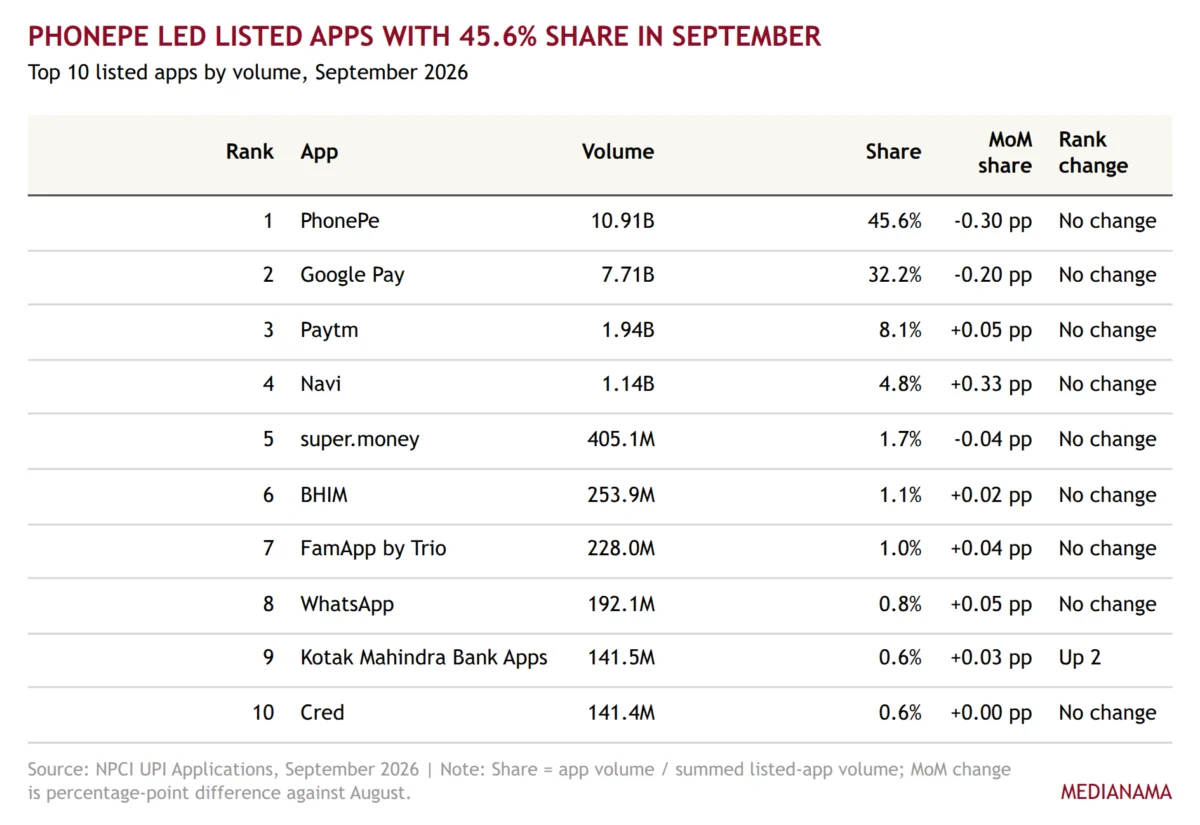
The landscape of India’s digital payments ecosystem continues to be defined by a persistent, high-stakes dominance. According to the latest data released by the National Payments Corporation of India (NPCI) for September 2026, the Unified Payments Interface (UPI) remains anchored by the overwhelming presence of two industry titans: PhonePe and Google Pay. Together, these platforms accounted for 77.8% of the total transaction volume processed by NPCI-listed applications. While this figure represents a marginal contraction from the 78.3% recorded in August 2026, it underscores a structural reality that continues to challenge the NPCI’s long-standing mandate to democratize the payments space through a 30% volume cap.
Main Facts: The September 2026 Snapshot
The data for September 2026 paints a picture of a market that, while growing in absolute volume, remains concentrated at the top. PhonePe continues its reign as the market leader, processing 10.91 billion transactions, which constitutes a 45.57% share of the listed-app market. Google Pay trails, yet maintains a massive footprint, processing 7.71 billion transactions for a 32.23% share.
When evaluating these figures, it is essential to note the methodology: the NPCI’s reporting focuses on "listed-app" volume, which totaled 23.93 billion transactions for the month. This serves as the denominator for market share calculations, distinct from the broader 24.07 billion total transactions processed across the entire UPI network. The discrepancy highlights the existence of a "long tail" of smaller entities and bank-specific apps that, while individually smaller, collectively influence the network’s liquidity and reach. Notably, the NPCI continues to aggregate apps with fewer than 20,000 monthly transactions into an "Other Apps" category, masking the granular performance of niche fintech entrants.
Chronology: A Year of Shifting Sands
To understand the current state of play, one must look at the year-on-year trajectory. In September 2025, the combined market share of PhonePe and Google Pay sat at a staggering 81.9%. The subsequent twelve months have seen this figure drift downward to 77.8%, a shift of 4.1 percentage points.

- September 2025: PhonePe held a 46.47% share, while Google Pay accounted for 35.43%.
- Early 2026: Market competition intensified as players like Navi and the emerging super.money began to carve out niches in the lending and credit-linked payments space.
- August 2026: The duopoly share stood at 78.3%, indicating a brief stabilization before the slight dip observed in September.
- September 2026: The current reporting cycle shows PhonePe’s share has retracted by 0.9 percentage points year-on-year, while Google Pay has seen a more significant contraction of 3.2 percentage points.
This downward trend—however slow—suggests that the market is finally seeing the fruits of increased competition, even if the "market cap" remains an elusive target for the duopoly.
Supporting Data: The Rising Challengers
While the top two remain entrenched, the secondary tier of the UPI ecosystem is showing signs of aggressive growth. Paytm, once the undisputed leader of the early digital wallet era, maintained its position as the third-largest player with 1.94 billion transactions, capturing 8.1% of the listed-app volume.
The most interesting movements, however, are occurring in the fourth through tenth positions:
- Navi: Continuing its upward momentum, Navi recorded 1.14 billion transactions in September, up from 1.08 billion in August. Its focus on integrated financial services seems to be paying dividends in user stickiness.
- super.money: Emerging as a significant disruptor, the platform recorded 405.1 million transactions, signaling a successful entry into the hyper-competitive UPI landscape.
- Banking Infrastructure: Traditional financial institutions are also asserting themselves. Kotak Mahindra Bank’s apps have surged, moving from 11th to 9th place in the rankings. This reflects a broader trend where banks are reclaiming digital territory by enhancing their native UPI-enabled applications, moving away from a total reliance on third-party payment providers.
The Compliance Quagmire: The 30% Volume Cap
The central tension in the Indian payments market remains the NPCI’s circular regarding the 30% volume cap for Third-Party Application Providers (TPAPs). The regulation, designed to mitigate systemic risk by preventing any single entity from becoming a "single point of failure," has been subject to multiple extensions. The most recent extension pushes the compliance deadline to December 31, 2026.

It is critical to clarify that the 30% threshold is not a monthly "hard stop." The NPCI measures compliance based on a three-month rolling average of total UPI volume. Consequently, while September’s data shows both PhonePe and Google Pay significantly exceeding the 30% threshold in monthly volume, this does not constitute a technical breach of the regulation.
The NPCI’s cautious approach to enforcement—extending deadlines rather than imposing penalties—acknowledges the reality that forcing a sudden exodus of users from these platforms could lead to massive consumer disruption. The regulator is caught between the need for market diversification and the necessity of maintaining the seamless, frictionless experience that has made UPI a global success story.
Implications for the Future of Payments
The dominance of PhonePe and Google Pay carries profound implications for the future of the Indian digital economy:
1. The Monetization Challenge
As the volume of transactions grows, the challenge of monetization becomes more acute. With UPI being a zero-MDR (Merchant Discount Rate) ecosystem for consumers and small merchants, these apps rely on cross-selling financial products—insurance, loans, and mutual funds. The battle for market share is, in reality, a battle for customer data and the "financial services funnel."

2. Risk Concentration
The NPCI’s insistence on the 30% cap is fundamentally a stability argument. If the majority of the nation’s transactions flow through only two private servers, any technical outage at one of these providers could paralyze economic activity in entire cities. The growth of bank-led apps and smaller fintechs is, therefore, not just about "fair play," but about systemic resilience.
3. The Role of Banks
The ascent of Kotak Mahindra Bank and other institutional players suggests that the "UPI 2.0" era will be characterized by a shift toward banking-led payment experiences. As consumers become more comfortable with digital transactions, they are increasingly seeking value-added services that banks are uniquely positioned to offer, such as credit lines linked directly to savings accounts.
4. Regulatory Transparency
As noted in the broader context of India’s digital policy (such as the recent telecom sandbox rules), there remains a recurring theme of "transparency gaps." While the NPCI provides excellent data, the lack of clarity on how the 30% cap will actually be enforced come January 2027 remains a source of uncertainty for the industry. Will the regulator mandate a phased reduction, or will it shift the goalposts once again?
Conclusion
The September 2026 data confirms that while the UPI market is evolving, it is doing so at a glacial pace regarding structural change. The duopoly of PhonePe and Google Pay remains the bedrock of the system, providing the infrastructure for billions of transactions monthly. However, the slow, steady rise of challengers like Navi and the resurgence of bank-native applications suggest that the market is not entirely stagnant.

As December 31, 2026, approaches, all eyes will be on the NPCI. The decision to enforce, extend, or redefine the volume cap will be the single most important regulatory milestone in the history of Indian fintech. For now, the players continue to grow, the volume continues to surge, and the digital backbone of the Indian economy remains as robust—if as concentrated—as ever.