Beyond the Token Tipping Point: How Established Software Giants are Pragmatically Monetizing AI in 2027
By Nicole Segerer General Manager, Revenera
Successfully monetizing artificial intelligence features starts with better visibility into how customers use software, where they find tangible value, and which specific capabilities actually drive deep engagement.
As the software industry navigates the structural shifts of 2026 and heads into 2027, the conversation surrounding AI monetization has moved at breakneck speed. Early fears that autonomous AI agents would entirely erode traditional software "seats"—briefly triggering a market panic dubbed the “SaaSpocalypse”—have given way to a more nuanced reality.
Today, while AI pioneers like Anthropic, OpenAI, and GitHub lean heavily into consumption-based billing models (such as meters, credits, and tokens) to align revenue directly with operational costs, established enterprise software producers are finding a different path forward. Rather than undergoing a wholesale revolution, legacy and hybrid software vendors are charting an evolutionary course that balances the economics of AI with what enterprise customers still value above all else: financial predictability.
Main Facts: The State of AI Monetization in 2027
The release of the Revenera Monetization Monitor: Software and AI Pricing Models and Strategies 2027 report—which surveyed 415 product and technology leaders across established software producers and intelligent device manufacturers—reveals a stark contrast between media headlines and boardroom realities.
Ubiquitous AI Integration: The share of traditional software producers incorporating AI capabilities into at least some of their products skyrocketed from 80% last year to a near-universal 96% today.
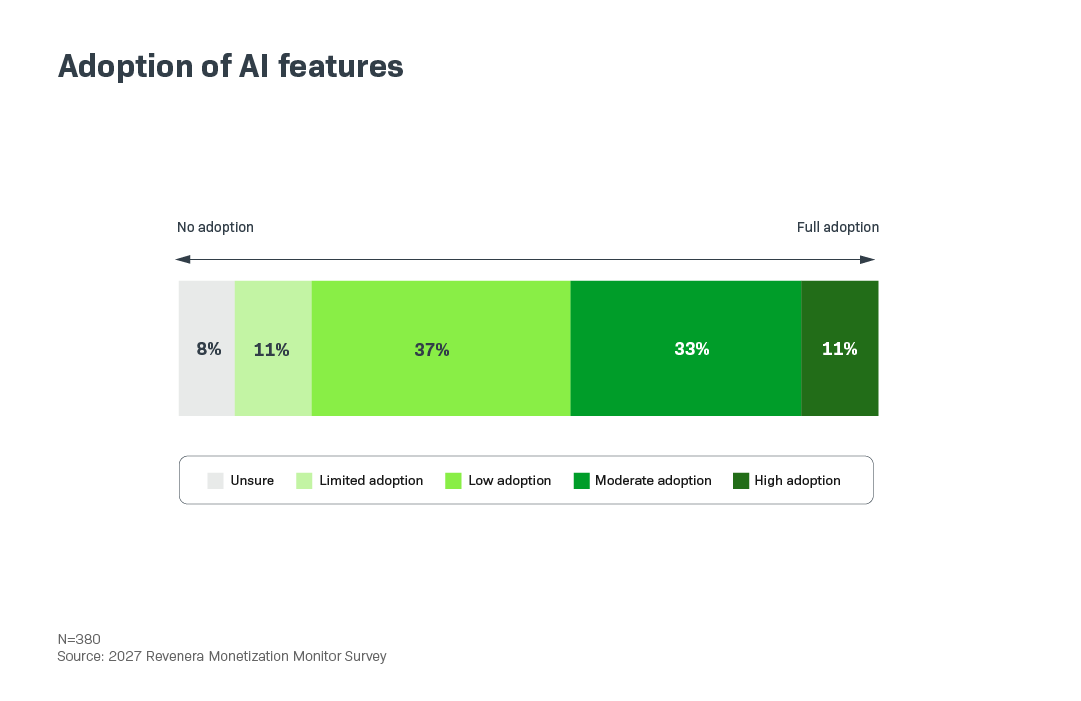
The Adoption Lag: Despite widespread feature availability, almost half (nearly 50%) of surveyed technology leaders report that actual customer adoption of their AI features remains limited or low.
Limited Seat Loss: Contrary to early fears of mass job and seat displacement, only 7% of software producers report experiencing actual seat loss due to AI agents automating human workflows.
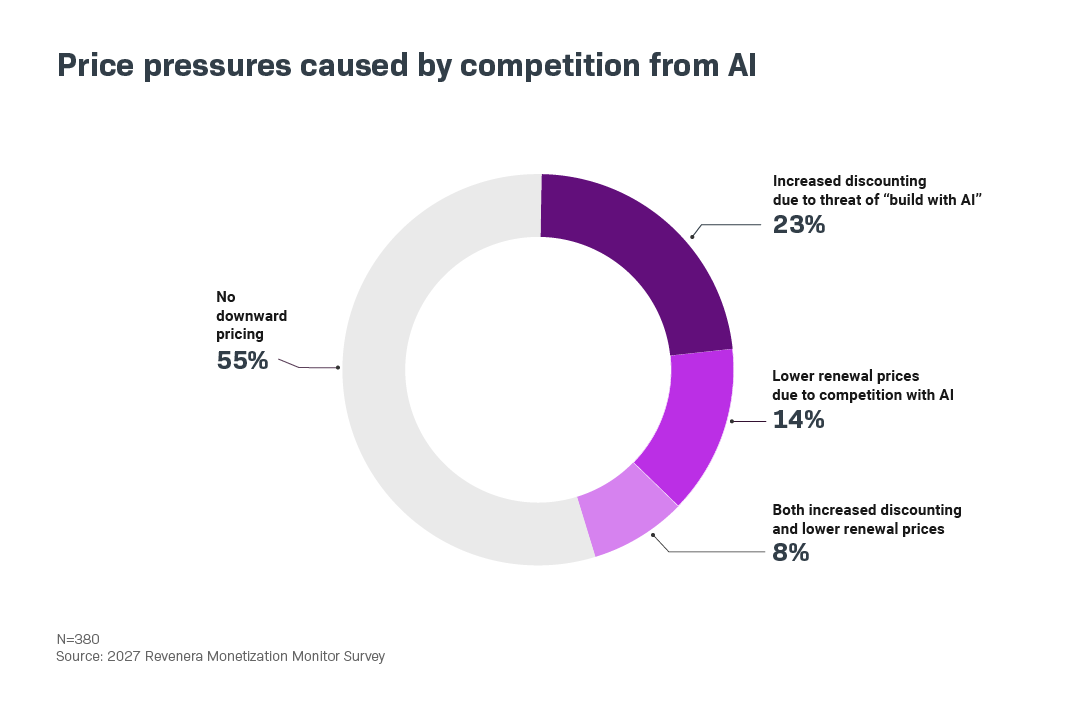
The Rise of Pricing Pressure: Nearly half of all software vendors report facing downward pricing pressure. This is driven less by automated job loss and more by buyers using DIY AI alternatives as negotiating leverage, alongside tightening enterprise software budgets.
Predictability Over Short-Term Gains: Established software producers are nearly three times more likely to prioritize cost predictability for their customers than maximizing near-term revenue.
Chronology: From "SaaSpocalypse" to Pragmatic Evolution
To understand where software monetization stands today, it is essential to trace how the market arrived at its current crossroads over the past eighteen months.
Early 2026: The "SaaSpocalypse" and AI-Native Disruption
The year began under a dark cloud for traditional SaaS providers. Following aggressive breakthroughs in autonomous AI agents, financial markets panicked over the prospect that companies would no longer need dozens or hundreds of human-operated software seats. Software stocks suffered sharp selloffs as investors questioned the longevity of per-seat licensing models.
Concurrently, AI-native infrastructure companies introduced dynamic, consumption-based pricing. Because training and executing large language models incur massive, variable compute costs, charging by the token or API call felt like a natural economic alignment.
Mid 2026: The Reality Check and Bill Shock
As enterprise adoption broadened, a secondary phenomenon emerged: "AI bill shock." Organizations that had eagerly adopted consumption-based pricing found themselves blindsided by volatile monthly invoices. CFOs balked at unpredictable expenses, pushing back against pure pay-as-you-go models.
At the same time, traditional software companies—those managing complex portfolios spanning SaaS, on-premises, embedded, and edge environments—realized they could not simply flip a switch and abandon decades-old multi-product contracts in favor of token meters.
Late 2026 to 2027: The Pivot to Hybrid and Tiered Models
Entering 2027, the industry has settled into a pragmatic middle ground. Software producers are discovering that AI cannot simply be jammed into existing pricing structures without careful orchestration. Instead of copying AI-native startups, established players are focusing on evolutionary packaging: bundling AI into premium tiers, offering usage limits, and adopting hybrid models that combine steady recurring subscriptions with transparent consumption thresholds.
Supporting Data: What the Numbers Tell Us
Data from the Revenera Monetization Monitor highlights the friction points and strategic shifts defining the current market landscape.
1. The Strategy Breakdown: How Companies Price AI Today
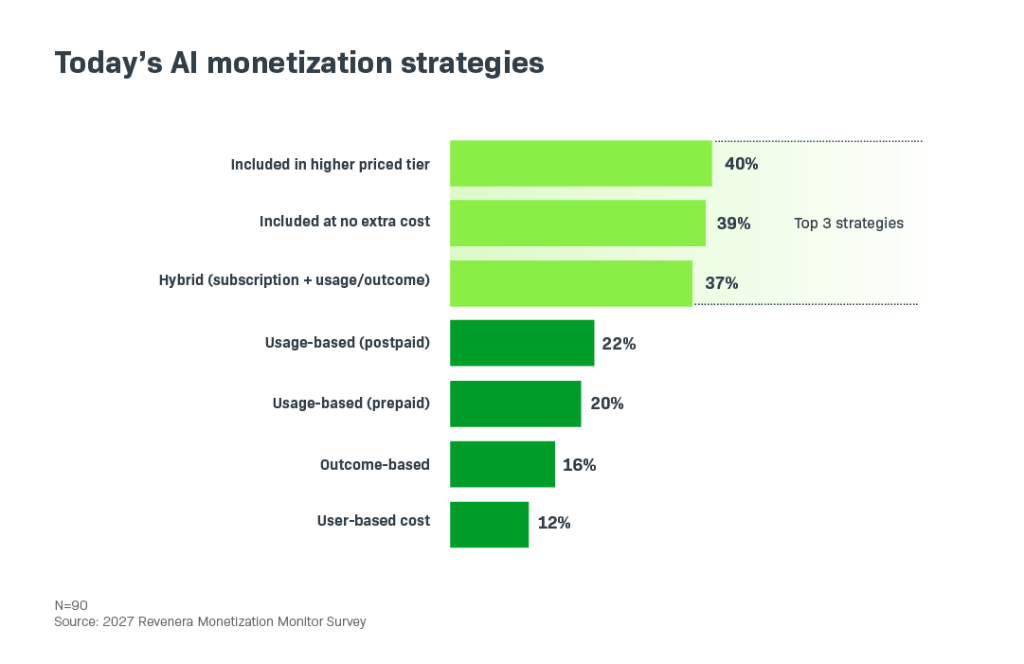
Rather than racing toward pure consumption pricing, established software producers are relying on three primary monetization strategies:
Higher-Priced Subscription Tiers: Placing advanced AI capabilities behind a premium paywall (e.g., Enterprise or Platinum tiers).
Value-Add Inclusion: Providing basic or core AI features at no additional charge to drive initial adoption and user familiarity.
Hybrid Models: Combining a baseline recurring subscription with bundled usage allowances, followed by usage-based or outcome-based overage fees.
Over the next 18 months, industry leaders expect predictability-oriented approaches to vastly outperform pure usage-based models within traditional enterprise portfolios.
2. Profitability vs. Margin Pressure
While more than half of surveyed companies report improved profitability and incremental revenue growth stemming from AI, the financial picture is far from straightforward.
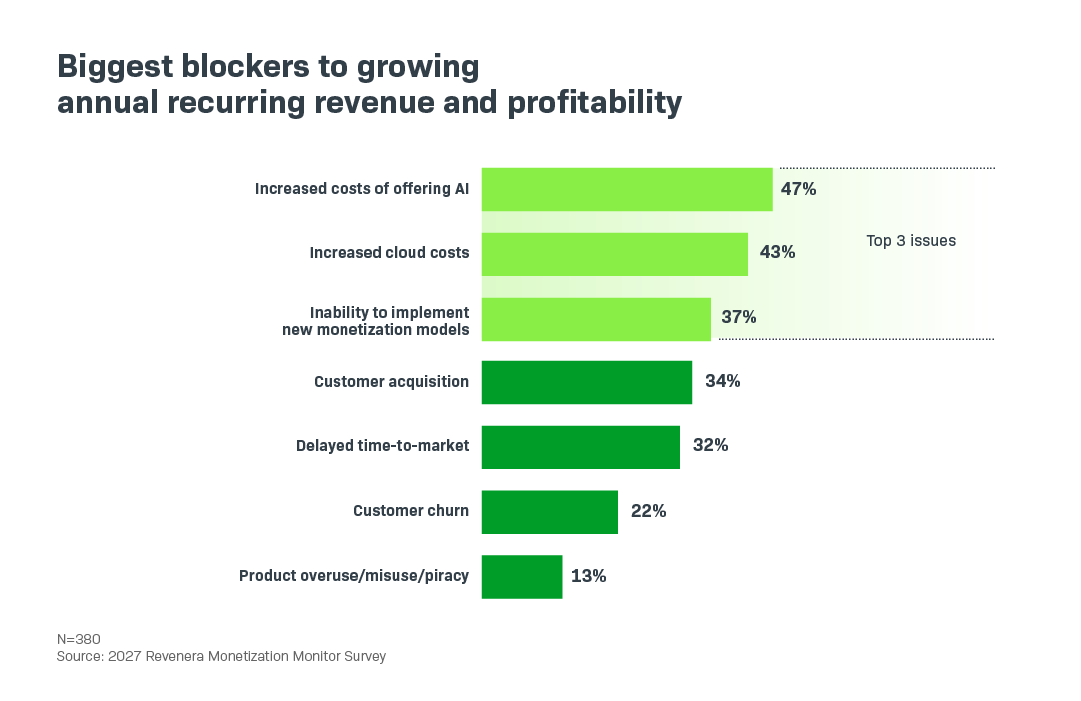
Increased AI delivery costs and escalating cloud infrastructure expenses now rank among the top barriers to growing Annual Recurring Revenue (ARR). Furthermore, many organizations cite their own internal inability to implement new monetization models quickly enough as a major operational bottleneck. Consequently, AI can simultaneously generate top-line revenue growth while applying severe pressure to operating margins.
3. The Visibility Blind Spot
Perhaps the most foundational hurdle uncovered by the research is a widespread lack of internal data. A significant percentage of software organizations either lack clear, granular visibility into how their customers actually interact with AI features or rely entirely on manual analysis and custom engineering work to unearth those insights.
Without knowing who is using a feature, how frequently, and which specific workflows drive ROI, product teams struggle to answer a fundamental question: What metric should we price against?
Official Responses and Industry Perspectives
Industry leaders emphasize that the rules of software engagement have fundamentally changed, requiring a shift in mindset from static product development to continuous monetization management.
"Successfully monetizing AI features starts with better visibility into how customers use software, where they find value, and which capabilities actually drive engagement," notes Nicole Segerer, General Manager at Revenera.
Segerer points out that legacy software vendors operate under constraints entirely foreign to Silicon Valley AI startups: "They aren’t replacing their businesses with a new AI pricing model. They are figuring out how AI fits into products and commercial models that already exist."
According to enterprise tech strategists, the winners of the 2027 software landscape will not be the companies that happen to guess the "right" pricing model on day one. Rather, competitive advantage will belong to organizations agile enough to alter their packaging dynamically as technology and customer expectations mature.
Implications: Navigating the 2027 Software Landscape
As the market continues to mature, software executives, product managers, and pricing strategists must confront several profound implications:
Evolution Over Revolution
Traditional software companies must abandon the pressure to adopt aggressive, AI-native pricing models overnight. A phased, evolutionary approach is far more sustainable:
Stage 1 (Adoption): Include AI features at no additional charge to lower barriers to entry, build user familiarity, and gather crucial usage data.
Stage 2 (Tiering & Guardrails): Move proven capabilities into higher-priced subscription tiers, incorporating usage limits to insulate the business against runaway compute costs.
Stage 3 (Hybrid Maturity): Once usage patterns stabilize and become predictable, transition mature features into hybrid models that blend base subscriptions with transparent consumption or outcome-based metrics.
Granular Analytics as a Strategic Imperative
Usage data can no longer be viewed merely as a technical requirement for billing engines. It is a core strategic input. Companies must invest in telemetry and analytics infrastructure that isolates feature-level engagement. Without this visibility, businesses cannot distinguish between an AI feature that fails to deliver value and one that is simply packaged or introduced ineffectively.
Sustainable Unit Economics
The ultimate test for enterprise software in 2027 is no longer “Can we charge for AI?” but rather “Can we charge for AI in a way that supports sustainable long-term economics?” Managing cloud delivery costs, streamlining monetization release cycles, and protecting profit margins while scaling AI features will separate market leaders from those weighed down by invisible compute expenses.
Ultimately, the 2027 software economy belongs to organizations that treat monetization not as a static contract negotiation, but as an ongoing, data-driven dialogue with their customers.