







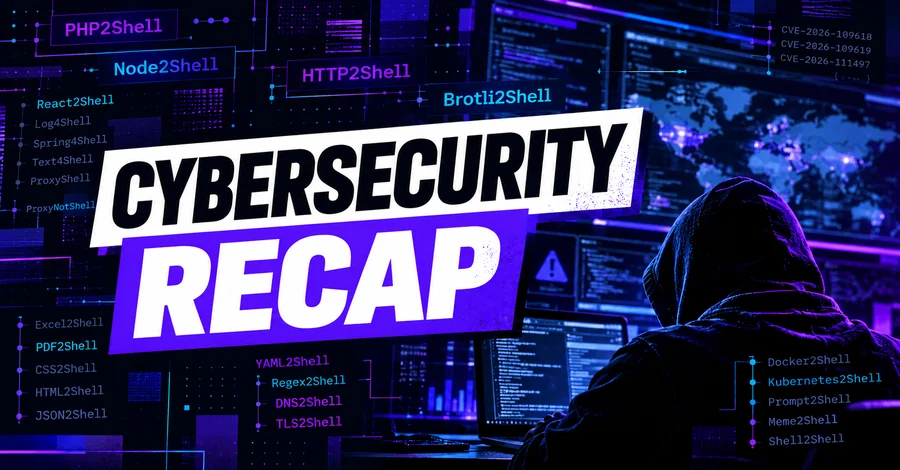
Global Security Operations Centers (SOCs) have faced one of the most punishing weeks in recent memory. A relentless cascade of critical vulnerabilities—dominated by a new wave of remote code execution (RCE) flaws colloquially dubbed the “X2Shell” phenomenon—has pushed enterprise defense teams to their absolute breaking point.
From ubiquitous web frameworks like PHP and Node.js to foundational enterprise infrastructure from Cisco, Oracle, Splunk, and Atlassian, the attack surface expanded exponentially over a span of just seven days. Security professionals are no longer just fighting fires; they are managing a raging wildfire where software supply-chain compromises, AI agent manipulation, and classic authentication bypasses are colliding simultaneously.
Main Facts: The Anatomy of an Unprecedented Patch Storm
The defining characteristic of the week’s threat landscape was the sheer velocity and severity of unauthenticated remote code execution bugs. Leading the charge was the sudden disclosure of PHP2Shell—comprising critical vulnerabilities CVE-2026-109618 and CVE-2026-109619—which forced the PHP Foundation to scramble patches. Because PHP underpins a massive percentage of the dynamic web, the response was immediate and frantic. Cloudflare reported recording millions of automated scanning and exploitation attempts within hours of public disclosure.
Compounding the crisis was Node2Shell (CVE-2026-111497), a severe flaw affecting Node.js ecosystems via Brotli data compression handling that similarly allows threat actors to achieve unauthenticated RCE.
This barrage of "X2Shell" vulnerabilities underscores a troubling reality: foundational software components that have been trusted for decades are increasingly proving to be fragile pillars. When combined with a leaked software supply-chain key, widespread exploitation of legacy bugs, and emerging threats targeting AI frameworks—such as those discovered across Coze Studio, Letta, and Langchain-Chatchat—defenders found themselves overwhelmed by the sheer volume of high-severity CVEs demanding immediate attention.
Chronology of Events: A Week in Review
The unfolding of the crisis followed a brutal, non-stop timeline that left little breathing room for security teams:
- Early Week — The Discovery Wave: The security research community initiated a coordinated or near-simultaneous dump of critical advisories. Major enterprise software vendors, including Cisco, Oracle, Atlassian, and GitLab, pushed emergency security patches for dozens of high-severity vulnerabilities.
- Mid-Week — The "X2Shell" Explosions: Public disclosures surrounding PHP2Shell and Node2Shell triggered automated botnets worldwide. Threat actors weaponized the flaws almost instantly, scanning the global IP space for vulnerable servers. The sheer volume of incoming traffic forced several high-profile web services to temporarily take their portals offline as a precautionary containment measure.
- Late Week — Supply Chain & AI Vectors: Attention shifted toward secondary vectors. Security analysts grappled with a software supply-chain breach stemming from a leaked cryptographic key, while AI security firms highlighted a slew of vulnerabilities (such as
CVE-2026-77934and related identifiers) showing that artificial intelligence agents could be easily tricked via indirect prompt injection and insecure deserialization. - Weekend — Triage and Remediation: SOC teams spent the weekend frantically prioritizing thousands of newly issued CVEs, attempting to patch zero-day exposures and implement network-level mitigations where updates were not yet available.
Supporting Data: The Expanding Vulnerability Matrix
The breadth of this week’s software vulnerabilities is staggering. A comprehensive review of the active threat register reveals critical updates across nearly every major technology stack:
Core Infrastructure & Web Technologies
- PHP:
CVE-2026-109618,CVE-2026-109619, andCVE-2026-115560(PHP2Shell and associated unauthenticated RCE vectors). - Node.js / Brotli:
CVE-2026-111497(Node2Shell). - Cisco: A massive advisory block spanning
CVE-2026-20043throughCVE-2026-20356andCVE-2026-76466toCVE-2026-76481. - Oracle: Critical patches issued under
CVE-2026-91403, part of a broader cycle addressing over 1,200 vulnerabilities. - Splunk: Multiple high-severity flaws including
CVE-2026-76299,CVE-2026-76302,CVE-2026-76531, andCVE-2026-76407.
Enterprise Software & Collaboration Tools
- Atlassian: A sweeping set of patches covering Fisheye, Crucible, Crowd Data Center, Confluence Data Center, Jira Service Management, and Bamboo Data Center (e.g.,
CVE-2026-77185,CVE-2026-65182,CVE-2026-58062). - GitLab:
CVE-2026-110264(addressing critical regex and authorization flaws). - WordPress Ecosystem: Wordfence Argus discovered
CVE-2026-82814, a high-severity unauthenticated PHP object injection vulnerability in the ubiquitous Duplicator and Duplicator Pro plugins. - Google Chrome: Critical stable channel updates patching memory safety issues (
CVE-2026-113341,CVE-2026-113279,CVE-2026-113072, etc.).
AI and LLM Frameworks
The week also highlighted the vulnerability of modern AI infrastructure, with a wave of CVEs assigned to agentic workflows and machine learning integration platforms:
- Coze Studio:
CVE-2026-77934 - DB-GPT:
CVE-2026-77933,CVE-2026-77932 - Letta:
CVE-2026-77936,CVE-2026-77937 - Langchain-Chatchat:
CVE-2026-75128 - Additional framework vulnerabilities affected EvoScientist, MaxKB, Yuxi, OpenSRE, and LangAlpha.
Official Responses and Industry Guidance
In the wake of the disclosures, major technology vendors and cybersecurity authorities issued urgent advisory statements.
The PHP Foundation emphasized the necessity of immediate patching, while content delivery networks like Cloudflare stepped up edge-filtering rules to block malicious payloads targeting PHP2Shell and Node2Shell before they could reach origin servers. Wordfence and other application-security firms released emergency firewall signatures to protect WordPress installations from object injection exploits.
Furthermore, artificial intelligence security specialists—such as Lasso Security, which cataloged many of the LLM-related CVEs—urged developers to treat AI agent integrations with the same rigorous access controls and input-validation standards applied to traditional databases and web APIs. The consensus among official bodies is unanimous: traditional perimeter defenses are insufficient against multi-vector attacks that combine supply-chain exposure with unauthenticated code execution.
Implications: The New Normal of Cyber Resilience
The events of this past week serve as a sobering wake-up call for the cybersecurity industry. Several critical implications emerge from this crisis:
- The Shrinking Window of Exploitation: The gap between the public release of a vulnerability and active, automated exploitation in the wild has effectively closed. Attackers are leveraging automated scanning infrastructure to weaponize CVEs within minutes of disclosure.
- The Expansion of the Attack Surface: As organizations adopt modern AI agents, complex containerized runtimes (like Xorbits Xoscar or SPIP plugins), and distributed cloud services, the number of entry points for malicious actors multiplies. Securing traditional endpoints is no longer enough; every layer of the software stack—from base language runtimes to third-party plugins—must be continuously audited.
- The Cost of Inaction: The fact that several organizations chose to take their web properties completely offline rather than risk compromise demonstrates the extreme pressure on IT leadership. Relying on "security through obscurity" or delaying patches is no longer a viable operational strategy.
Conclusion
If this week was not a sufficient warning, it is difficult to imagine what will be. Critical remote code execution bugs are piling up faster than organizations can patch them, automated botnets are hammering newly exposed doors, and the inclusion of AI and supply-chain vectors has made threat management exponentially more complex.
The immediate directive for security teams is clear: do not wait for proof of an active breach before taking action. Conduct rapid asset discovery, apply emergency patches to high-severity vectors immediately, lock down exposed services that cannot be patched instantly, and treat any leaked credentials or keys as a five-alarm emergency. In a threat landscape where attackers only need one open door to compromise an entire enterprise, leaving even a single vulnerability unmitigated is a risk no organization can afford to take.