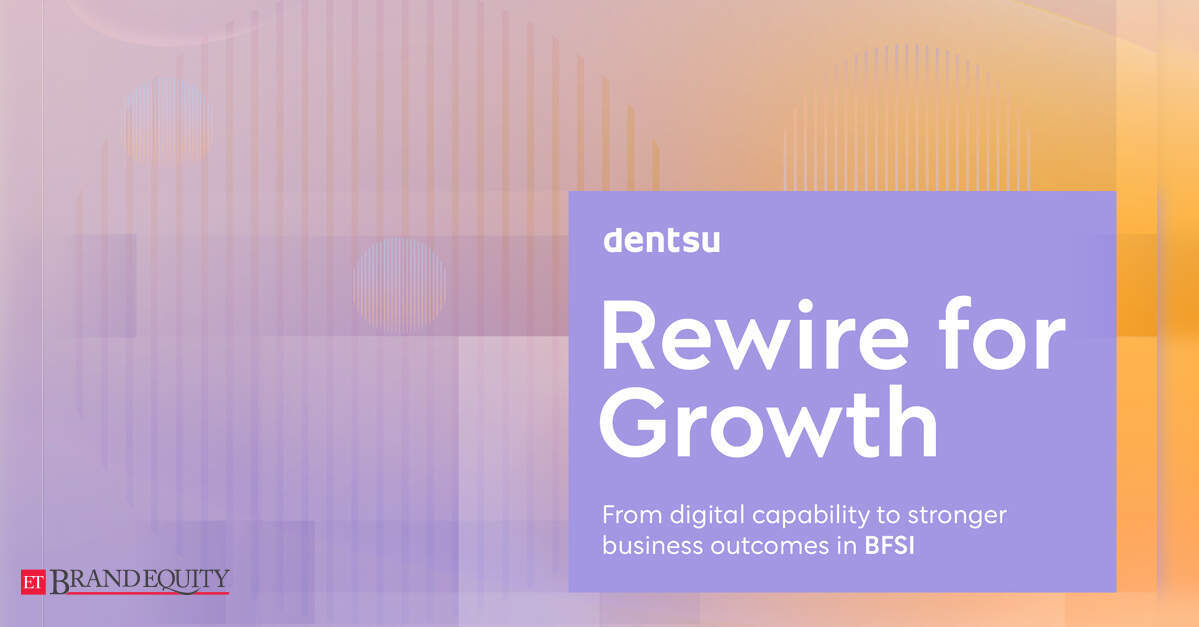
Beyond Digitization: Dentsu India’s ‘Rewire for Growth’ Report Maps the Future of BFSI
The Banking, Financial Services, and Insurance (BFSI) sector in India—and indeed globally—has spent the last decade in a relentless pursuit of digital transformation. From the adoption of mobile banking apps to the integration of sophisticated AI-driven chatbots, the sector has successfully digitized its front-end operations. However, a new report from Dentsu India, titled “Rewire for Growth,” suggests that this initial wave of digital adoption has reached a point of diminishing returns.
The report posits a fundamental shift in the growth agenda: the era of "fragmented technology metrics" is over. To capture the next frontier of market share, financial institutions must stop treating AI and digital as standalone features and start integrating them into a cohesive, customer-centric commercial strategy.
The Core Thesis: Moving Beyond the "Digital Mirage"
For years, the success of BFSI transformation projects was measured by the number of active users on an app, the volume of digital transactions, or the speed of an onboarding process. Dentsu’s Rewire for Growth report argues that while these metrics are important, they are essentially "hygiene factors." They no longer provide a competitive advantage because they have become industry standard.
The report identifies a common pitfall: financial institutions are increasingly siloed. Marketing, sales, product development, and IT departments often operate in bubbles, each optimizing for their own departmental KPIs rather than the total customer journey. This leads to what the report describes as the "growth gap"—the disconnect between a marketing signal and the actual fulfillment of a customer’s need.
To bridge this gap, Dentsu suggests a radical "rewiring" of the enterprise. This involves aligning functional teams around specific business outcomes—such as increasing the lifetime value of a customer or reducing the friction in complex insurance claims—rather than merely optimizing technology silos.
Chronology of the Shift: From Digitization to Value Realization
To understand the necessity of this report, one must look at the evolution of the BFSI sector over the last decade:
2014–2017: The Digital Onboarding Phase. Banks and insurance firms focused on moving customers from physical branches to digital platforms. The priority was volume, reach, and accessibility.
2018–2021: The AI and Data Proliferation Phase. Institutions began utilizing data analytics to personalize marketing and automated AI to handle customer support. However, these tools were often implemented as "add-ons" rather than core structural shifts.
2022–2024: The Integration Crisis. The market has reached a state of saturation. Most customers are already digital. The problem is no longer "getting them on the app," but keeping them engaged and profitable.
The Present Moment: Dentsu’s report arrives at a time when BFSI leaders are questioning the ROI of their massive technology spending. The focus has pivoted toward "value realization"—using AI not just for efficiency, but for driving specific commercial outcomes.
Official Perspectives: The Leadership View
The leadership at Dentsu South Asia emphasizes that the "Rewire for Growth" framework is not a call to abandon technology, but a call to humanize and synchronize it.
Harsha Razdan, CEO, South Asia, Dentsu, notes the shift in the executive mindset required for this new era:
"BFSI has come a long way on digital and data, and AI is now raising the stakes. The institutions that create the most value will be those that decide clearly where they want to grow and organise the enterprise around that choice."
Razdan’s point touches on the concept of strategic focus. In a world of infinite data, many institutions suffer from "analysis paralysis." The report suggests that successful firms will be those that narrow their focus to specific, high-value growth levers rather than trying to optimize every metric simultaneously.
Narayan Devanathan, President and Chief Strategy Officer, South Asia, Dentsu, highlights the structural friction that prevents growth:
"In BFSI, growth rarely breaks at one point. It breaks in the gaps between teams, between a signal and a fulfilled customer, or between acquisition and long-term value."
Devanathan’s observation is critical. Often, an acquisition campaign might be highly successful, but if the fulfillment process is slow or the long-term engagement strategy is disjointed, the cost of acquisition (CAC) outweighs the lifetime value (LTV). Dentsu’s research emphasizes that growth is a continuous thread, not a series of isolated events.
Strategic Implications: Why "Rewiring" is Essential
The report outlines several key areas where BFSI firms must pivot to maintain growth momentum:
1. From Product-Centric to Journey-Centric
Financial products are increasingly becoming commodities. A credit card or a savings account from one bank is often functionally identical to one from another. The differentiator is the "journey." By mapping the customer journey—from the moment a user realizes a need to the moment the service is delivered—firms can identify the friction points that cause churn.
2. Breaking the Functional Silos
The most successful organizations are those that form cross-functional "squads." Instead of Marketing, Sales, and IT working separately, these teams should be organized around specific customer segments or product lines. This allows for rapid iteration and ensures that technology choices are driven by business requirements, not just technical specifications.
3. AI as a Commercial Engine
The report argues that AI should move from the back office (cost reduction/automation) to the front office (revenue generation). Using AI to predict when a customer is likely to need a loan, or to proactively offer an insurance product based on life events, is the future of BFSI growth.
Supporting Data and Market Context
While the specific quantitative data of the report focuses on the qualitative shifts in industry strategy, the broader market context supports Dentsu’s findings. Recent industry trends show:
Increased CAC: Customer Acquisition Costs have risen by approximately 20% year-over-year in the Indian financial sector due to intense competition and higher digital marketing spend.
Tech Spend Saturation: Global banking spend on IT is expected to reach new heights in 2024, yet many executives report that their "digital transformation" efforts have failed to meet revenue targets.
The AI Imperative: According to recent industry surveys, over 75% of financial services firms are currently testing or deploying Generative AI, but only a small fraction have successfully integrated it into their core business workflows.
Dentsu’s report serves as a timely intervention for these firms, urging them to pivot from spending on tech to organizing for outcomes.
Challenges and Future Outlook
The transition proposed by Rewire for Growth is not without its challenges. It requires a significant cultural shift within legacy financial institutions. Many banks and insurance companies are burdened by technical debt and a risk-averse culture that discourages cross-functional collaboration.
However, the consequences of inaction are high. As fintech disruptors continue to enter the market with leaner, more integrated models, traditional institutions risk being relegated to "utility" providers—background infrastructure for the more agile, customer-facing platforms.
The Rewire for Growth report suggests that the winners of the next decade will be the "Adaptive Enterprises." These are the organizations that can:
Sense: Use data to pick up on subtle changes in customer behavior.
Respond: Reconfigure their internal teams and processes in real-time to address those behaviors.
Scale: Once a process is proven to drive value, standardize it across the enterprise.
Conclusion: The Path Forward
Dentsu India’s latest initiative is more than just a white paper; it is a strategic blueprint for the next phase of the BFSI revolution. By highlighting the limitations of current digital strategies, the report encourages leaders to stop viewing technology as a panacea and start viewing it as a component of a much larger, human-centric business strategy.
For the BFSI sector, the message is clear: The "digital" phase is complete. The "growth" phase, powered by deep integration, cross-functional collaboration, and outcome-oriented thinking, has just begun. As the industry moves forward, the institutions that succeed will not be those with the most advanced AI models, but those that can best bridge the gaps between their teams, their technology, and their customers.
In the words of the report, it is time to stop measuring the technology and start measuring the business. The future of BFSI growth lies in the seamless, human-centric delivery of value—a goal that requires a fundamental rewiring of the traditional enterprise.