










For the modern data professional, the web browser is not merely a utility; it is a primary workspace. The daily rhythm of a data scientist or analyst involves a high-velocity cycle of reviewing model cards on Hugging Face, deciphering complex research papers on arXiv, navigating sprawling GitHub repositories, and synthesizing internal business intelligence.
Over the past two years, AI assistants have been grafted onto this workflow. However, the convenience of tools like Gemini, ChatGPT, and Perplexity often masks a significant architectural cost: the erosion of data privacy. As these tools ingest sensitive documentation, proprietary code, and unreleased architectures, they often route that data through cloud servers, where it may be logged, stored, or used to train future iterations of the model.
For those operating in high-stakes environments—handling client research, confidential datasets, or trade secrets—the standard "convenience over privacy" tradeoff is becoming untenable. This is where Brave Leo enters the conversation. By integrating an AI assistant directly into the browser architecture, Brave offers a privacy-first alternative that challenges the status quo of how we interact with LLMs in a professional capacity.
The Architectural Shift: Why Privacy Matters in AI Browsing
To understand the necessity of Leo, one must first look at the "hidden" mechanics of mainstream browser AI. When you trigger an assistant in a standard browser, you are frequently engaging in a data-sharing agreement you may not have fully vetted.
The Problem with Mainstream Models
- Google Gemini (Chrome): Google’s documentation explicitly warns against sharing sensitive information. On consumer tiers, human reviewers may access anonymized snippets of conversations, and inputs are utilized for model improvement by default.
- Perplexity: While a powerhouse for research, it operates on a cloud-first infrastructure. Queries and the content of the pages you are analyzing are routed to remote servers for processing.
- Safari (Apple Intelligence): While Apple’s on-device processing is a gold standard for privacy, it is restricted to Apple’s hardware ecosystem, leaving Linux and Windows-based data professionals without a comparable native solution.
The Leo Advantage
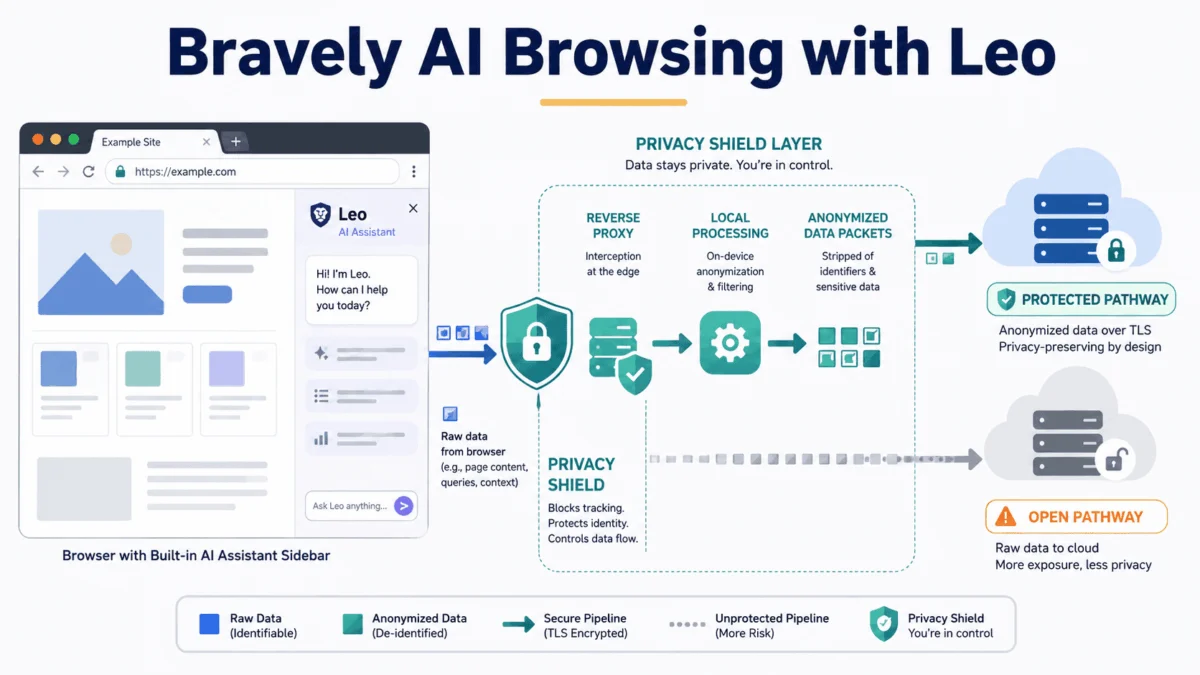
Brave Leo operates on a fundamentally different paradigm. Queries are routed through a reverse proxy that effectively strips the user’s IP address before the request reaches the model. Most importantly, conversations are transient; they are discarded immediately after the response is generated. There is no training on user input, no persistent logging, and no requirement for an account—even on the free tier. For the data professional, this means the browser ceases to be a potential leak point for proprietary intellectual property.
Chronology of a Privacy-First Assistant
Brave’s journey into the AI space has been marked by a rapid, feature-dense rollout designed to capture the attention of technical users:
- Initial Launch: Brave introduced Leo as an integrated, sidebar-based AI assistant, eliminating the need for third-party extensions.
- December 2025: The introduction of "Skills" allowed users to create reusable, chain-of-thought prompt sequences, shifting Leo from a simple chatbot to an automated research assistant.
- April 2026: The release of Brave Ocelot, a local-first summarization model, marked a major milestone by allowing inference to occur entirely on the user’s hardware.
- May 2026: Early access to Agentic Browsing enabled Leo to autonomously navigate and complete multi-step tasks within an isolated, sandboxed browser profile.
Supporting Data: The Model Ecosystem
Brave Leo’s strength lies in its versatility. While many assistants lock users into a single proprietary model, Leo offers a tiered approach that balances accessibility with high-performance requirements.
The Free Tier
Designed for daily consumption, the free tier provides access to capable models without requiring registration. For 90% of technical tasks—summarizing documentation, explaining snippets of code, or extracting evaluation metrics from research papers—this tier is highly performant.
Leo Premium ($14.99/mo)
For power users, Premium unlocks the "frontier" models, including Claude Sonnet 4, DeepSeek R1, and Kimi K2.5. Crucially, the privacy model remains identical to the free version; the payment system uses a tokenized credential system that ensures financial data remains cryptographically separated from chat history.
The BYOM (Bring Your Own Model) Feature
Brave has acknowledged the needs of enterprise-level data scientists by implementing a BYOM system. This allows users to connect local LLMs (running via Ollama or similar frameworks) or plug in their own API keys for proprietary enterprise models. This ensures that even the most sensitive analysis can be conducted within a "walled garden" of the user’s choosing.
Practical Workflows for the Modern Data Professional
The true value of Leo is its "page-awareness." Unlike a standard ChatGPT window where you must copy-paste content, Leo has direct access to the active DOM (Document Object Model).
1. Research Synthesis and Literature Review
Instead of manually reading 40-page arXiv papers, users can keep the PDF open in Brave and prompt Leo:
"Extract the evaluation metrics from the results section, explain the primary loss function used, and summarize the limitations mentioned in the conclusion."
Leo parses the document natively, providing concise, structured outputs without ever sending your sensitive, draft-stage research to a third-party server for logging.
2. Technical Documentation and Code
When working with new libraries, developers often struggle with outdated or sprawling documentation. Leo can parse entire documentation pages to generate boilerplate code that matches the specific version described in the current tab. Its ability to "read" the context of the page prevents the hallucinations often caused by generic models that rely only on outdated training data.
3. Transcript Analysis
YouTube has become a primary repository for technical knowledge. By opening a conference talk (such as a NeurIPS presentation), Leo can digest the transcript in seconds. This allows professionals to filter for relevant sections, skipping the filler to reach the core architectural contributions or experimental setups.
Implications: The Future of Browser-Based AI
The integration of agentic browsing and local-first models like Ocelot suggests a shift in the AI landscape: the browser is becoming the "operating system" for AI.
A Balanced AI Stack
It is important to note that Leo is not intended to be a monolithic replacement for all AI tools. Data professionals should maintain a hybrid workflow:
- Use Leo for proprietary documentation, internal dataset analysis, and tasks requiring high privacy.
- Use Perplexity for live, public-domain web research, citations, and fast-moving news where web-crawling is essential.
- Use Local Models (Ollama/LM Studio) for strictly air-gapped, sensitive data processing.
The "Privacy-First" Standard
The success of Brave Leo signals that the industry is beginning to treat privacy as a feature, not a secondary concern. As AI-powered browsing becomes the standard, professionals will increasingly demand that their tools provide the same level of security as their IDEs.
Official Perspective and Limitations
Brave maintains transparency regarding what Leo cannot do. It is not an autonomous web-crawler; if you ask for information that does not exist on the current page or in its training data, it will not hunt for it across the open web. It lacks image generation and persistent, long-term memory across sessions—a deliberate choice to minimize the data footprint of the user.
For those seeking persistent project memory or multi-modal generation, external enterprise tools remain superior. However, for the data professional who prioritizes security, speed, and context-aware analysis, Brave Leo offers a compelling case for migration.
Final Thoughts: A Call to Re-evaluate
Many data professionals are still using the same browser AI stack they adopted in 2024. In the fast-evolving landscape of 2026, this is a missed opportunity. The structural decision to use a browser that treats your data as a liability rather than an asset is one of the most impactful security choices a professional can make.
By leveraging tools that prioritize privacy-first architecture, you aren’t just protecting your work—you are ensuring that your most valuable insights remain under your control, exactly where they belong. Whether you are conducting exploratory data analysis or documenting proprietary model architectures, Brave Leo provides the utility of an AI assistant without the existential risk of the cloud.



