Beyond the Scroll: Instagram’s Grand Leap Into 90-Minute Widescreen Video and the Battle for the Living Room
By Manisha Priyadarshini Tech & Entertainment Desk
Main Facts: A Paradigm Shift for Meta’s Flagship App
Instagram is fundamentally reshaping its platform identity, moving far beyond the bite-sized vertical Reels and square photo grids that defined its previous decade. In a sweeping update that signals a direct challenge to long-form video giants like YouTube, the Meta-owned platform is expanding testing for "Features"—a new format allowing select creators to upload horizontal, widescreen videos running up to 90 minutes long.
Initially piloted among content creators in Brazil, this ambitious long-form video test is scaling up significantly, rolling out to tens of thousands of creators across the United States.
The core mechanics of Features are designed to bridge the gap between fast-paced discovery and immersive viewing. Users browsing through their usual short-form Reels feed might stumble upon a 30-second teaser for a podcast, comedy special, or serialized documentary. With a single tap, the platform seamlessly connects that snippet to the full-length episode.
Furthermore, this pivot is not confined to smartphones. Instagram is aggressively expanding its footprint into the living room. Alongside its mobile rollout, the platform is optimizing long-form, horizontal content for television screens via dedicated apps for Samsung TV, Fire TV, Google TV, and newly announced integration with Apple TV. By introducing episodic "Series," expanding live-streaming visibility, and supporting cross-device playback, Instagram is shedding its skin as a mere mobile distraction tool, positioning itself as a full-fledged home entertainment hub.
Chronology: The Evolution from Square Photos to Widescreen Epics
To understand the magnitude of Instagram’s latest strategy, it is necessary to trace how the platform transformed from a simple photo-sharing app into a multi-format video behemoth over the last several years:
October 2010: Instagram launches as a square-format photo-sharing application, focusing strictly on static imagery and rudimentary filters.
August 2016: Responding to the soaring popularity of Snapchat, Instagram introduces Stories, pioneering disappearing vertical content and conditioning users to consume ephemeral media.
August 2020: In a direct counter-offensive against TikTok, Instagram rolls out Reels, cementing vertical, short-form video as the platform’s primary growth driver and shifting algorithmic priorities away from traditional photo grids.
Early 2024–2025: As microdramas and episodic creator content surge in popularity globally, Instagram begins experimenting behind the scenes with sequential video playback and profile-based organization systems.
June 2026: Meta launches the Instagram for TV app on major smart TV operating systems—initially rolling out on Samsung TV, Fire TV, and Google TV—signaling a deliberate push out of the pocket and into the living room.
October 2026: Instagram officially kicks off international trials of "Features" in Brazil, testing 90-minute horizontal videos. Shortly after, the test expands to tens of thousands of creators across the United States, accompanied by the announcement of an Apple TV app and the development of episodic "Series" functionality.
Supporting Data and Technical Architecture
The rollout of 90-minute widescreen videos is backed by a robust structural framework intended to make long-form content friction-free for both creators and consumers:
Duration & Orientation: Creators can upload horizontal videos reaching up to 90 minutes in length, departing entirely from the traditional vertical-only guidelines enforced by standard Reels.
Geographic Scale: Following initial regional validation in Brazil, the test footprint immediately scales to tens of thousands of creators in the U.S.
Cross-Platform Accessibility: Content is engineered to perform seamlessly across dual ecosystems—handheld mobile devices and home theater environments via the Instagram TV ecosystem (Samsung, Fire TV, Google TV, and Apple TV).
Monetization & Advertising Integration: Existing ad placements are fully carried over into longer-form horizontal videos. Additionally, Instagram is developing algorithmic pathways to connect creators who lack pre-existing brand deals with new advertising opportunities.
Non-Exclusivity: Recognizing that major podcasters and digital creators already distribute content across multiple destinations, Instagram’s Features format imposes no exclusivity clauses, permitting creators to upload the exact same master files to competitor platforms like YouTube.
Official Responses and Strategic Vision
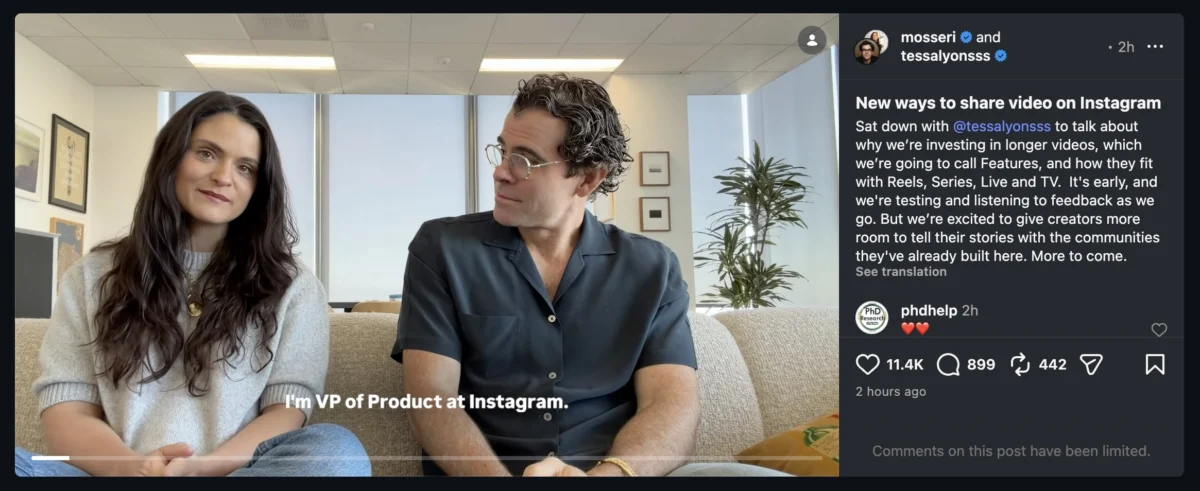
Meta leadership has been vocal about the necessity of this pivot, framing it as an organic response to how modern audiences consume media. Tessa Lyons, Vice President of Product at Instagram, detailed the philosophy driving the Features format during the rollout announcement.
"You’ll be able to click on a short clip of a podcast you love and jump straight into the full-length podcast or video behind it," Lyons explained, emphasizing the continuity between discovery and deep engagement.
Addressing the controversial introduction of horizontal video formats on a historically vertical-first app, Lyons noted that long-form content naturally demands a different physical environment.
"Horizontal, long-form content simply works better on a big screen, where most of the watching will eventually happen," Lyons stated.
This sentiment aligns with broader internal directives at Meta, which view the traditional smartphone screen as only the first step in a user’s journey. By enabling cross-device playback—allowing a user to start a video on their phone during a commute and seamlessly pick up at the exact same timestamp on an Apple TV or Samsung TV at home—Instagram is mimicking the user experience perfected by streaming giants like Netflix and YouTube.
Implications: The Looming Showdown with YouTube
Instagram’s transition into 90-minute widescreen videos carries profound implications for the digital media landscape, creator economies, and platform monopolies.
1. The Direct War on YouTube
For over a decade, YouTube has held an unchallenged monopoly over long-form creator content, mid-tier documentaries, podcast archives, and living room viewing habits. By introducing 90-minute horizontal capabilities alongside dedicated TV apps, Instagram is no longer just fighting TikTok for short attention spans; it is launching a direct assault on YouTube’s core domain. Creators who traditionally split their workflows—uploading short clips to TikTok and Instagram Reels while keeping full episodes exclusive to YouTube—now have a viable, unified alternative. Because Instagram imposes no exclusivity restrictions, creators can double-dip their distribution efforts without penalty.
2. Redefining the Creator Economy
The monetization implications for creators are substantial. Short-form video monetization has historically struggled to match the revenue-per-view metrics of traditional long-form advertising, largely because ads on Reels must be brief and non-intrusive. By incorporating traditional ad placements into 90-minute Features—and actively assisting un-monetized creators in securing brand deals—Instagram is creating a more lucrative ecosystem for podcasters, educators, and independent filmmakers.
3. Cultural and Psychological Shifts: The Living Room Takeover
The cultural impact of bringing Instagram into the living room cannot be overstated. Apps like Instagram and TikTok were originally architected to encourage solitary, mobile "doomscrolling." By moving these ecosystems onto home television screens via Apple TV, Google TV, and Fire TV, Meta is attempting to rebrand social media as a shared, ambient living room experience.
However, this transition also raises questions about user fatigue and screen time. While features like third-party physical app blockers (such as the newly released Brick Night device) attempt to combat late-night mobile doomscrolling in the bedroom, Instagram’s push toward passive, couch-based television viewing threatens to deepen user entanglement across all household screens.
Conclusion
Instagram’s introduction of 90-minute widescreen videos and living room apps marks the end of an era where the app could be easily categorized. No longer just a photo-sharing app or a short-form video clone, Instagram is maturing into an all-encompassing video utility. Whether audiences will willingly migrate their long-form viewing habits from YouTube to Instagram remains to be seen, but Meta’s strategic trajectory is unmistakable: they want to capture every single minute of your viewing time, from the palm of your hand to the biggest screen in your house.