










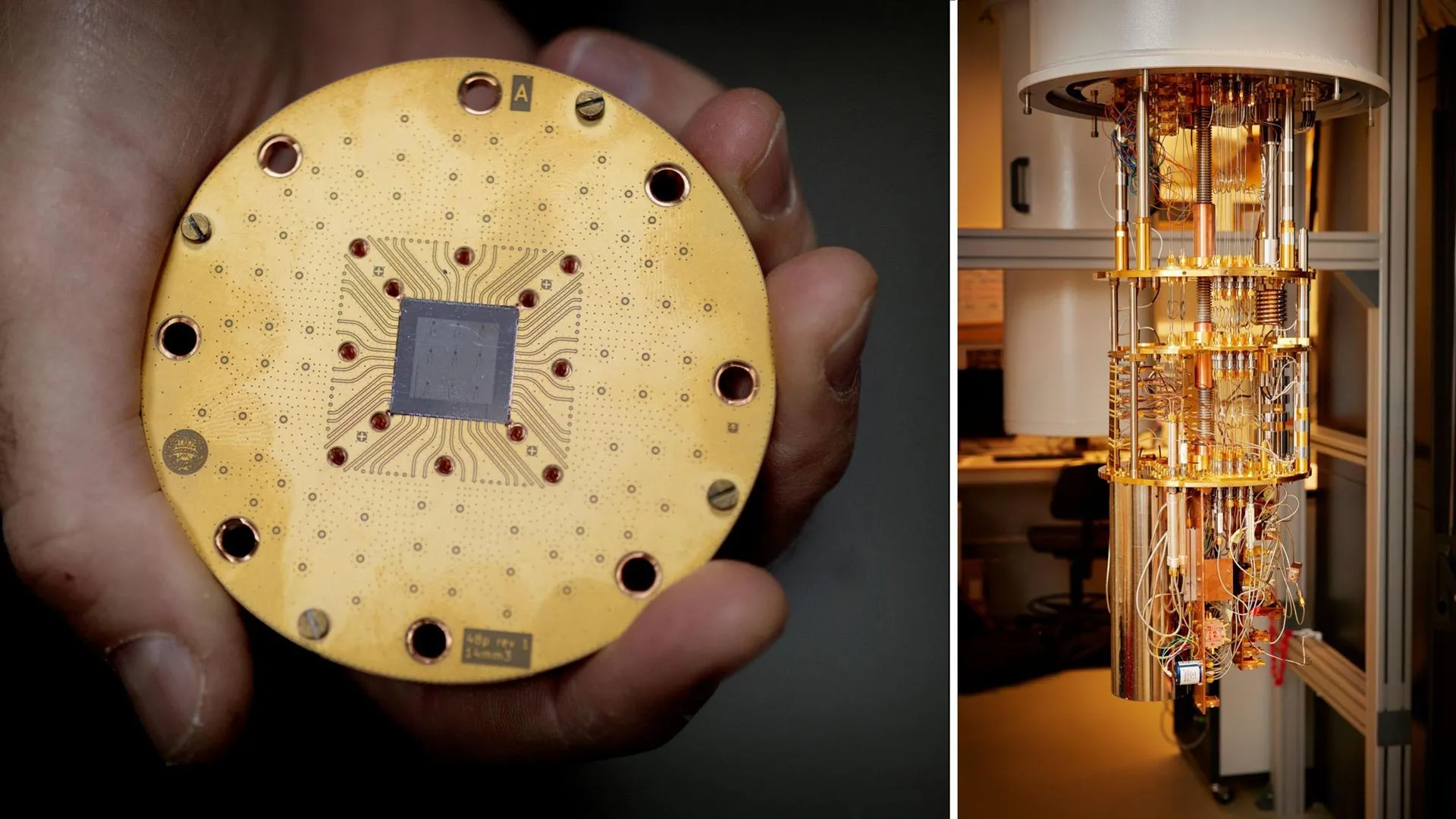
GOTHENBURG, Sweden — In the high-stakes global race to build commercially viable quantum computers, researchers at Chalmers University of Technology have unveiled a major breakthrough that could fundamentally alter the timeline of the industry. By slashing the time required to execute advanced quantum operations by a factor of more than one thousand, a team of applied physicists has effectively neutralized one of the most stubborn bottlenecks plaguing modern quantum architecture.
The peer-reviewed theoretical study, spearheaded by researchers Lei Du and Tangyou Huang in collaboration with Lingzhen Guo—spanning affiliations between Chalmers University of Technology and Tianjin University—was recently published in the prestigious journal Physical Review Letters. Their discovery introduces a novel method of controlling quantum states using "quantum lattice gates," offering a streamlined pathway that bypasses thousands of micro-operations that traditionally leave quantum systems open to catastrophic environmental corruption.
As technology giants and academic institutions alike pour billions of dollars into scaling up quantum hardware, the Chalmers breakthrough offers a vital stepping stone toward overcoming the Achilles’ heel of quantum mechanics: decoherence and error accumulation.
Chronology of the Breakthrough: From Fragile Qubits to Single-Cycle Control
To understand the magnitude of the Chalmers team’s achievement, it is necessary to trace the historical progression—and the persistent frustrations—of quantum computing development over the last three decades.
- The Early Decades (Late 20th Century – 2010s): Theoretical physicists established the mathematical foundations of quantum computing, demonstrating that phenomena like superposition and entanglement could exponentially outpace classical computing capabilities in specific domains. However, early experiments quickly ran into the harsh reality of quantum fragility. Every interaction with the outside world threatened to collapse a qubit’s delicate state.
- The Rise of Superconducting Circuits (2010s – Present): Researchers coalesced around several competing hardware modalities, with superconducting circuits emerging as a leading platform. Institutions worldwide—including Chalmers, which is currently spearheading the development of a homegrown 100-qubit quantum computer—began fabricating circuits cooled to temperatures colder than deep space.
- The Error Correction Bottleneck (Recent Years): While classical computers easily manage bit-flip errors via redundant checking, quantum information cannot simply be copied due to the no-cloning theorem. Scientists turned to advanced error-correcting paradigms, notably bosonic quantum codes, which store information in continuous variables like microwave fields rather than individual, isolated qubits.
- The Iterative Control Dilemma: Implementing bosonic codes historically required forcing quantum systems through thousands of repetitive driving cycles. Every cycle took precious time, acting like an open window during which ambient electrical noise, cosmic rays, and thermal fluctuations could corrupt the computation.
- The 2024–2025 Paradigm Shift: Moving away from iterative accumulation, Lei Du and Tangyou Huang developed a theoretical framework utilizing "quantum lattice gates" driven via Floquet control. By compressing thousands of driving steps into a single, cohesive operational period, the team achieved a speedup exceeding 1,000 times, published formally in Physical Review Letters.
Supporting Data and Technical Architecture: How Quantum Lattice Gates Work
To contextualize the Chalmers innovation, one must examine the physics of error accumulation and the mechanics of bosonic codes.
In standard quantum computing paradigms, information is mapped onto individual qubits. These components are hypersensitive; even microscopic thermal gradients or stray electromagnetic waves cause phase shifts and bit flips, collectively known as decoherence. If errors occur faster than the system’s error-correction protocols can identify and mend them, the entire calculation collapses into noise.
The Bosonic Advantage and the Speed Trap
To mitigate this, physicists developed bosonic quantum codes. Instead of scattering information across hundreds of vulnerable, discrete qubits, bosonic codes sequester quantum states inside the controlled microwave fields of superconducting resonators. This architecture inherently shields the data from certain classes of environmental noise.
However, manipulating these microwave fields to perform actual computations presented a compounding paradox:
- The Old Method: To shape and control bosonic states, researchers relied on iterative driving cycles. A typical operation demanded anywhere from several hundred to several thousand sequential control steps.
- The Time-Error Ratio: In quantum mechanics, time is the enemy of fidelity. The longer a gate operation takes to execute, the broader the window of vulnerability for environmental disturbances to creep in.
The Solution: Single-Period Floquet Control
The Chalmers team solved this by leveraging a recently proposed universal set of quantum gates known as quantum lattice gates, managed via an advanced application of Floquet control (using periodic control signals to drive a quantum system).
Instead of building quantum states incrementally—akin to assembling a complex structure brick by brick, with each placement risking a misalignment—the quantum lattice gates act as pre-fabricated modules. By restructuring how the control signals interact with the superconducting circuits, the researchers proved mathematically that complex operations on bosonic states can be executed entirely within a single driving cycle.
[Traditional Approach]:
Step 1 ➔ Step 2 ➔ Step 3 ➔ ... ➔ Step 3,000 (High cumulative error risk)

[Chalmers Quantum Lattice Gate Approach]:
Single Driving Cycle (Maximized speed, drastically reduced exposure window)
The data speaks for itself: operations that previously required extensive temporal sequencing can now be completed more than a thousand times faster, systematically starving environmental noise of the time it needs to ruin a calculation.
Official Responses and Expert Insights
The scientific community has met the publication with considerable enthusiasm, viewing it as a practical counterweight to the prevailing pessimism surrounding error-corrected quantum scaling.
"The fundamental building blocks of quantum computers, known as qubits, are so sensitive that even the smallest disturbance can cause the quantum state to deviate from the target, resulting in the loss of information. If too many errors accumulate before they can be corrected, the computation can fail," notes Lei Du, researcher in Applied Quantum Physics at Chalmers University of Technology and lead author of the study.
Du emphasizes that the new methodology successfully dismantles one of the most stubborn traffic jams in the physics laboratory.
"Our results address one of the major bottlenecks in the field: how to quickly and reliably create and control the error-correcting quantum states that could play an important role in future quantum computers," Du adds.
Co-author Tangyou Huang, a researcher in Quantum Technology at Chalmers, breaks down the mechanical reality of bosonic encoding and why the new gate structure represents a leap forward for hardware engineers:
"Rather than storing quantum information in individual qubits, bosonic codes encode information in the microwave fields found within superconducting circuits. This approach has been shown to provide stronger protection against certain types of errors," Huang explains.
To illustrate the operational difference of quantum lattice gates, Huang offers a striking analogy:
"You can think of it like building a large Lego castle. Instead of assembling it brick by brick and risking mistakes along the way, quantum lattice gates act like pre-built Lego modules that can be connected quickly and efficiently."
Crucially, the Chalmers team designed this breakthrough with real-world manufacturing constraints in mind. Rather than requiring entirely theoretical hardware variants that are decades away from production, the technique interfaces smoothly with existing engineering frameworks.
"A key advantage of our approach is that it can be implemented using existing superconducting quantum circuit platforms," Huang states. "We are already discussing possible experimental realizations with colleagues at Chalmers, and we hope to see a demonstration of the method in the near future."
Global Implications: Moving Toward Fault-Tolerant Quantum Supremacy
The implications of the Chalmers University of Technology study ripple far beyond academic journals, directly touching the commercial and geopolitical race for quantum utility.
1. Accelerating Fault-Tolerant Architecture
Fault tolerance is the holy grail of quantum computing. Without robust error correction, quantum computers are destined to remain fragile laboratory novelties useful only for niche simulations. By accelerating error-correcting operations by a thousandfold, the Chalmers method brings practical, fault-tolerant machines significantly closer to reality. Hardware can operate closer to theoretical thresholds without succumbing to thermal or electrical noise.
2. Synergies with Superconducting Hardware
Because the technique is tailor-made for superconducting circuits—the technology underlying prominent systems built by industry heavyweights like IBM and Google, as well as Chalmers’ own 100-qubit project—it offers an immediate upgrade path. Laboratories do not need to discard their current dilution refrigerators or circuit designs; instead, they can integrate single-period Floquet control algorithms into their existing control software stacks.
3. Broad Industrial Applications
Once fault-tolerant quantum computers are successfully scaled, their transformational impact will touch nearly every advanced sector of the global economy:
- Drug Discovery & Pharmaceuticals: Simulating molecular interactions and protein folding at a quantum level, cutting drug development timelines from decades to months.
- Energy Technology: Designing hyper-efficient catalysts for carbon capture, next-generation battery electrolytes, and high-temperature superconductors.
- Cryptography: While threatening legacy RSA encryption schemes, quantum advancements simultaneously drive the implementation of unbreakable quantum key distribution (QKD).
- Artificial Intelligence & Logistics: Optimizing global supply chains, complex financial modeling, and accelerating machine learning training workloads through quantum-assisted processing.
4. Funding and International Collaboration
The research itself stands as a testament to cross-border scientific cooperation, supported jointly by the Wallenberg Centre for Quantum Technology (WACQT) and the Knut and Alice Wallenberg Foundation in Sweden, alongside the National Natural Science Foundation of China (NSFC). This fusion of European and Asian research funding underscores how critical resolving the quantum error problem is viewed on the world stage.
Conclusion and Next Steps
The team at Chalmers University of Technology has successfully turned a stubborn theoretical roadblock into an actionable engineering pathway. By proving that complex bosonic quantum operations can be executed in a single driving cycle via quantum lattice gates, Lei Du, Tangyou Huang, and Lingzhen Guo have provided the quantum computing community with a much-needed accelerator.
As the research group transitions from theoretical publications to experimental laboratory realizations in Gothenburg, the global quantum community will be watching closely. If experimental data mirrors theoretical models, the world may soon witness a new generation of superconducting quantum computers that are not only larger, but fundamentally faster, more stable, and fully equipped to withstand the chaotic noise of the physical world.



