










LONDON — Every single day, consumers turn to search engines to articulate their most pressing challenges, compare competing products, and seek out trusted partners. In an era defined by billions of daily queries, search engines have evolved far beyond simple indexes of information; they serve as vast, real-time focus groups, mapping out consumer intent, vocabulary, and pain points with startling precision.
Yet, despite this treasure trove of consumer data sitting at their fingertips, many businesses continue to operate under a fragmented marketing paradigm. For years, organizations have walled off Search Engine Optimization (SEO) and Pay-Per-Click (PPC) advertising into separate silos. Handled by different teams, measured by disparate metrics, and reported through independent channels, these two disciplines have historically functioned as parallel tracks that rarely intersect.
Industry experts argue that this siloed approach is not only inefficient—it is leaving money on the table. The most successful modern search strategies do not begin with the tired debate of whether to invest in organic or paid channels. Instead, they start by asking a far more fundamental question: What is search already telling us about our customers?
Main Facts: The Anatomy of Unified Search Intelligence
At its core, search data represents an unfiltered reflection of consumer thought processes. When users type queries into Google, they reveal the exact language they use, the problems they are trying to solve, the information they trust, and their underlying commercial intent.
While individual searches may only offer a fragmented glimpse into consumer behavior, aggregated patterns construct a comprehensive blueprint of audience mindset. Despite this, corporate structures often treat organic and paid search as adversarial combatants fighting for budget allocations rather than complementary tools working toward a shared goal.
- The Core Premise: SEO and PPC are ultimately trying to answer the exact same question: How do we connect with the right customer, with the right message, at the right moment?
- The Shared Foundation: Organic search acts as a long-term listening post, uncovering persistent behavioral patterns, emerging market demand, and natural customer language.
- The Agile Accelerator: Paid search acts as an agile testing ground, allowing brands to quickly validate messaging, evaluate commercial intent, and capture immediate visibility where organic rankings take time to mature.
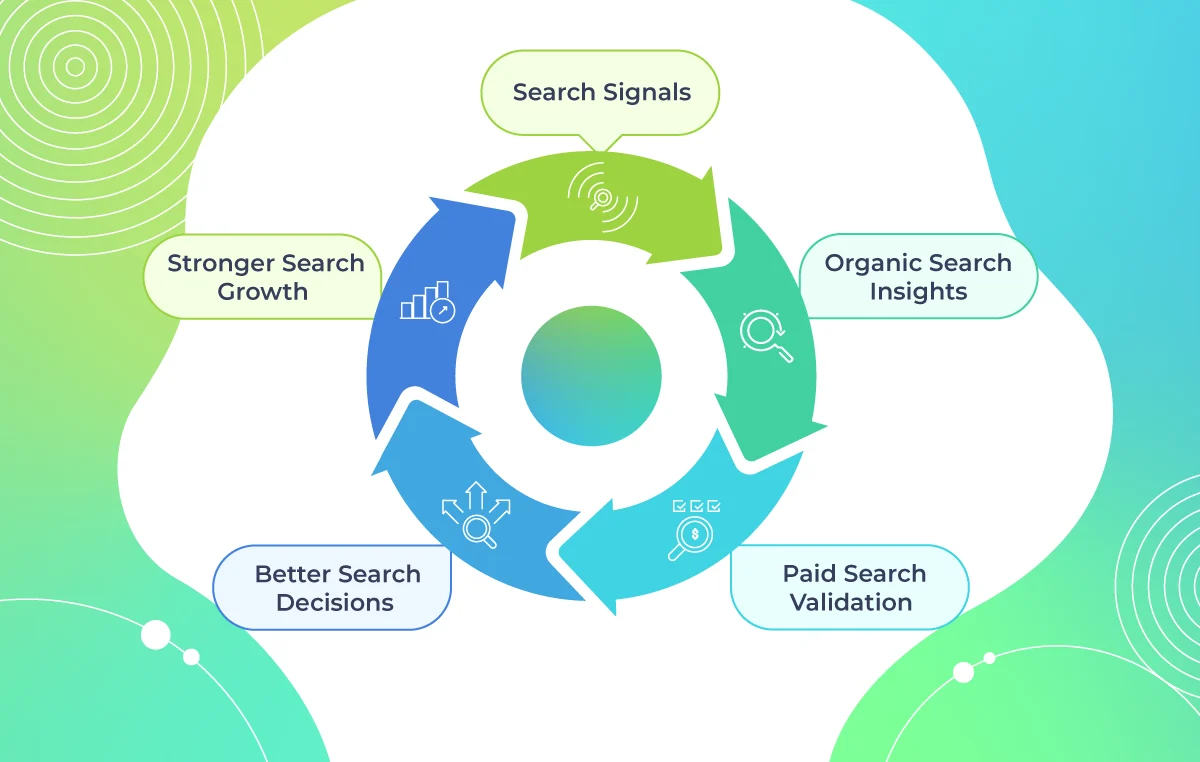
- The Catalyst: Unifying these strategies creates a compounding feedback loop—termed the "Search Growth Loop"—where insights from one channel actively inform and optimize the performance of the other.
Chronology: The Evolution from Siloed Tactics to Integrated Growth
To understand how modern marketing arrived at this crossroad, it helps to examine the historical trajectory of search engine marketing.
Phase One: The Great Divide (Early 2000s – 2010s)
In the formative years of digital marketing, SEO and PPC emerged as distinct technical disciplines. SEO was viewed as a long-term, content-driven effort focused on technical site health and keyword rankings. PPC was treated as a direct-response sales tool governed by bidding strategies, quality scores, and immediate return on ad spend (ROAS). Because agencies and internal departments were organized around these technical specialties, budgets were fiercely contested, and data sharing between organic and paid teams was rare.

Phase Two: The Rise of Algorithm Sophistication (2015 – 2022)
As search engines grew more sophisticated—integrating machine learning, natural language processing, and semantic search—the boundaries between keywords and user intent began to blur. Algorithms started prioritizing context over exact-match phrases. However, organizational inertia persisted. Many businesses continued to evaluate SEO and PPC in isolation, failing to recognize that consumers do not distinguish between organic and paid listings on a search engine results page (SERP).
Phase Three: The Convergence and the Case of Bridewell (Present Day)
The paradigm began to shift as forward-thinking brands realized that consumer insights gathered organically could drastically improve paid efficiency. A notable turning point in this evolution is highlighted by the cybersecurity firm Bridewell. Having invested heavily in both organic and paid search for several years—each managed by a separate partner—Bridewell possessed a wealth of organic customer demand data, but none of it was actively informing its paid search strategy.
When Bridewell restructured its approach to integrate these workstreams, the transformation was immediate. Rather than treating SEO and PPC as separate execution tasks, the strategy pivoted to using organic insights to guide paid messaging, test commercial intent, and target high-value gaps. The resulting synergy bypassed months of guesswork, setting a new benchmark for how integrated search strategies can drive accelerated commercial growth.
Supporting Data: The Scale of Search and the Cost of Isolation
The argument for unifying search marketing is heavily underscored by the sheer volume of global interactions taking place across search engines daily.
- Five Trillion Searches: According to industry data, more than five trillion Google searches take place every single year, continuously generating fresh signals regarding shifting consumer priorities.
- The 15% Rule: Approximately 15% of the searches Google processes every single day are entirely new—meaning consumer vocabulary, needs, and buying priorities are perpetually evolving. This high volatility proves that static internal marketing language quickly becomes obsolete.
- The Bridewell Benchmark: Following the implementation of an integrated search strategy centered on the Search Growth Loop, Bridewell achieved its ambitious annual commercial targets within the first six months of the new approach, proving the compounding value of cross-channel intelligence.
Official Responses and Industry Perspectives
Industry leaders and digital strategists are increasingly vocal about the necessity of breaking down internal silos. Marketing authorities emphasize that treating SEO and PPC as competing entities is a relic of outdated organizational charts.
"Businesses rarely grow by improving SEO or PPC independently," notes digital marketing analysis from leading search consultancies. "They grow by understanding what search has already revealed, and then using that understanding to make better commercial decisions."
Experts point out that organic search provides a risk-free validation environment. When a web page consistently earns strong organic visibility, it serves as empirical proof that real demand exists and that search engines recognize the brand as a credible resource.

Rather than throwing PPC budget at unverified assumptions, market leaders advocate for an intelligence-led transition:
- Validating Demand via Organic: Use high-ranking organic content to confirm that a topic or service has proven market interest.
- Deploying Paid with Confidence: Apply paid search budgets to capture immediate market share around those validated topics, especially where competitors dominate or where seasonal spikes require rapid visibility.
- Refining Customer Language: Adopt the natural, conversational phrasing uncovered by organic search into ad copy, moving away from rigid corporate jargon.
Implications: Building the "Search Growth Loop"
The implications of adopting a unified search strategy extend far beyond immediate cost-per-click (CPC) efficiencies or ranking improvements. By institutionalizing the Search Growth Loop, organizations transform marketing from an expense line item into an ongoing engine of business intelligence.
1. Eradicating Guesswork in PPC
Paid search campaigns often suffer from bloated budgets spent testing unproven keywords, ad variations, and landing pages. By letting organic search spearhead the discovery phase—revealing what terms audiences use, what questions they ask, and what value propositions resonate—paid campaigns launch from a foundation of hard evidence rather than intuition.
2. Maximizing Commercial Intent Mapping
Not all searches carry equal weight. An informational query like "What is endpoint security?" serves a vastly different purpose than a transactional query like "Enterprise cybersecurity agency." Organic data maps out the entire customer journey, illuminating where users are exploring, when they are comparing options, and when they are ready to convert. Paid search can then be strategically deployed to intercept high-intent users precisely when it matters most.
3. Sustainable, Compounding Growth
When organic and paid search feed into one another, every campaign iteration sharpens the organization’s overall market understanding. New product offerings can be vetted rapidly through paid ads, long-term content strategies can be fortified by organic insights, and budget allocations can shift dynamically based on verified commercial returns.
Conclusion: The Ultimate Shift in Perspective
Ultimately, the persistent debate over whether to prioritize SEO or PPC misses the forest for the trees. The question is no longer about choosing one channel over the other, but about how effectively an enterprise can harness the collective intelligence of search to drive holistic business growth.
By dismantling internal silos and embracing a continuous loop of shared insight, brands can stop guessing what their customers want and start responding to what search has already taught them. In doing so, better search decisions naturally give rise to better commercial decisions—the foundational bedrock of sustainable, long-term success.



