






WASHINGTON — In a watershed moment highlighting the dangerous convergence of artificial intelligence and advanced cyber espionage, Microsoft Security Research has attributed the recent, disruptive supply-chain assault on ConnectWise Cloud Backup customers to a China-state-aligned threat actor tracked as Storm-0940.
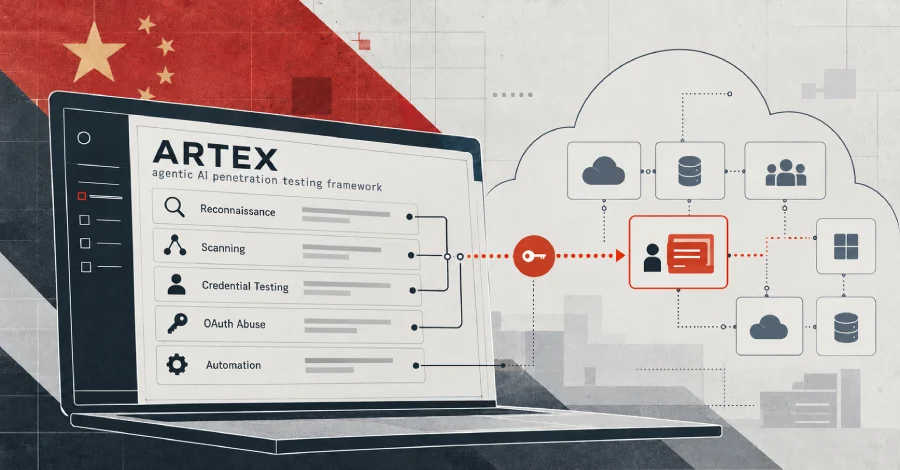
According to comprehensive telemetry released by Microsoft, the threat group systematically weaponized an agentic AI penetration-testing framework known as ARTEX. By deploying this autonomous system, Storm-0940 bypassed traditional velocity thresholds, executing hyper-fast, large-scale attacks targeting Microsoft 365 environments across more than 2,250 corporate and governmental tenants globally.
The campaign underscores a terrifying evolution in the threat landscape: state-sponsored actors are no longer merely experimenting with artificial intelligence; they are utilizing fully autonomous, LLM-driven agentic loops to conduct end-to-end cyberattacks—ranging from reconnaissance and initial credential harvesting to privilege escalation and persistence—with minimal human intervention.
Main Facts
The revelations from Microsoft Security Research paint a stark picture of how advanced persistent threat (APT) groups are industrializing offensive operations through artificial intelligence.
- The Threat Actor: Microsoft tracks the perpetrator as Storm-0940, a sophisticated, China-state-aligned cyber-espionage collective active since at least 2021.
- The Weapon: The group utilized ARTEX, an open-source, LLM-driven agentic penetration-testing framework capable of executing autonomous offensive security workflows with any underlying AI model.
- The Target Vector: The campaign culminated in a major supply-chain compromise targeting the Microsoft 365 environments of ConnectWise Cloud Backup customers, following a broader cross-industry espionage effort.
- The Scale: Storm-0940 leveraged ARTEX to reach over 2,250 cloud tenants, hitting an unprecedented velocity of 2,900 sign-in attempts per minute.
- Victim Profile: Organizations spanning a vast array of critical sectors were targeted, including aerospace, defense, automotive, chemicals, energy, financial services, government bodies, legal institutions, manufacturing, media, military entities, semiconductors, software developers, technology firms, think tanks, and non-profit organizations.
Chronology of the Attack
The timeline compiled by Microsoft researchers reveals a meticulously planned operation that escalated from reconnaissance and broad-scale credential testing to a precision supply-chain infiltration over a matter of weeks.
September 2026: The Integration of ARTEX
According to Microsoft Security Research, Storm-0940 began integrating the ARTEX framework into its operational toolset as early as September 2026. Designed as an automated penetration-testing utility, the framework allowed the group to streamline reconnaissance, automate scanning paradigms, and orchestrate rapid password-spraying campaigns against hundreds of organizations worldwide.
October 10–14, 2026: The High-Velocity Password Spray
Immediately preceding the ConnectWise vector exploitation, Storm-0940 initiated a concentrated, high-intensity password-spraying campaign. Over a grueling four-day window concluding on October 14, the group targeted 327 Microsoft 365 and Exchange Online accounts distributed across eight primary organizations.
During this short burst, Microsoft’s automated defenses recorded more than 151,000 failed authentication events. The attack spiked dramatically at times, registering an automated velocity of 2,900 failed logon attempts per minute—a throughput designed to overwhelm conventional defensive monitoring systems and exhaust security operations centers (SOCs).
October 15, 2026: The ConnectWise Supply-Chain Compromise
Pivoting rapidly, Storm-0940 directed its AI-driven infrastructure toward ConnectWise Cloud Backup customers on October 15. Leveraging the exact same malicious infrastructure and automated loops established during the earlier password-spraying phases, the AI agents systematically compromised the Microsoft 365 environments of multiple downstream ConnectWise clients.
Rather than stopping at initial authentication, the autonomous agents utilized Microsoft Graph and native directory operations to perform deep internal reconnaissance. The AI modified application credentials to secure persistent access and systematically manipulated identities, user groups, and privileged roles within the compromised tenants.
October 17–22, 2026: Service Shutdown and Phased Recovery
Faced with unauthorized access and anomalous activity across its cloud architecture, ConnectWise proactively pulled the plug on its services on Saturday, October 17. Following intense remediation efforts, the company announced a phased service restoration on Wednesday, October 21, advising customers to maintain strict network isolation while recovery operations continued.
Supporting Data & Technical Mechanics
The technical details of the Storm-0940 campaign provide a sobering look at how agentic artificial intelligence changes the economics of cyber warfare.
The Capabilities of ARTEX
Traditional automated attacks typically rely on scripted tools, rigid credential-stuffing bots, or human operators executing commands sequentially. ARTEX, by contrast, operates as a coordinated system of Large Language Model (LLM)-driven agents.
According to Microsoft Threat Intelligence, ARTEX is capable of running autonomous penetration tests from initial target reconnaissance all the way through to data exfiltration with virtually zero human interaction. When faced with defensive hurdles—such as multi-factor authentication (MFA) prompts, conditional access policies, or API rate-limiting—the LLM agents can dynamically reason, adapt their tactics, and select alternative pathways to achieve their objectives.
Velocity and Scale
The primary advantage demonstrated by Storm-0940 was sheer speed and scale. By decoupling attack execution from human processing limits, the threat group was able to:
- Pivot across more than 2,250 unique tenants using automated workflows.
- Sustain a relentless cadence of 2,900 sign-in attempts per minute.
- Automatically abuse and manipulate OAuth applications in downstream victim environments, weaponizing trusted third-party integrations against their owners.
Post-Authentication Actions
Microsoft’s analysis noted that in several targeted environments, the AI agents successfully navigated beyond the initial login boundary. Using automated scripts executed via Microsoft Graph, the agents performed:
- Internal Reconnaissance: Enumerating users, administrative roles, and cloud resource configurations.
- Persistence Establishment: Modifying application credentials, adding rogue service principals, and generating secondary backdoors.
- Privilege Modification: Altering group memberships and elevating privileges to ensure long-term, hard-to-detect access.
Microsoft emphasized that while a successful authentication event does not automatically confirm that data exfiltration occurred, the capability of threat actors to establish automated persistence presents a severe risk of delayed or hidden compromise.
Official Responses
The severity of the incident has triggered urgent warnings and operational responses from both tech giants and affected service providers.
Microsoft’s Assessment
Microsoft executives underscored that this attack represents a fundamental shift in how threat actors operate. Igor Tsyganskiy, Executive Vice President at Microsoft, took to social media to sound the alarm.
"Since early October, a wave of AI-driven cyberattacks has been ongoing," Tsyganskiy wrote in a public post. Pointing to the ConnectWise incident, he added that this assault is simply "one of many" orchestrated by state-sponsored actors utilizing agentic frameworks to accelerate their campaigns.
Microsoft Security Research echoed these concerns, noting that multiple distinct threat groups from various geographical regions have begun adopting ARTEX and similar frameworks to multiply their operational capacity and shrink the window of detection for defenders.
ConnectWise’s Remediation Efforts
In the wake of the breach, ConnectWise moved swiftly to contain the blast radius. After temporarily suspending core cloud backup services on October 17 to purge malicious footholds, the company initiated a controlled, phased restoration schedule beginning Wednesday, October 21.
In official trust advisories, ConnectWise urged its client base to maintain caution, keep third-party connections disabled until verified, and prepare for a multi-day recovery window as security teams validate each restored environment.
Broader Implications for Cybersecurity
The Storm-0940 campaign marks a permanent crossing of the Rubicon in digital security: the advent of automated, AI-driven cyber espionage at scale.
1. The Death of Traditional Rate-Based Detection
For decades, security operations centers (SOCs) have relied on velocity metrics—such as failed login thresholds and rate-limiting triggers—to spot brute-force attacks and credential stuffing. When threat actors can seamlessly distribute attacks across thousands of tenants while dynamically modulating their request rates through autonomous AI agents, static thresholds become obsolete. Defenders are forced to move away from reactive, signature-based monitoring toward continuous identity posture management and behavioral analytics.
2. Supply-Chain Vulnerability Amplified
The exploitation of ConnectWise’s Cloud Backup service demonstrates that compromising a single trusted third-party vendor with elevated privileges provides nation-state actors with a skeleton key to thousands of downstream enterprise and government networks. As attackers utilize AI to rapidly map and abuse OAuth permissions, third-party risk management (TPRM) must evolve from periodic compliance questionnaires into real-time runtime monitoring of application behavior.
3. The Democratization of Advanced Attack Capabilities
Frameworks like ARTEX lower the technical barrier to entry for sophisticated cyber operations. While Storm-0940 is a well-resourced, China-aligned state actor, the availability of open-source agentic penetration testing tools means that financially motivated cybercriminals and less-sophisticated hacking syndicates will soon possess the capability to launch high-velocity, automated multi-tenant attacks.
Conclusion
The assault by Storm-0940 serves as a stark wake-up call for the global cybersecurity community. As artificial intelligence becomes both the sword and the shield in modern conflicts, organizations can no longer rely on human-speed defenses to counter machine-speed adversaries. Mitigating future threats will require a fundamental re-architecting of cloud security models, assuming continuous, automated probing, and enforcing zero-trust principles across every connected third-party application.