The landscape of agentic AI has evolved from experimental prototypes to a crowded, high-stakes ecosystem of orchestration frameworks. By 2026, the question is no longer whether your organization can build an agent, but which architecture will ensure that agent remains reliable, maintainable, and cost-effective in a production environment.
This guide provides a structured, decision-tree approach to selecting the right framework based on your workload’s actual requirements, moving beyond superficial metrics like GitHub stars or "ease of use" to address the core architectural trade-offs that define production-grade software.
Main Facts: The Shift to Production-Grade Orchestration
In the early days of 2023, agentic AI was characterized by "scaffolding"—lightweight, often fragile wrappers around LLM calls. Today, the focus has shifted toward robust orchestration. The core reality of 2026 is that developers are no longer building toy projects; they are architecting systems that will manage high-value workflows for years.
The most critical realization for engineering teams is that framework choice is an architectural commitment. Choosing a framework optimized for open-ended, conversational exploration (like those used for creative research) is a liability if your goal is a tightly regulated, deterministic compliance pipeline. Conversely, choosing a rigid state-machine for a simple conversational assistant creates unnecessary bureaucratic overhead. The primary objective is to align the framework’s "mental model"—how it handles state, coordination, and failure—with your specific business logic.
Chronology: The Maturation of the Agentic Stack
The trajectory of these tools reflects the broader maturation of the industry:
- 2023: The Prototyping Era. The industry focused on "chaining" prompts. Frameworks were primarily experimental, prioritizing developer velocity and rapid iteration over durability or state management.
- 2024: The Rise of Multi-Agent Systems. As developers pushed LLMs to solve more complex tasks, the need for specialized agents (a "team" approach) emerged. Tools like AutoGen and CrewAI gained prominence by introducing the metaphor of collaborative teams.
- 2025: The Demand for Reliability. With agents entering production, the industry hit a wall: "hallucination loops" and unpredictable agent behavior. The industry pivoted toward state machines (LangGraph) and type-safe systems (PydanticAI) to impose guardrails on autonomous behavior.
- 2026: The Specialized Ecosystem. Today, we have reached a phase of specialization. Frameworks have moved from "do-it-all" solutions to domain-specific tools, forcing developers to make binary choices between agility and control.
The Decision Tree: Evaluating Your Needs
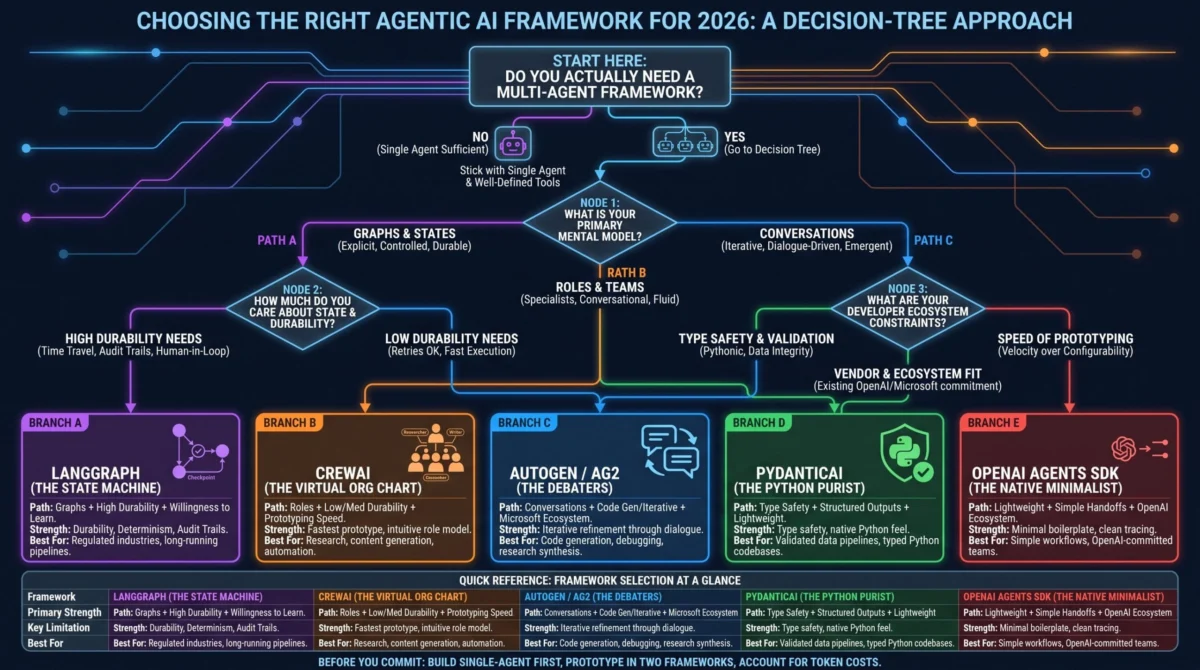
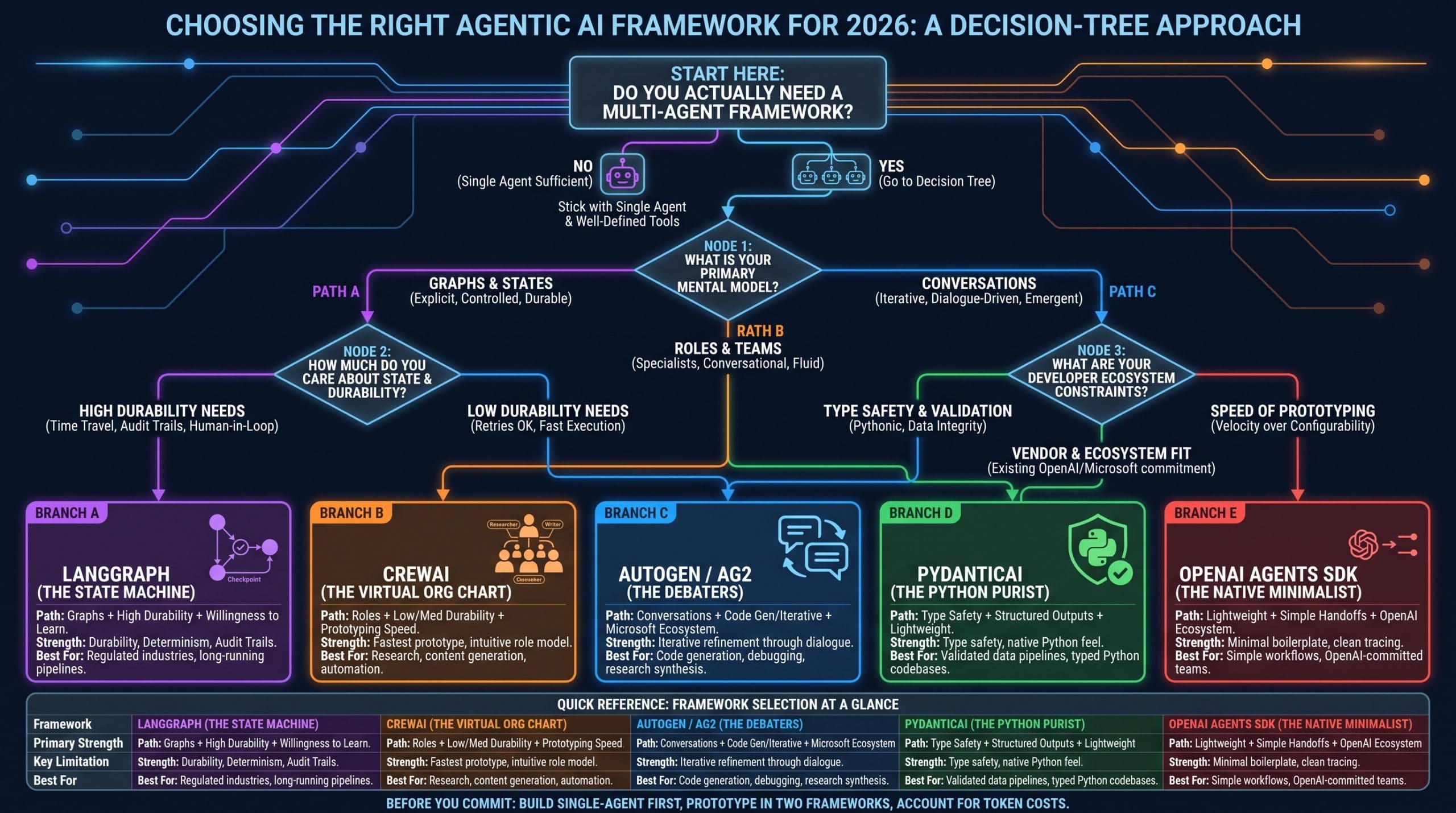
Before committing to a library, you must address three fundamental architectural nodes.
Node 1: The Mental Model
How does your team naturally visualize the workflow?
- Graphs and States: You view the system as a series of defined nodes with explicit transition rules. This is ideal for processes where failure handling and retries are critical.
- Roles and Teams: You view the system as a hierarchy of specialists. This works well for creative or research-driven tasks where the workflow is fluid.
- Conversational Dialogue: You view the system as an iterative loop where agents debate or refine outputs. This is best for code generation or complex problem-solving.
Node 2: Durability and State
- High Durability: Your workflow runs for extended periods, requires human-in-the-loop approvals, or manages sensitive data. You need audit trails and the ability to "rewind" execution.
- Low Durability: Your workflow is ephemeral. If a failure occurs, the cost of restarting from scratch is negligible.
Node 3: Ecosystem Constraints
- Strict Typing: Your codebase is heavily reliant on Python type hints and data validation.
- Vendor Lock-in: You are already deeply integrated into the Azure or OpenAI stacks, making native tools a strategic advantage.
The Five Pillars: Framework Deep-Dive
1. LangGraph: The State Machine
LangGraph is the industry standard for production pipelines where determinism is non-negotiable. By treating workflows as directed graphs, it allows for explicit state management.
- Implications: You can pause, modify, and resume a process—a feature essential for legal, medical, or financial workflows.
- Trade-off: The "verbosity tax." Setting up a LangGraph system requires significant boilerplate code. It is not for teams looking for a "quick win."
2. CrewAI: The Virtual Org Chart
CrewAI excels in human-centric metaphors. By assigning roles (e.g., Researcher, Editor) and goals, developers can stand up complex multi-agent systems in hours.
- Implications: Rapid prototyping is the primary advantage. It is highly effective for research and content generation.
- Trade-off: Constraint management. Because the coordination is role-based rather than state-based, it is harder to prevent "agent drift" in complex, sensitive environments.
3. AutoGen / AG2: The Debaters
AG2 is the premier framework for iterative refinement. It is built on the concept of agents conversing until they reach a consensus.
- Implications: It is exceptionally strong at code generation and data analysis, where an "execution and feedback" loop is required.
- Trade-off: Conversational complexity. Without careful prompt engineering, these systems can fall into infinite loops or "chatty" patterns that drive up token costs.
4. PydanticAI: The Python Purist
PydanticAI is not an orchestration framework in the traditional sense; it is a validation layer. It treats agents as endpoints for typed, structured data.
- Implications: If you are a Python shop that values data integrity above all else, this is the most "native" feeling tool. It prevents type errors at the boundaries of your agentic calls.
- Trade-off: You are responsible for building your own orchestration layer if your workflow becomes complex.
5. OpenAI Agents SDK: The Native Minimalist
Released in 2025, this SDK is the "path of least resistance" for organizations already committed to the OpenAI API.
- Implications: Extremely fast setup with built-in tracing and observability. It is ideal for small, focused internal tools.
- Trade-off: Severe vendor lock-in. Switching model providers or building a provider-agnostic architecture is significantly more difficult with this SDK.
Supporting Data: Operational Considerations
When moving to production, developers often overlook the Token Multiplier Effect. A multi-agent system does not cost the same as a single-agent system.
- Latency: Each handoff between agents adds overhead.
- Cost: A crew of four agents performing a task can easily consume 5–10x the tokens of a single, optimized prompt due to the overhead of inter-agent communication, planning, and repeated context window processing.
Teams must conduct "unit cost" analysis before scaling a multi-agent architecture to ensure the added intelligence justifies the exponential increase in operational expense.
Official Industry Perspective: The "Single-Agent First" Rule
Industry leaders across the board—from the maintainers of LangChain to the engineering teams at Microsoft—advocate for the "Single-Agent First" mandate.
The most common failure in 2026 is "orchestration over-engineering." Developers often reach for complex multi-agent frameworks to solve problems that a single, well-prompted agent with access to a robust set of tools could handle more efficiently. Before implementing a multi-agent framework, ask: Does this task genuinely require a team, or does it just need a better tool definition?
Implications for Future Architecture
The evolution of these frameworks suggests that the future of AI engineering will move away from "all-purpose" libraries. We are entering an era of modular agentic design, where companies will mix and match: using PydanticAI for data validation, LangGraph for state management, and specialized agents for specific tasks.
Ultimately, the "right" framework is the one that minimizes your specific risk profile. If your primary risk is regulatory non-compliance, choose the framework that guarantees an audit trail. If your risk is falling behind competitors, choose the framework that guarantees the fastest path to a working prototype. By following this decision tree, you ensure that your architecture is not just technically sound, but aligned with the business realities of your production environment.