










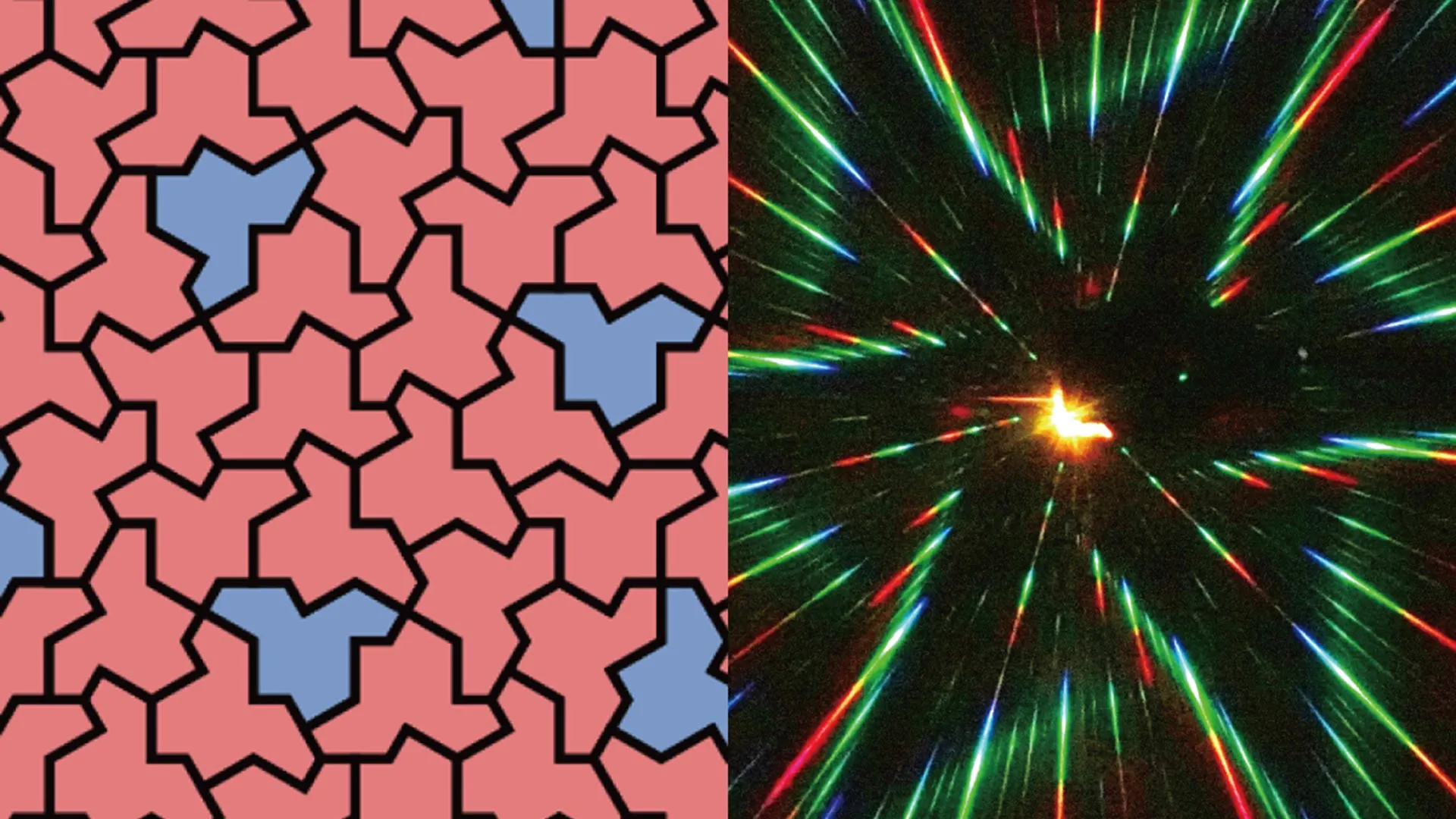
TOKYO — In the realm of fundamental science, abstract mathematics and applied physics often operate in parallel universes. Mathematicians chase symmetries, tessellations, and topological puzzles, while physicists manipulate electromagnetic fields, refractive indices, and quantum states. Occasionally, however, a discovery bridges these domains with such elegance that it forces a re-evaluation of both fields.
A prime example of this rare convergence has just unfolded in laboratories across Japan. A mathematical shape that captured global headlines in 2023 for solving a half-century-old topological puzzle is now revealing an unexpected connection to the physical behavior of light. Researchers have demonstrated that optical structures built on this mathematical geometry can force light to form unusual chiral patterns, opening unprecedented pathways for manipulating optical responses at the nanoscale.
Published in the journal Nature Communications, a collaborative study led by researchers from the Institute of Industrial Science at The University of Tokyo, alongside partner institutions, has transformed an abstract mathematical curiosity—the "Smith hat" monotile—into a functional optical device. When illuminated with laser light, these nanoscale structures produce diffraction effects fundamentally distinct from those observed in conventional quasicrystals, showcasing a novel interplay between aperiodicity, symmetry, and chirality.
Main Facts: The Intersection of Tiling Theory and Nanophotonics
At the core of this breakthrough is a profound synergy between geometry and wave optics. The primary discoveries and structural parameters of the research include:
- The Smith Hat Foundation: The research utilizes the "hat" shape, a recently discovered aperiodic monotile that successfully solved the mathematical "Einstein problem" by tiling a two-dimensional surface without ever repeating its pattern.
- Nanoscale Fabrication: Researchers fabricated nanoscale versions of these monotile patterns onto silicon nitride films utilizing advanced electron beam lithography, achieving precise geometric control at optical wavelengths.
- Chiral Light Diffraction: When subjected to laser illumination, the fabricated structures generated distinctive, pinwheel-like diffraction patterns. This optical asymmetry directly reflects the chiral character of the underlying aperiodic geometry.
- Symmetry-Controlled Responses: The optical behavior of the structures—specifically the resulting diffraction patterns—shifts dynamically based on the direction and polarization of the incoming light. Furthermore, mirroring the physical structure reverses its optical behavior.
- A New Class of Optical Media: Unlike traditional periodic crystals or standard quasicrystals, monotile-based optical structures provide a novel platform where an absence of mirror symmetry in an aperiodic arrangement dictates advanced light-matter interactions.
Chronology: From the 1960s Puzzle to Nanoscale Optics
The journey from a pencil-and-paper geometry problem to a cutting-edge optics experiment spans decades of theoretical progression and recent technological leaps.
Phase 1: The Long Quest for the Einstein Monotile (1960s–2022)
For decades, mathematicians wrestled with the "Einstein problem"—derived from the German ein Stein, meaning "one stone." The challenge asked whether a single, specific geometric shape could tile an infinite flat plane entirely aperiodically. While pioneering mathematicians like Roger Penrose discovered sets of shapes (such as Penrose tiles) that could achieve aperiodic tiling, using two or more distinct shapes, finding a single monotile that could accomplish this feat remained an elusive Holy Grail for over fifty years.
Phase 2: The Discovery of the Smith Hat (2023)
In 2023, a team of mathematicians and amateur sleuths—including David Smith, Joseph Samuel Myers, Craig S. Kaplan, and Chaim Goodman-Strauss—announced the discovery of the "hat" tile. This polygonal shape, dubbed the Smith hat, proved mathematically capable of covering a surface infinitely without ever falling into a repeating grid or periodic lattice. The discovery made international news, fascinating both academic circles and the public.
Phase 3: Conceptualizing the Optical Leap (Late 2023–Early 2024)
Shortly after the mathematical community digested the implications of the Smith hat, physicists at The University of Tokyo began asking whether this abstract geometrical property could manifest as physical phenomena. Led by doctoral researchers and senior faculty, the team hypothesized that the unique constraints of an aperiodic monotile might impart unusual scattering or diffraction properties if translated into physical matter at the wavelength scale.
Phase 4: Fabrication and Laser Illumination (2024–Present)
Using high-resolution electron beam lithography, the researchers etched the Smith hat geometry into silicon nitride thin films. Upon directing coherent laser light through these manufactured arrays, the team observed anomalous diffraction behaviors. The light did not scatter symmetrically; instead, it formed pinwheel-like, chiral distributions, confirming that abstract mathematical aperiodicity could directly dictate complex optical wave mechanics.
Supporting Data: Decoding the Optical Mechanics
To understand why the Smith hat produces such unusual optical behavior, one must examine the intersection of crystallography, topology, and wave physics.
The Geometry of the Hat
Familiar tiling structures, such as square checkerboards or hexagonal honeycombs, possess translational symmetry: shift them by a specific distance, and they align perfectly with themselves. Quasicrystals, discovered in the 1980s by Dan Shechtman, possess long-range order without translational periodicity (often exhibiting forbidden five-fold or tenfold rotational symmetries).
The Smith hat represents a different tier of spatial arrangement. As lead author Yuto Moritake notes, although the resulting pattern appears irregular and disordered at first glance, it is fundamentally constructed from an underlying honeycomb lattice framework governed strict aperiodic rules.
Fabrication Parameters and Light-Matter Interaction
The research team employed silicon nitride ($textSi_3textN_4$) due to its high refractive index and transparency across visible and near-infrared wavelengths, making it an ideal material for dielectric nanophotonics.
- Feature Sizes: Features were scaled down to nanometer dimensions, matching the sub-micron wavelengths of the laser sources used in the experiments.
- Diffraction Signatures: Standard periodic lattices yield discrete, highly symmetric diffraction spots (Laue spots). Quasicrystals yield intricate star-like diffraction patterns with high rotational symmetry. By contrast, the Smith hat structures produced asymmetric, pinwheel-like intensity distributions.
- Polarization Dependence: The handedness (chirality) of the diffraction pattern inverted completely when the polarization state of the incident laser beam was modulated or when the physical silicon nitride sample was flipped to its mirror-image orientation.
| Structural Property | Traditional Periodic Lattice | Quasicrystal | Smith Hat Monotile Structure |
|---|---|---|---|
| Symmetry | Translational & Rotational | Quasiperiodic, Rotational | Aperiodic, Local Honeycomb-Derived |
| Mirror Symmetry | Typically Present | Frequently Present | Lacks Mirror Symmetry |
| Diffraction Response | Discrete regular grids | Symmetric star patterns | Chiral, pinwheel-like distributions |
| Polarization Sensitivity | Low to Moderate | Moderate | High, symmetry-controlled |
Official Responses and Expert Insights
The publication of these findings in Nature Communications has drawn commentary from across the international optics and materials science communities. The researchers themselves emphasize that the work represents a conceptual bridge rather than a finalized commercial application, yet its theoretical weight is substantial.
"What is especially fascinating about the hat tile is that, although the resulting pattern appears irregular at first glance, it is actually constructed from the honeycomb lattice," explains Yuto Moritake, lead author of the study from The University of Tokyo. "We wanted to see whether this unique shape could also produce any unexpected physical phenomena."
The transition from mathematical abstraction to physical reality required meticulous handling of nanoscale tolerances. Senior investigators noted that predicting how light would interact with an aperiodic, non-mirror-symmetric boundary condition required advanced numerical modeling of electromagnetic wave propagation.
"We found that the diffraction patterns themselves become chiral because the structure lacks mirror symmetry," elaborates Masaya Notomi, senior author on the project. "This kind of optical response is fundamentally different from that observed in conventional quasicrystalline materials."
Notomi and his colleagues stress that the ability to control optical chirality—the directional twisting of light waves—purely through the spatial arrangement of an aperiodic monotile opens up a new parameter space for optical engineering.
"These results open a new direction of research on the fusion of quasiperiodic order and chirality," Moritake adds. "Monotile patterns provide a platform for exploring optical phenomena that emerge from the interplay of symmetry, chirality, and aperiodicity."
Independent physicists reviewing the work have echoed these sentiments, noting that the study exemplifies how deep mathematical structures contain hidden physical blueprints waiting to be unlocked by advanced nanofabrication techniques.
Implications: Toward Next-Generation Optical Technologies
While the immediate value of this research lies in fundamental physics, the long-term implications stretch across several applied technological domains. The ability to dictate optical behavior through pure geometry—independent of exotic chemical compositions or complex metamaterial designs—offers several distinct advantages.
1. Advanced Polarization Control
Polarization is a fundamental characteristic of light, crucial for everything from high-resolution microscopy and quantum communication to liquid-crystal displays and optical sensors. Traditional optical components rely on birefringent crystals or chiral molecules to manipulate polarization. Structures based on monotile geometries provide a mechanical, structural method for tailoring polarization states, potentially leading to ultra-thin, highly stable polarization filters and rotators.
2. Tailored Light Manipulation and Metasurfaces
Metasurfaces—two-dimensional arrays of subwavelength nanostructures designed to control phase, polarization, and amplitude—are revolutionizing optics by replacing bulky lenses and prisms with flat surfaces. Incorporating aperiodic, monotile-inspired layouts into metasurface design could yield novel optical elements that scatter, focus, or filter light in ways impossible with standard periodic or random arrangements.
3. The Philosophy of Physical Discovery
Beyond specific engineering applications, this research highlights a deeper epistemological truth about the natural world: mathematics is not merely a language we invent to describe physics; it appears to be an intrinsic architectural blueprint of reality. When mathematicians solve a purely abstract puzzle about tiling a two-dimensional plane without repetition, they are inadvertently mapping out structural rules that light itself obeys when interacting with matter.
As researchers continue to explore the boundaries where topology, aperiodicity, and nanophotonics meet, the "Smith hat" stands as a testament to the unpredictable utility of pure mathematics. What began as a geometric curiosity about a single, oddly shaped tile has illuminated a new path forward in our quest to understand and master the behavior of light.



