










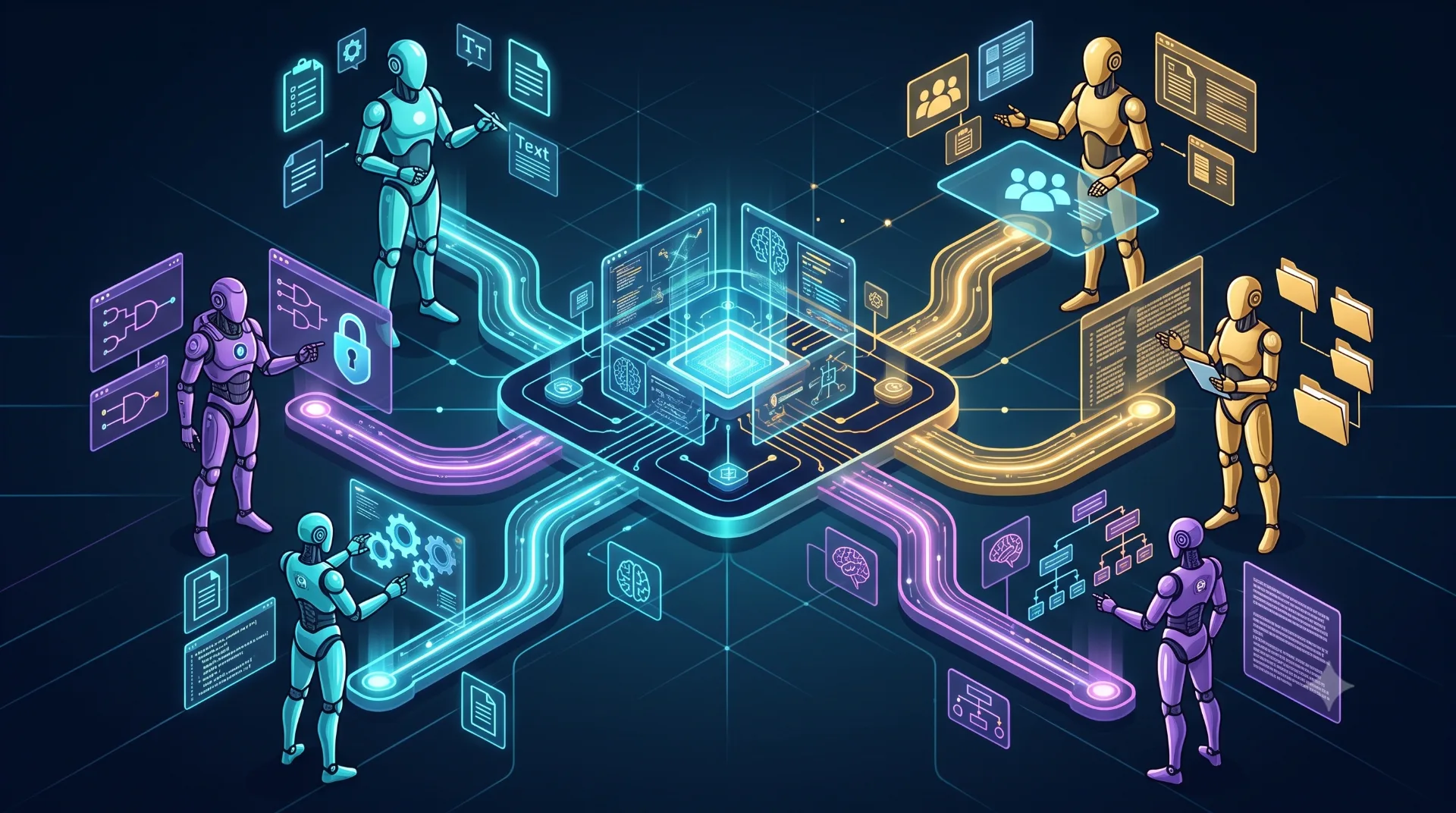
As the artificial intelligence landscape transitions from static conversational bots to dynamic autonomous workflows, enterprise technology leaders face a pressing operational challenge. While conversational AI and standalone large language models (LLMs) have proven their utility for text generation and semantic retrieval, moving an agentic system from a proof-of-concept to a reliable, production-ready enterprise workflow requires rigorous optimization across scalability, deterministic responsiveness, and cost-effectiveness.
To understand how to achieve enterprise-grade reliability, developers and systems architects must first answer a fundamental question: Why are autonomous agents needed in the first place? Simply put, conversational insights derived from retrieval-augmented generation (RAG) are frequently insufficient for complex business operations. Modern LLMs possess the innate capabilities to plan, reason, and act. Autonomous agents serve as the logical constructs built around this LLM "brain," allowing systems to leverage external tools, interact with APIs, correct their own operational mistakes, and collaborate with peer agents.
Executing these workflows requires systems to make high-frequency decisions—such as determining the next execution step, selecting an appropriate specialized agent, choosing a specific tool, or evaluating whether accumulated context is sufficient to respond to a user. A major evolution in this space is the advent of low-cost calibrated decision models (such as TypeSafe’s JEV), which shift deterministic workloads away from expensive LLMs, leaving the foundational models to focus purely on deep reasoning and synthesis.
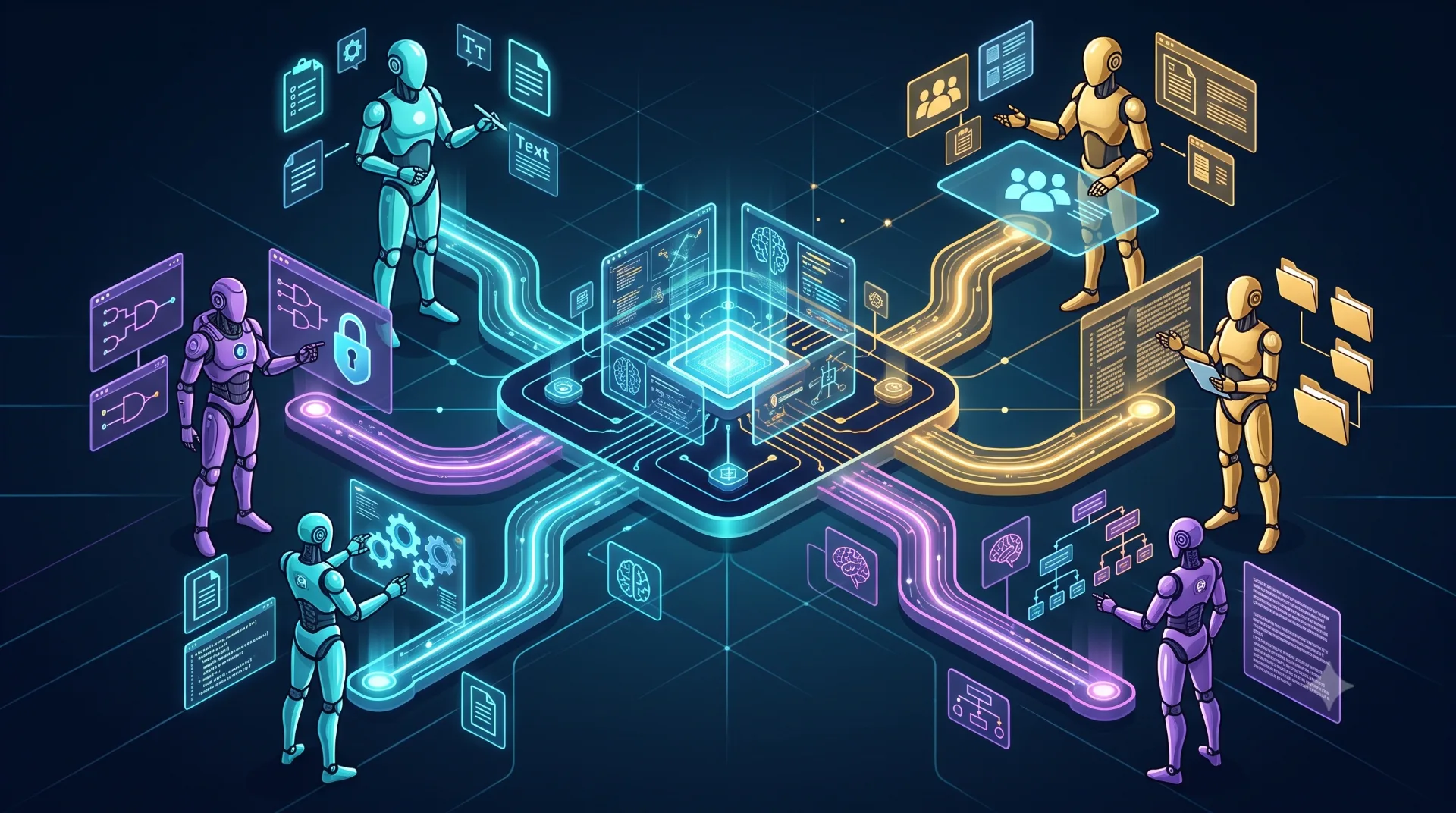
Just as retrieval mechanisms evolved beyond flat semantic search into specialized, deterministic topologies, the broader agentic landscape is rapidly moving away from naive "single agent loops" toward heavily engineered multi-agent workflows and constrained architectures. This article provides a comprehensive practitioner’s deep dive into six distinct architectural patterns for building robust agentic systems, analyzing their data flows, the vital role of Context Engineering, and their ideal production use cases.
Chronology and Evolution of Agentic Architectures
The trajectory of generative AI development over the past thirty-six months highlights a clear maturation curve:
- Phase 1: Basic Prompt-Response (2022–2023): Developers relied on static, zero-shot or few-shot prompts sent to standalone LLMs, resulting in high rates of hallucination and an inability to interact with live enterprise systems.
- Phase 2: Naive Single-Agent Loops (Early 2023): The introduction of ReAct (Reason + Act) patterns allowed models to iterate with basic tool calls, but these loops frequently suffered from context window bloat and infinite execution traps.
- Phase 3: Deterministic Topologies and Multi-Agent Collaboration (Late 2023–Present): The industry recognized that unstructured agent swarms were too chaotic for enterprise use. This realization spurred the adoption of state graphs, hierarchical supervisor-worker models, and strict context management frameworks.
Core Components and Context Engineering
Before evaluating specific architectures, it is necessary to establish the baseline pillars of an AI agent: a foundational LLM, a tailored system persona, a suite of external tools or APIs, and an active memory state.

However, the hidden success criterion for any production-ready agentic system is Context Engineering. Unlike traditional prompts where input context remains static, an agent’s context is highly dynamic. As an agent executes actions, it accumulates observations, operational errors, and intermediate thoughts. Appending every single observation directly to the prompt leads to rapid context window bloat, soaring API latencies, and exorbitant financial costs. Furthermore, bloated contexts trigger the "Lost in the Middle" phenomenon, where the LLM loses visibility of granular facts buried within massive blocks of text, ultimately degrading downstream response quality.
Effective Context Engineering involves strategies such as observation truncation, prompt compression, state projection, and strategic context pruning.
Furthermore, enterprise applications cannot trust autonomous agents to execute unmonitored operations. Because LLMs are inherently non-deterministic, any action that extends beyond a simple read operation—such as modifying a SQL database, authorizing a financial transaction, or emailing a client—carries inherent risk. Implementing Human-in-the-Loop (HITL) control flows allows the orchestration layer to serialize the execution state to a database, halt the graph, and wait for human review and approval via a user interface before resuming operations.

The Six Architectural Patterns for Production Agentic Systems
Pattern 1: The Standard ReAct (Reason + Act) Loop
The ReAct pattern serves as the foundational building block of agentic workflows, forcing the LLM to alternate between "thinking" about a goal, "acting" by calling a tool, and observing the resulting output.
- Data Flow: The agent operates within a continuous loop, outputting a logical thought followed by a tool action. The orchestration layer intercepts the action, executes the tool, and feeds the observation back to the LLM until a final response is reached.
- Pros & Cons: Highly flexible for open-ended tasks, but vulnerable to latency spikes and context bloat if observations are unmanaged.
- When to Use: Ideal for open-ended, research-oriented tasks where exact execution steps cannot be predetermined, such as deep-dive web research or isolated code debugging.
Pattern 2: The Sequential Multi-Agent Workflow
When a task is too complex for a single ReAct agent, the Sequential Workflow mimics a factory assembly line, chaining specialized agents together.
- Data Flow: The output of one specialized agent is passed as structured input to the next. For instance, a Researcher agent gathers data, passes a clean brief to an Analyst, who passes code to a Writer.
- Pros & Cons: Excellent predictability and context isolation via state projection, but inflexible if a downstream step requires revisiting prior assumptions.
- When to Use: Best for well-defined, multi-stage data processing pipelines, automated content generation, and traditional ETL workflows.
Pattern 3: The Adaptive Router Agent
The Adaptive Router treats the agentic system as an intelligent triage desk, analyzing user intent and routing execution to specialized downstream pipelines.
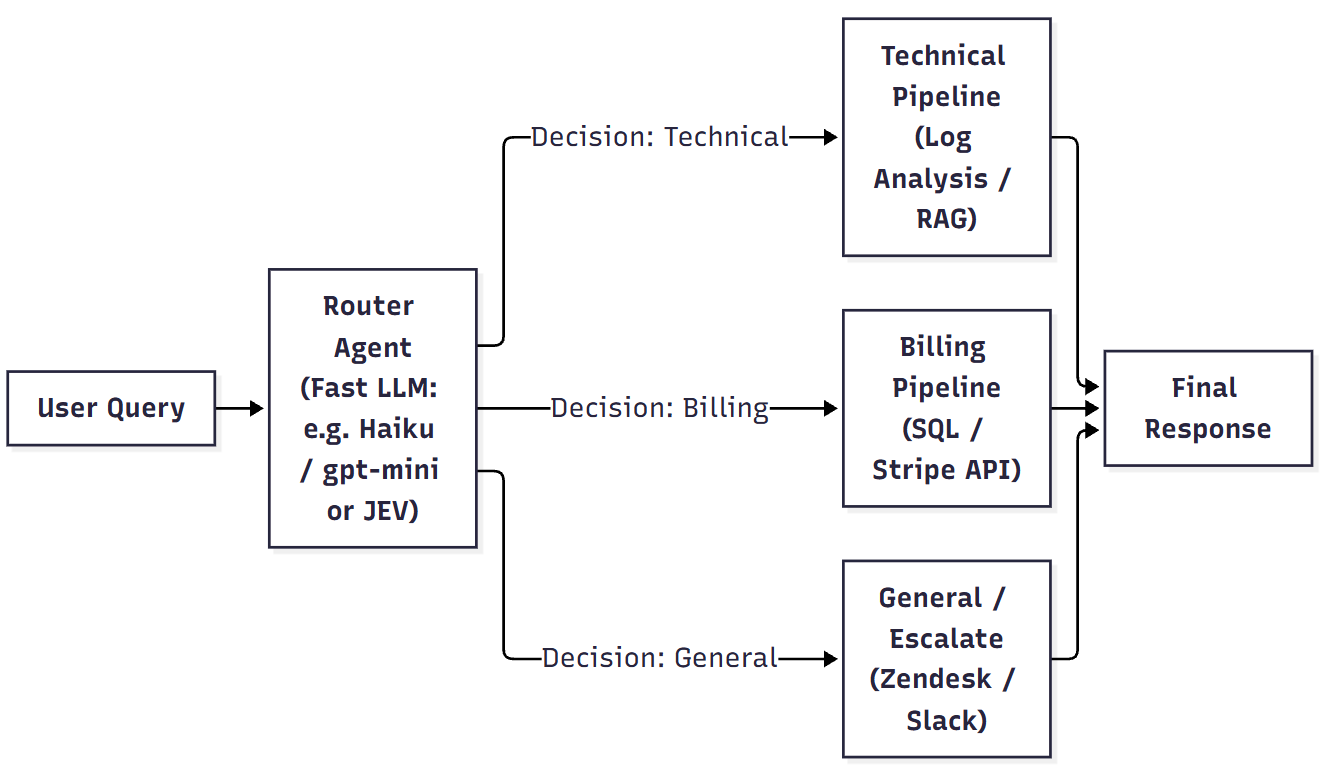
- Data Flow: A fast, calibrated classification model reviews the user query and outputs a structured JSON routing decision. The router then exits, handing off execution to dedicated sub-pipelines.
- Pros & Cons: Highly cost-effective and fast, but dependent on the router’s initial classification accuracy.
- When to Use: The standard architecture for multi-tenant enterprise chatbots, customer service automation, and multi-departmental support routing.
Pattern 4: The Supervisor-Worker (Hierarchical) Architecture
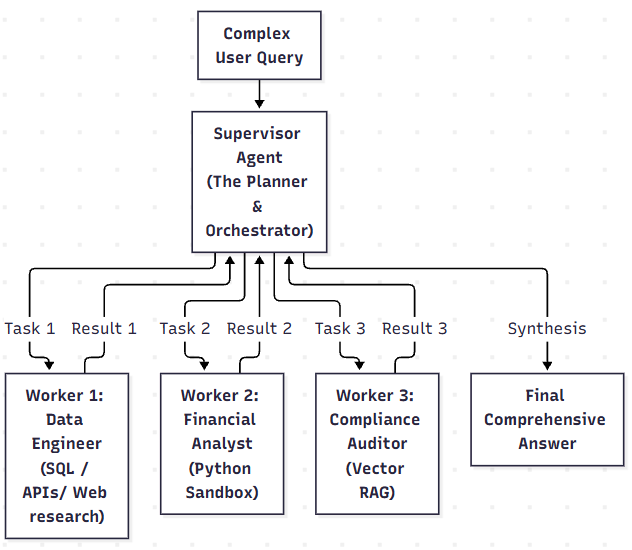
Moving beyond linear pipelines, this pattern introduces a central Manager agent that dynamically plans workflows, dispatches sub-tasks to worker agents in parallel, and synthesizes results.
- Data Flow: The Supervisor analyzes a complex query, builds a dynamic task ledger, assigns isolated sub-tasks to workers, reviews their outputs, and iteratively refines the global plan.
- Pros & Cons: Highly capable of handling complex, multi-faceted problems, but introduces orchestration overhead and increased token consumption.
- When to Use: Standard for comprehensive enterprise research, complex financial analysis, and multi-source data synthesis.
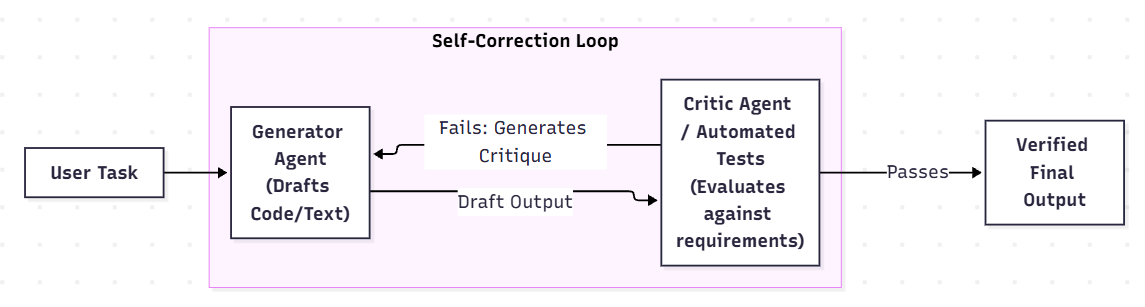
Pattern 5: The Reflection and Self-Correction Loop
Because LLMs frequently make mistakes, hallucinate facts, or write buggy code, the Reflection pattern catches flaws before outputs reach the end user.
- Data Flow: A Generator agent produces an initial output (such as code or a report). A Critic agent—or an automated compiler—evaluates the output against original instructions, generating a strict critique that loops back to the Generator for revision.
- Pros & Cons: Dramatically improves output quality and accuracy, but increases execution time and API costs.
- When to Use: Mandatory for autonomous software engineering assistants, automated data science pipelines, and high-stakes content drafting.
Pattern 6: The Autonomous Swarm (Decentralized Network)
The most experimental pattern, the Autonomous Swarm places multiple specialized agents in a shared environment where they collaborate and negotiate without a central manager.
- Data Flow: Agents communicate via shared workspaces or topic-based pub/sub messaging channels, stepping up to contribute based on their specific tool capabilities and protocols.
- Pros & Cons: Highly adaptable for creative and open-ended exploration, but notoriously difficult to debug and prone to unpredictable behaviors.
- When to Use: Best reserved for open-ended research sandboxes and simulated environments rather than strict enterprise automation.
Evaluating Agentic Systems and Production Best Practices
Evaluating multi-step agentic workflows requires shifting away from single-turn metrics. Systems architects rely on Trajectory Analysis to debug execution paths, tracking tool selection accuracy, argument validity, and final synthesis quality using observability platforms like LangSmith or Arize Phoenix.
Official recommendations from enterprise AI engineering teams emphasize several foundational best practices:
- Isolate Context Windows: Never pass full conversational histories or raw tool outputs down the line when structured state projection will suffice.
- Enforce Guardrails: Implement deterministic validation layers and human-in-the-shelf approval gates before allowing agents to execute external write operations.
- Optimize Cost via Model Tiering: Reserve expensive, frontier reasoning models exclusively for supervisory tasks and deep synthesis, utilizing fast, low-cost models for routing and basic text extraction.
Implications and Conclusion
The shift toward agentic systems represents a fundamental architectural evolution in software engineering. Organizations are moving away from writing explicit, rigid, step-by-step deterministic code and toward orchestrating networks of probabilistic, intelligent entities.
The ultimate success of an enterprise AI deployment relies less on choosing the newest foundational model and more on mastering Context Engineering—meticulously managing what agents see, remember, and forget. By combining rigorous architectural patterns with strict observability and human oversight, developers can build scalable systems that reliably solve complex, real-world problems.



