










The American media ecosystem is currently navigating a period of profound volatility, characterized by high-stakes constitutional friction between the executive branch and major news organizations, alongside significant operational realignments across legacy broadcast and cable networks. From the steps of the White House to the boardrooms of global news conglomerates, the industry is grappling with challenges to its editorial independence and a rapidly evolving audience engagement strategy.
The White House vs. The Press: A Constitutional Standoff
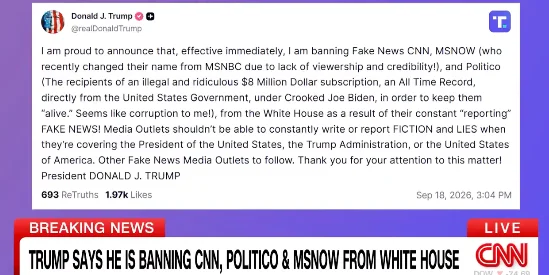
The most pressing issue currently dominating the media conversation is the escalating confrontation between President Donald Trump and several major news organizations. On Friday, the President announced via social media that he intends to ban CNN, MS NOW, and Politico from reporting within the White House grounds, claiming the action is "effective immediately."
The Chronology of Conflict
The announcement followed a tumultuous week of press interactions. During a Q&A session inside the Oval Office on Friday afternoon, the President was pressed by reporters regarding the legal and procedural basis for such an unprecedented ban. When asked for his rationale, the President cited no specific incident, instead attributing the decision to a "cumulative" history of unfavorable coverage spanning the last two years.
Despite the President’s public declarations, reporters from the targeted networks continued to file reports from the White House grounds throughout the day, effectively ignoring the directive in a show of journalistic defiance.
Official Responses and Legal Implications
The response from the affected networks has been swift and firm. CNN released a formal statement emphasizing that it stands "fully behind its White House reporters." The network asserted that it maintains a fundamental "right under the U.S. Constitution" to conduct reporting without government interference.
"Should the ban which President Trump threatened go ahead, it would be an illegal assault on that fundamental and constitutionally-protected right," the statement concluded.
Legal experts and press advocates have echoed this sentiment. Weijia Jiang, a former president of the White House Correspondents’ Association (WHCA), underscored the gravity of the situation by invoking the First Amendment. In a widely circulated post, Jiang highlighted the constitutional protections afforded to the press, noting that the government cannot legally curtail the freedom of speech or the press. This stance aligns with established legal precedents, which have historically protected the right of journalists to access public forums, even when those forums are within the confines of the executive mansion.
Shifting Anchors: The Evolution of Weekend Television
While political tension brews in Washington, the broadcast networks are simultaneously undergoing significant internal restructuring. ABC News has moved to revitalize its flagship weekend morning programming, announcing a series of new co-anchor teams for Good Morning America (GMA).
The New Weekend Lineup
The network’s senior political correspondent, Rachel Scott, has been elevated to co-anchor the Saturday edition of GMA alongside Whit Johnson. Scott, who has gained prominence for her incisive reporting, will maintain her role as the host of the streaming news program What You Need to Know on Disney+.
For the Sunday edition, ABC has paired correspondent Rhiannon Ally with Gio Benitez. The overhaul also extends to the weather segment: Leslie Lopez, formerly of the ABC Los Angeles affiliate KABC, has been tapped as the weekend meteorologist for GMA. She succeeds Somara Theodore, who is transitioning to a full-time role on the weekday shift for ABC News Live.
Beyond their morning duties, the new weekend team—Johnson, Scott, Benitez, and Ally—will participate in a rotating schedule to anchor ABC News Live Weekend, reinforcing the network’s 24/7 digital-first strategy.
Corporate Realignments: Leadership and Bureau Closures
The industry’s structural shift is perhaps best exemplified by the significant changes at NBC News and CNBC.
Leadership Transition at NBC
NBC News is set to lose a key executive with the departure of Janelle Rodriguez, the executive vice president of programming. Rodriguez, who served at the network for 12 years, described her exit as "the right moment" to pursue new professional chapters.
In response, Rebecca Blumenstein, NBC News president of editorial, announced a reorganized leadership structure. Catherine Kim has been promoted to executive vice president of editorial and content, a role that grants her oversight of NBC News Now and the network’s various specials. Matt Carluccio will see his portfolio expanded to manage core editorial units, including business, health, investigations, and climate reporting. Additionally, Matt Frucci, the executive producer of NBC Nightly News, will now report directly to Blumenstein, streamlining the network’s editorial decision-making process.
The Global Pullback: CNBC’s Hong Kong Closure
In a move that signals a broader reevaluation of global media footprints, CNBC has officially shuttered its Hong Kong bureau. The closure marks the end of several business-day programs, including Inside India, The China Connection, and Europe Early Edition. Feature series such as CNBC Meets and Built for Billions will conclude once their current broadcast cycles end.
The network stated that it reached these "difficult decisions" after a multi-month review of its international programming, regional commercial viability, and resource allocation. While a "small number of employees" were impacted, CNBC confirmed that it is shifting its regional resources to its Singapore and Beijing offices. These hubs, alongside London and Abu Dhabi, will remain the network’s core operational centers for studio and technical production.
The 60 Minutes Controversy: Editorial Independence Under Scrutiny
CBS News’ long-running newsmagazine, 60 Minutes, returned for a new season this Sunday, signaling a push for continuity despite recent internal turbulence. Under the leadership of newly appointed guides Bari Weiss and Nick Bilton, the show aims to maintain its reputation for hard-hitting investigative journalism.
A New Chapter, Old Questions
In a note shared with CNN’s Brian Stelter, Weiss, Bilton, and CBS News president Tom Cibrowski touted the season premiere as a "powerful start" featuring original, revelatory reporting. To bolster the production team, Bilton confirmed the hiring of producers Jordan Kronick—formerly of HBO’s Real Sports with Bryant Gumbel—and Wally Griffith, who arrives from CNBC’s documentary unit.
However, the transition has not been without detractors. Guy Campanile, the show’s former managing editor, has leveled serious allegations regarding editorial interference. In a private Facebook post obtained by The Guardian, Campanile expressed concern that the program’s integrity is being compromised. He argued that the current leadership has fostered an environment where journalists are pressured to prioritize "unverifiable notions or White House talking points."
Campanile’s departure, and his public criticism, suggest a deepening rift between the show’s legacy staff and its new management, raising questions about whether the program can maintain its traditional editorial distance in an increasingly polarized political climate.
Digital Innovation and Future Debates
As the industry faces traditional pressures, networks are also aggressively pursuing new digital revenue streams and public service mandates.
MS NOW’s Direct-to-Consumer Pivot
This past Wednesday, MS NOW launched "MS NOW Membership," a direct-to-consumer service designed to deepen viewer loyalty. The offering provides subscribers with exclusive access to a seven-day interactive lineup, including live Q&As with reporters. By allowing members to speak directly with hosts via video, the network is attempting to bridge the gap between traditional broadcast and interactive social media, creating a more intimate, community-based viewing experience.
The California Governor Debate
Finally, CNN is continuing its role as a key player in the political arena, announcing that it will host the upcoming California Governor Debate. The event is scheduled for Wednesday, September 30, at 9 p.m. ET, and will be moderated by veteran anchors Jake Tapper and Dana Bash.
The debate will feature candidates Xavier Becerra and Steve Hilton and will be broadcast across CNN’s global platforms, including CNN International and CNN en Español, with a live stream available for subscribers. As the nation prepares for the next electoral cycle, the event underscores the enduring necessity of moderated, high-profile debates as a cornerstone of the democratic process.
Implications for the Future of News
The convergence of these events—legal battles over press access, the consolidation of newsroom leadership, and the rise of membership-based digital models—paints a picture of an industry in transformation. The tension between the White House and the press suggests that the fundamental role of the media as a watchdog is being tested more severely than at any point in recent memory. Meanwhile, the strategic shifts by CNBC and the leadership changes at NBC and CBS highlight an industry desperately trying to adapt to a globalized economy and a fragmented digital audience.
As the calendar turns toward the end of the year, the stability of the Fourth Estate will depend on how these organizations navigate the dual pressures of political hostility and the relentless demand for digital innovation. The events of this past week are not merely isolated headlines; they are indicators of a broader, ongoing struggle to define the parameters of truth and accessibility in the 21st-century media landscape.



