










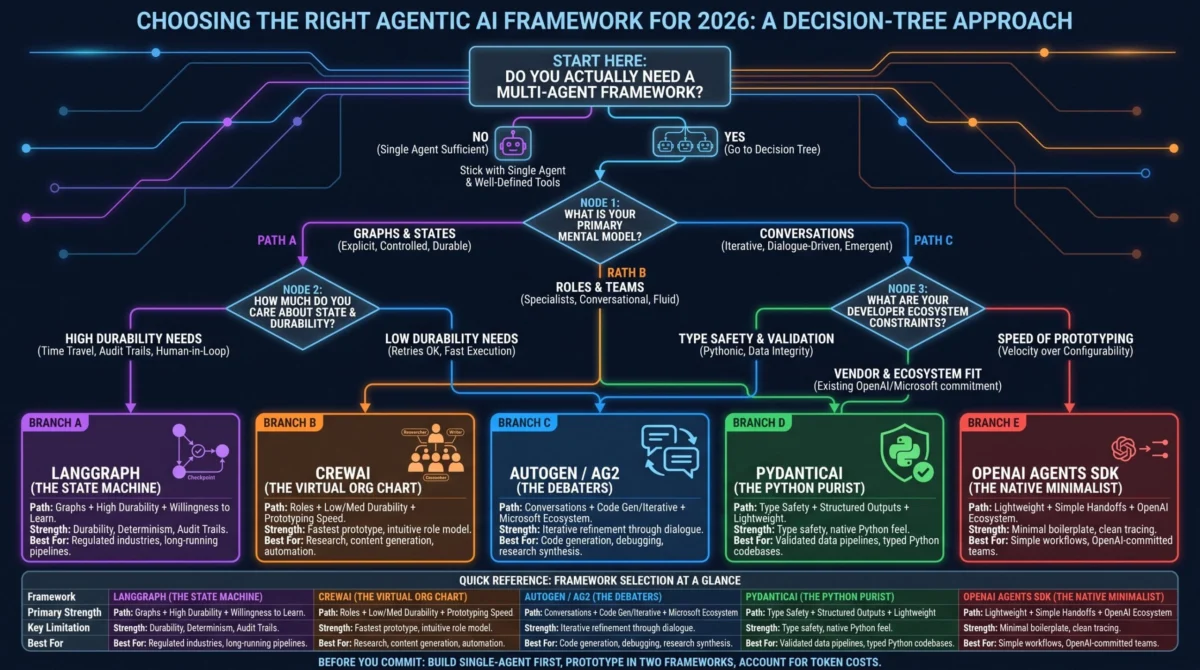
The landscape of artificial intelligence is no longer defined by simple prompts and singular responses. As we move into 2026, the industry has shifted decisively toward "agentic" systems—autonomous or semi-autonomous workflows capable of planning, tool use, and multi-step reasoning. However, for engineering teams tasked with deploying these systems into production, the transition from experimental notebook environments to robust, reliable infrastructure is fraught with hidden challenges.
Choosing the right orchestration framework is no longer a matter of checking GitHub stars or benchmarking latency; it is a fundamental architectural decision that will dictate the stability, observability, and compliance posture of your product for years to come.
The State of the Industry: From Scaffolding to Systems
In 2023, the agentic space was a collection of "toy" projects and experimental wrappers. Today, it has matured into a crowded ecosystem of specialized orchestration frameworks. These frameworks hold strong, often divergent, opinions on how agents should think, coordinate, and—crucially—fail.
The primary error developers make when evaluating these tools is focusing on the wrong metrics. "Ease of getting started" is a seductive but deceptive KPI. A framework that allows for rapid prototyping may lack the state management required for complex, high-stakes environments. Conversely, a framework built for high-assurance compliance may introduce unnecessary bureaucratic overhead for simple conversational assistants. This article provides a structured, decision-tree-based methodology to help you match your workload requirements to the right framework, ensuring your architecture is built to last.
The Fundamental Pre-requisite: Do You Need Multi-Agent Complexity?
Before diving into the framework selection process, it is vital to perform an honest assessment of your system’s necessity. Many developers reach for multi-agent orchestration prematurely.
A single, well-prompted agent equipped with robust tools can handle an astonishingly high percentage of production tasks. Single-agent systems are inherently easier to debug, monitor, and reason about. They possess a linear execution path that simplifies root-cause analysis when things go wrong.
You should only consider a multi-agent framework if your task exhibits the following:
- Separation of Concerns: The problem requires distinct skill sets (e.g., a data scientist agent and a software engineer agent) that cannot be effectively compressed into a single prompt.
- Recursive Planning: The task requires the agent to critique its own work or iterate based on external execution feedback in a way that requires separate "personas."
- Human-in-the-Loop Constraints: The workflow requires intermediate human intervention or oversight that is difficult to manage within a single-turn agent loop.
If your requirements do not align with these, build a single-agent system first. Add complexity only when the bottleneck becomes undeniable.
The Decision Tree: A Three-Node Architecture
To select the correct framework, map your project against three critical nodes.
Node 1: Defining Your Mental Model
How do you visualize the flow of information?
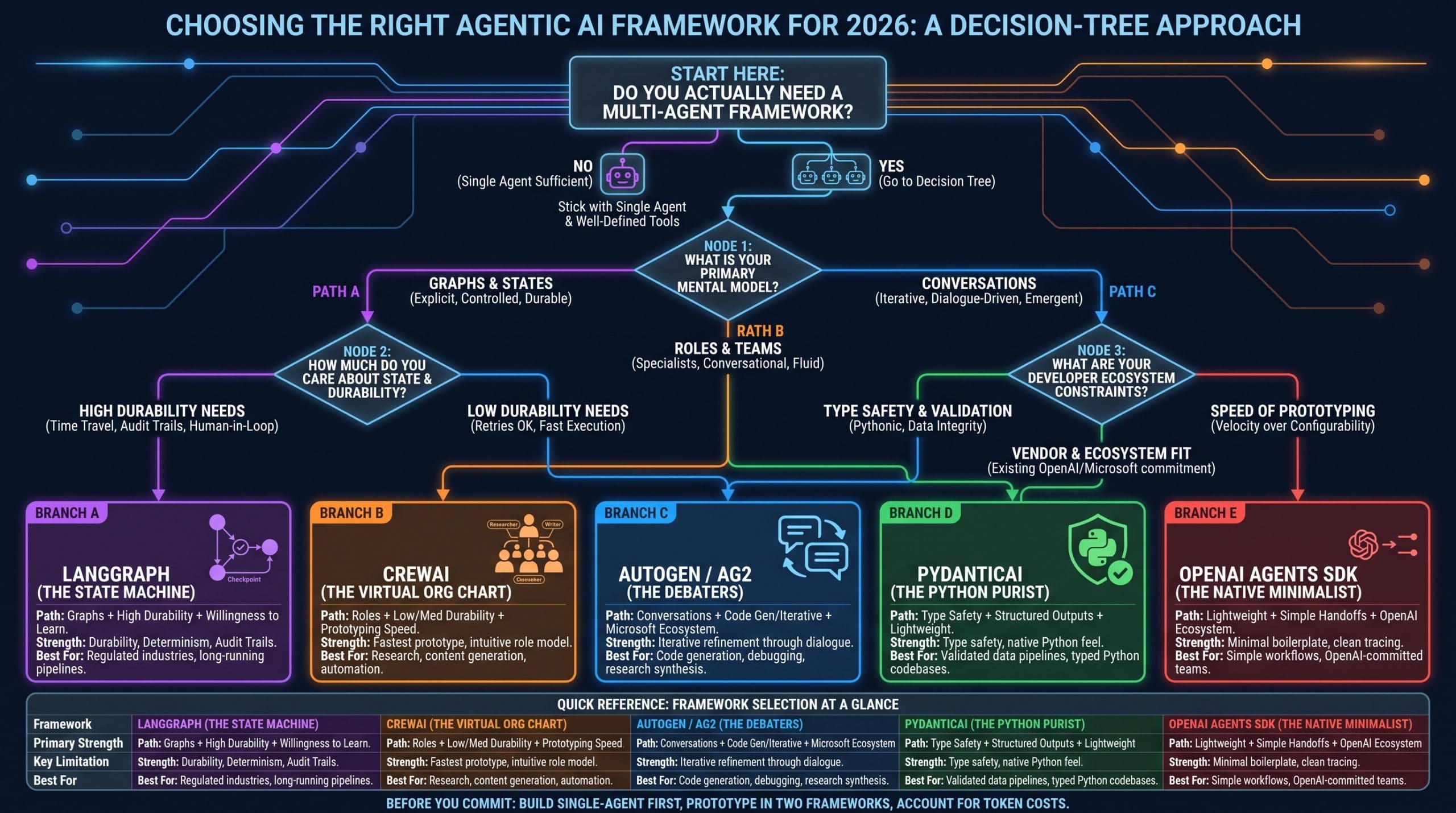
- The Graph/State Approach: You think in states and deterministic transitions. You care about what happens if a node fails or requires a retry.
- The Role-Based Approach: You think in teams. You want a "Researcher," a "Reviewer," and a "Writer" to hand off tasks in a collaborative, fluid manner.
- The Conversational Approach: You think in dialogues. Structure emerges from the debate between agents rather than from a pre-planned flow.
Node 2: Durability and State Management
Does your application require long-running persistence? If your process runs for minutes or hours, involves financial transactions, or deals with medical/legal records, you need high durability. This means the ability to "pause" a process, inspect state, and resume—a feature often lacking in lightweight frameworks.
Node 3: Ecosystem and Typing Constraints
Does your team live in Python with strict Pydantic models? Are you already heavily invested in the Microsoft Azure stack? Your framework choice should minimize "context switching" for your developers.
Analyzing the Five Pillars of Agentic Orchestration
1. LangGraph: The State Machine for Regulated Environments
LangGraph represents the most rigorous approach to agentic orchestration. By modeling workflows as directed graphs, it treats state as a first-class citizen.
- Key Advantage: "Time-travel" debugging. Because the state is serialized at every checkpoint, you can pause, inspect, modify, and resume a workflow.
- Best For: Banking, legal, and compliance-heavy sectors where "what the agent decided and why" must be auditable.
- Implication: It is verbose. It requires an investment in learning the graph abstraction and mapping out every edge case, but it provides the highest level of determinism.
2. CrewAI: The Virtual Organization
CrewAI utilizes the metaphor of a team. It allows developers to define agents with specific roles, backstories, and goals, then assemble them into a "crew."
- Key Advantage: Velocity. The mental model is intuitive, allowing for the rapid deployment of research-heavy or content-generation pipelines.
- Best For: Prototyping and tasks where moderate unpredictability is an acceptable trade-off for speed.
- Implication: Because coordination is fluid, it is harder to constrain agents if they begin to "hallucinate" or drift from their instructions.
3. AutoGen / AG2: The Conversational Engine
AG2 (formerly AutoGen) operates on the principle of agents conversing until they reach a result. It is particularly adept at iterative tasks like writing and testing code.
- Key Advantage: It thrives on complexity and iterative refinement, making it ideal for software development workflows.
- Best For: Teams already embedded in the Microsoft/Azure ecosystem and tasks that require iterative code execution.
- Implication: Conversation can lead to circular patterns. Developers must invest heavily in system prompt engineering to control the dialogue length and prevent drift.
4. PydanticAI: The Pythonic Choice
PydanticAI is not a full-blown orchestration suite; it is a library that brings type-safe validation to agent interactions.
- Key Advantage: It feels like native Python. If your codebase relies on FastAPI and Pydantic, this is the most seamless integration.
- Best For: Systems where data integrity and structured output are the primary requirements, not complex state transitions.
- Implication: You are responsible for building the orchestration layer yourself if your needs evolve beyond simple tool execution.
5. OpenAI Agents SDK: The Native Minimalist
Released in early 2025, this SDK offers the path of least resistance for organizations already fully committed to the OpenAI API.
- Key Advantage: Minimal boilerplate and excellent built-in observability for small-to-medium workflows.
- Best For: Rapid development of internal tools where vendor lock-in is a non-issue.
- Implication: The framework is tightly coupled to OpenAI. It is not designed for multi-model strategies or complex, non-linear branching.
Summary Comparison Table
| Framework | Primary Strength | Key Limitation | Best For |
|---|---|---|---|
| LangGraph | Durability/Auditability | Steep learning curve | Regulated Industries |
| CrewAI | Prototyping speed | Less constraint control | Content/Research |
| AutoGen/AG2 | Iterative refinement | Conversational drift | Code/Data Analysis |
| PydanticAI | Type safety | No built-in orchestration | Data-heavy pipelines |
| OpenAI SDK | Minimal boilerplate | Vendor lock-in | Simple workflows |
Operational Implications: The Hidden Costs
When moving to production, developers must account for the "Agent Tax." Multi-agent systems inherently consume more tokens than single agents. A four-agent crew performing parallel tasks can increase your token expenditure by an order of magnitude. Before committing to a framework, perform a cost-benefit analysis of the token throughput versus the value generated.
Final Recommendations for Engineering Leadership
- Start Single: Always validate your core logic with a single agent before introducing the complexity of an orchestrator.
- Conduct Parallel Prototyping: If you are undecided between two frameworks, spend 48 hours building the same workflow in both. The "feel" of the framework in your specific codebase will be more revealing than any marketing documentation.
- Prioritize Observability: Regardless of the framework, ensure your chosen path provides detailed logs of agent thoughts and tool calls. In production, the ability to trace a failure at 2 a.m. is more valuable than the number of features your framework provides.
The evolution of agentic AI is not just about the intelligence of the model, but the reliability of the system that hosts it. By choosing a framework that aligns with your operational constraints, you ensure that your AI is not just a demo, but a scalable, production-ready asset.



