





By Pierluigi Paganini
November 19, 2026
The PHP development team has issued a high-priority alert to the global web development community, announcing a series of critical security updates scheduled for release today, November 19, 2026. These patches are designed to address a spectrum of vulnerabilities affecting all currently supported versions of the ubiquitous server-side scripting language. While the project maintainers have labeled the most severe flaws as "CRITICAL," they have provided a crucial caveat: successful exploitation typically requires highly specific, non-default server configurations.
Nevertheless, given the foundational role PHP plays in the modern web—powering approximately 75% of all websites, including major content management systems and enterprise applications—the upcoming release is being treated as a high-stakes event for system administrators and cybersecurity teams worldwide.
The Core Situation: Understanding the Imminent Patches
The announcement, delivered via the official PHP development portal, confirms that the security patches will be deployed between 14:00 and 14:30 UTC today. This release aligns with the project’s established four-week maintenance and security cadence, though the severity of the identified flaws has heightened the urgency of this specific update cycle.
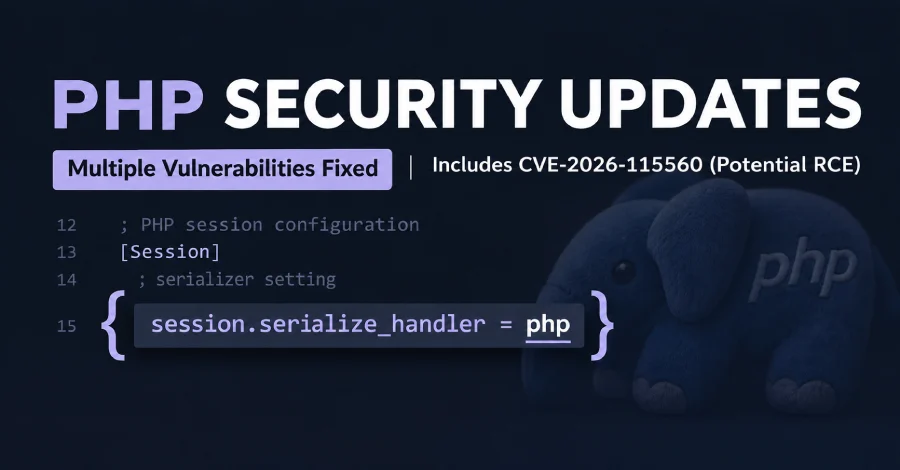
The primary concern among security researchers is a known remote code execution (RCE) vulnerability, tracked as CVE-2026-115560. This specific flaw targets the way PHP handles session data. While the development team has refrained from disclosing the full technical exploit chain prior to the patch release, they have confirmed that the vulnerability exists within the logic governing session serialization.
The Nuance of "Non-Default" Configurations
In the world of cybersecurity, "non-default" is often a double-edged sword. While it suggests that the average out-of-the-box installation of PHP might be safe, it provides a false sense of security for large-scale enterprise environments. Many enterprise applications, custom-built platforms, and legacy systems often utilize specialized php.ini configurations to maintain compatibility with older infrastructure or to optimize performance for specific traffic patterns. It is precisely these "uncommon setups" that the PHP security team warns are the most vulnerable.
A Chronology of Recent PHP Security Challenges
The November 19 release does not exist in a vacuum. The PHP project has faced an exceptionally volatile autumn in 2026, dealing with a rapid succession of critical vulnerabilities that have tested the agility of the security team and the response times of IT departments globally.
The "PHP2Shell" Crisis (October 2026)
Only one month ago, the security landscape was rocked by the discovery of two critical RCE flaws, collectively dubbed "PHP2Shell" (tracked as CVE-2026-109618 and CVE-2026-109619). These vulnerabilities allowed unauthenticated remote attackers to execute arbitrary code by sending specially crafted HTTP requests to a target server. The speed and severity of these flaws necessitated an emergency patch release on October 21, 2026, forcing many organizations to perform rapid, unscheduled maintenance over the following 48 hours.
The Emergence of CVE-2026-115560
Hardly had the dust settled from the PHP2Shell remediation when researchers identified a new, separate threat: CVE-2026-115560. Despite the proximity of the two events, the PHP team clarified that the new session-handling flaw was distinct from the PHP2Shell issues and was not addressed by the October 21 emergency patches.
On October 23, the team issued an interim advisory, recommending a temporary workaround: disabling "session upload progress" until a formal patch could be integrated into the core codebase. This sequence of events—a critical emergency patch followed immediately by the discovery of a new, complex session-management flaw—has placed significant strain on the community’s trust in the security posture of the current PHP development branch.

Technical Deep-Dive: The Mechanics of the Session Flaw
While full details are withheld to prevent exploitation before the patches are applied, the vulnerability profile of CVE-2026-115560 provides insight into the complexity of the issue. According to initial disclosures, the flaw triggers only when a specific, highly specific chain of conditions is met:
- Configuration Requirements: The application must explicitly set
session.serialize_handlerto eitherphp_binaryorphp_serialize. - Runtime Manipulation: The application must use
ini_set()to alter the session handler tophpat runtime. - Timing Constraints: This alteration must occur strictly before the
session_start()function is invoked. - Feature Dependencies: The
session.upload_progressfeature must remain enabled.
For the average developer, this combination of settings might seem obscure. However, in the context of complex frameworks that handle session serialization in abstracted ways, these conditions may be met unintentionally. The reliance on ini_set for dynamic configuration is a common practice in legacy applications or complex middleware, making the potential attack surface larger than a cursory glance might suggest.
Official Responses and Strategic Guidance
The PHP security team’s messaging has been consistent: prioritize preparation. By refusing to release technical details ahead of the patch, the team aims to prevent "day-zero" exploitation by malicious actors who would otherwise use the information to reverse-engineer the flaw.
Recommendations for Administrators
- Inventory Your Footprint: Before the patches land, administrators should use server audits to identify exactly which versions of PHP are running in production, staging, and development environments.
- Review
php.iniFiles: Search configurations for the specific parameters mentioned:session.serialize_handlerandsession.upload_progress. If your application does not strictly require the upload progress feature, disabling it remains the most effective short-term mitigation. - Monitor Distribution Channels: If your organization relies on PHP versions provided by Linux distributions (e.g., Debian, RHEL, Ubuntu) or third-party repositories, be aware that there may be a slight lag between the upstream PHP release and the distribution’s package update. Proactively check your provider’s security mailing lists.
- Test in Staging: Do not apply these patches directly to production without a smoke test. Given the nature of these fixes—touching core session handling—there is a risk of breaking authentication mechanisms or session persistence if an application relies heavily on non-standard serialization.
The Implications of "End-of-Life" Versions
A significant portion of the web continues to run on legacy PHP versions, such as 8.1 and earlier, which have reached their end-of-life (EOL) status. These versions no longer receive official security support from the PHP group.
The danger for organizations running these EOL versions is two-fold. First, they will not receive the official patch for the vulnerabilities disclosed today. Second, they may be operating under the false assumption that their OS vendor is providing "backported" security patches. While some enterprise Linux providers (like Red Hat or Canonical) provide extended support for specific versions, this is not a universal guarantee. Organizations currently running legacy PHP must treat their environment as permanently vulnerable and prioritize migration to a supported version (8.3, 8.4, or 8.5) as a critical business continuity initiative.
Conclusion: A Turning Point for PHP Security
The rapid-fire nature of the security disclosures in late 2026 highlights the ongoing tension between feature velocity and security stability. As PHP continues to evolve, the complexity of its core components—particularly those dealing with session management and HTTP request processing—becomes a focal point for security researchers and threat actors alike.
The upcoming release on November 19 is more than just a routine update; it is a reminder that the "security by obscurity" approach is no longer viable in an era of automated, large-scale vulnerability scanning. Administrators must move away from reactive, manual patching toward an automated, continuous delivery model for security updates.
As we await the technical disclosures accompanying today’s release, the global PHP community remains on high alert. The effectiveness of these patches will be measured not just by the code they change, but by how quickly and effectively the vast, distributed ecosystem of PHP-based web infrastructure can absorb them. For now, the directive is clear: Prepare to upgrade, verify your configuration, and ensure that your patching pipeline is ready for immediate deployment.
For ongoing updates regarding these vulnerabilities and further technical analysis, follow the official PHP mailing lists and monitor security bulletins from your respective distribution maintainers.