




By Security News Desk
Published: November 19, 2026
Category: Vulnerability / Web Security
Main Facts
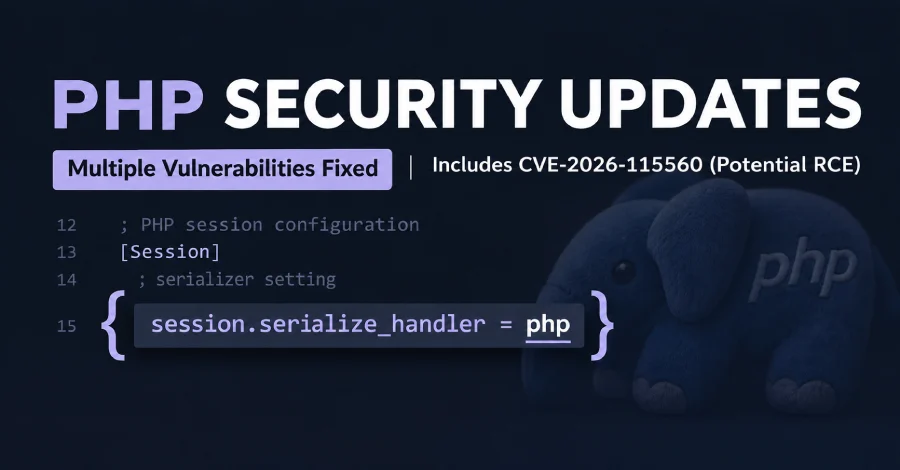
The PHP Foundation has officially rolled out critical security updates to address multiple severe vulnerabilities impacting all actively supported branches of the PHP programming language. Among these is a high-severity flaw tracked as CVE-2026-115560, alongside another critical vulnerability cataloged as CVE-2026-126714 and codenamed "phpAfterShell" by cybersecurity researchers at Depthfirst.
When successfully exploited, these vulnerabilities can allow remote attackers to achieve remote code execution (RCE) on target web servers. Depending on the specific configuration and the flaw being targeted, the consequences of exploitation extend far beyond RCE to include session corruption, denial-of-service (DoS) conditions, memory corruption, and local privilege escalation.
While the majority of these flaws manifest under non-default configurations, uncommon setups, or specific operational states, the ubiquity of PHP across the modern web means that millions of deployments are potentially exposed. The PHP Foundation has urged developers and system administrators to update their software immediately, particularly those running versions 8.2.x, 8.3.x, 8.4.x, and 8.5.x.
Chronology of the Discovery
The sequence of events leading to the release of these patches began with an advance notice issued by PHP project maintainers. In that initial advisory, the core development team alerted the global user base that multiple critical vulnerabilities had been discovered. These flaws were verified to affect all supported iterations of PHP under distinct operating conditions.
Following the advance warning, security research firm Depthfirst published deep-dive technical findings into CVE-2026-126714, shedding light on how a seemingly mundane file-write interruption could be weaponized into an advanced RCE primitive. Depthfirst’s researchers, including security analyst Yuhang Wu, mapped out the precise mechanics of the attack vector, subsequently dubbed "phpAfterShell."
Realizing the severity of the threat landscape—especially given the weaponizability of the session corruption flaws—the PHP Foundation expedited its development pipeline. Emergency patches were finalized and pushed to the official source repositories, culminating in the release of updated versions across the PHP ecosystem. Administrators are now racing to apply these updates before malicious actors can weaponize the proof-of-concept exploits currently circulating in security research circles.
Supporting Data and Technical Analysis
To fully understand the threat posed by CVE-2026-126714 ("phpAfterShell"), one must examine how PHP handles file-based sessions and how write operations can be manipulated.
The Anatomy of "phpAfterShell" (CVE-2026-126714)
At its core, the vulnerability stems from what happens when a pwrite() or ftruncate() system update is interrupted. Under normal operating conditions, PHP writes session data to disk atomically or sequentially. However, if a PHP worker process dies mid-write, or terminates immediately after a write finishes but before legacy data from a previous session is cleared, a malformed session file is left behind on the disk.
This results in a hybrid file state containing a mixture of two distinct session timelines. According to Yuhang Wu of Depthfirst:
"Depending on where the interruption happens, part of the new Session may already have been written while bytes from the previous Session remain on disk. The result can be a Session file containing the prefix of the new serialized data and the tail of the old one."
Exploitation Mechanics: Splicing and Deserialization
An attacker who understands this behavior can strategically manipulate length fields within the newly introduced prefix. By doing so, they trick PHP’s native Session decoder into interpreting leftover, dangling bytes—which were originally part of an ordinary, harmless string—as entirely separate session entries and serialized objects.

Crucially, the attacker does not need to execute malicious code during the upload-progress callback itself. The attack sequence unfolds in specific phases:
- The Setup: The attacker leaves the carefully crafted byte combination on the disk via interrupted file writes or upload-progress mechanics.
- The Wait: The attacker waits for the web application to invoke
session_start(). - The Execution: Upon reading the corrupted session file, PHP treats the spliced data as a legitimate server-side state, deserializing the embedded malicious objects.
- The Chaining: By chaining this unexpected deserialization primitive with a pre-existing memory-corruption bug found in a PHP-native class, the attacker achieves full remote code execution.
Affected Environments and Mitigations
The vulnerability universally impacts any web application running an affected version of PHP that relies on file-based session management.
For organizations unable to deploy the official software patches immediately, Depthfirst and PHP maintainers have recommended a temporary workaround: turning off session upload progress. While this mitigation does not fix the underlying code defects, it successfully blocks the primary attack vector used to trigger the file-write interruptions necessary for the exploit.
Official Responses and Remediation
The PHP Foundation has moved swiftly to remediate these issues, releasing comprehensive changelogs and source code updates. Official security advisories have been published on the official PHP website and mirrored on the project’s GitHub repository.
Patch Availability
Security updates have been integrated into the following PHP branches and version numbers:
- PHP 8.2.x: Upgraded to the latest secure release.
- PHP 8.3.x: Upgraded to the latest secure release.
- PHP 8.4.x: Upgraded to the latest secure release.
- PHP 8.5.x: Upgraded to the latest secure release.
System administrators, DevOps engineers, and enterprise IT teams operating servers on any of these active branches are strongly advised to consult the official PHP ChangeLog and execute upgrades immediately.
Broader Implications for Web Security
The discovery of CVE-2026-115560 and CVE-2026-126714 highlights ongoing systemic challenges in modern web application security, particularly regarding how complex languages interact with low-level operating system primitives like file systems and memory management.
1. The Danger of Implicit Trust in State Files
The "phpAfterShell" exploit serves as a stark reminder that data integrity checks must extend to local cache and session files. When applications blindly trust and deserialize data read from local disks—assuming that local storage is inherently secure from malformation—they open the door to advanced logic and memory corruption vulnerabilities. Attackers increasingly look for "secondary effects," turning standard operational anomalies (like an interrupted write) into critical security primitives.
2. Supply Chain and Infrastructure Vulnerabilities
Because PHP powers a vast majority of the world’s content management systems, e-commerce platforms, and custom web applications, a critical RCE vulnerability in the language interpreter itself poses a systemic risk. A single unpatched server running vulnerable file-based sessions can serve as an initial foothold for lateral movement within an enterprise network, potentially leading to widespread data breaches or ransomware deployment.
3. Proactive Defensive Posture
As security researchers continue to weaponize edge-case behaviors—such as race conditions, interrupted I/O operations, and deserialization chains—development foundations and open-source projects are under increasing pressure to adopt rigorous fuzzing and code-auditing practices. For enterprise defenders, this incident reinforces the necessity of automated vulnerability management, rapid patch deployment cycles, and the implementation of defense-in-depth strategies that minimize the impact of a potential remote code execution event.
Stay informed on the latest developments in web security by following trusted security advisories, reviewing official repository changelogs, and monitoring updates from organizations like the PHP Foundation.