







SEATTLE — In a major expansion of its serverless computing portfolio, Amazon Web Services (AWS) has announced native GPU support for EC2 G-series instances running on AWS Lambda Managed Instances (LMI). The launch bridges a long-standing divide in cloud architecture: the high-performance computing power required for modern artificial intelligence, machine learning inference, and media rendering, paired with the operational simplicity of serverless deployment.
For years, developers working with GPU-accelerated workloads have faced significant overhead. Setting up self-managed GPU infrastructure traditionally requires selecting precise instance types, manually installing and reconciling complex GPU drivers and CUDA libraries, planning rigid capacity, writing custom scaling logic, and building bespoke event integrations. While alternative serverless GPU solutions have emerged, they frequently operate outside core enterprise cloud environments, lacking native event sources, unified identity management, and secure networking.
AWS is aiming to dismantle these barriers. By combining Amazon EC2’s robust GPU hardware capabilities with Lambda’s fully managed orchestration framework, developers can now execute intensive workloads—such as large language model (LLM) inference, computer vision, scientific computing, and media transcoding—without ever managing a server, driver, or cluster.
Chronology of the Release and Hands-On Integration
The introduction of GPU support for Lambda Managed Instances follows a systematic rollout designed to integrate advanced hardware seamlessly into the existing Lambda programming model.
Step 1: Establishing the Capacity Provider
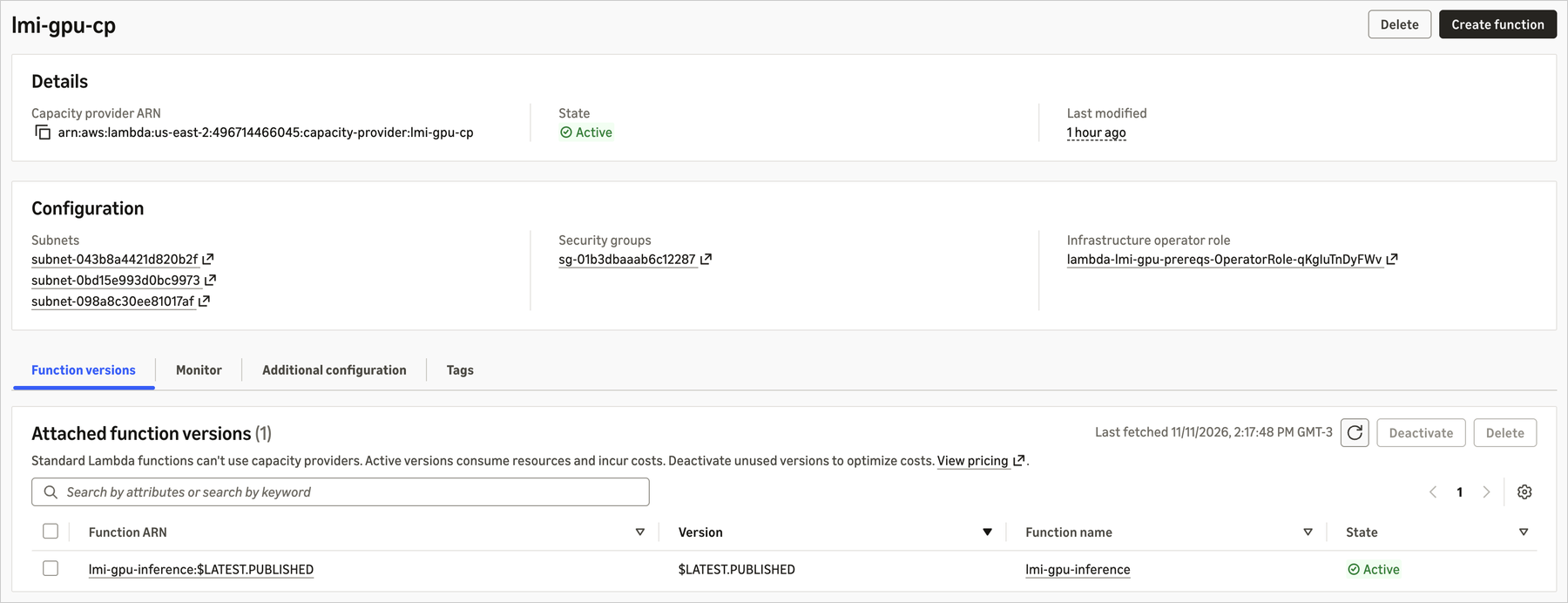
The operational lifecycle of a serverless GPU function begins with the creation of a dedicated capacity provider. Administrators define the allowed EC2 GPU instance types—such as g5.2xlarge, g6.2xlarge, or g6e.2xlarge—alongside Virtual Private Cloud (VPC) subnets, security groups, and automated scaling parameters. Listing multiple instance generations allows Lambda to dynamically select the most cost-effective and available hardware, mitigating Insufficient Capacity Errors (ICE).
Step 2: Building and Deploying the OCI Image
GPU-accelerated functions are packaged as Open Container Initiative (OCI) images up to 32 GB in size. To minimize boilerplate code, AWS provides a suite of curated base images pre-configured with popular frameworks and runtimes, including the CUDA toolkit (base:cuda), numeric computing libraries (cupy:cuda), machine learning suites (pytorch:cuda), and high-performance serving frameworks (vllm:cuda and sglang:cuda).

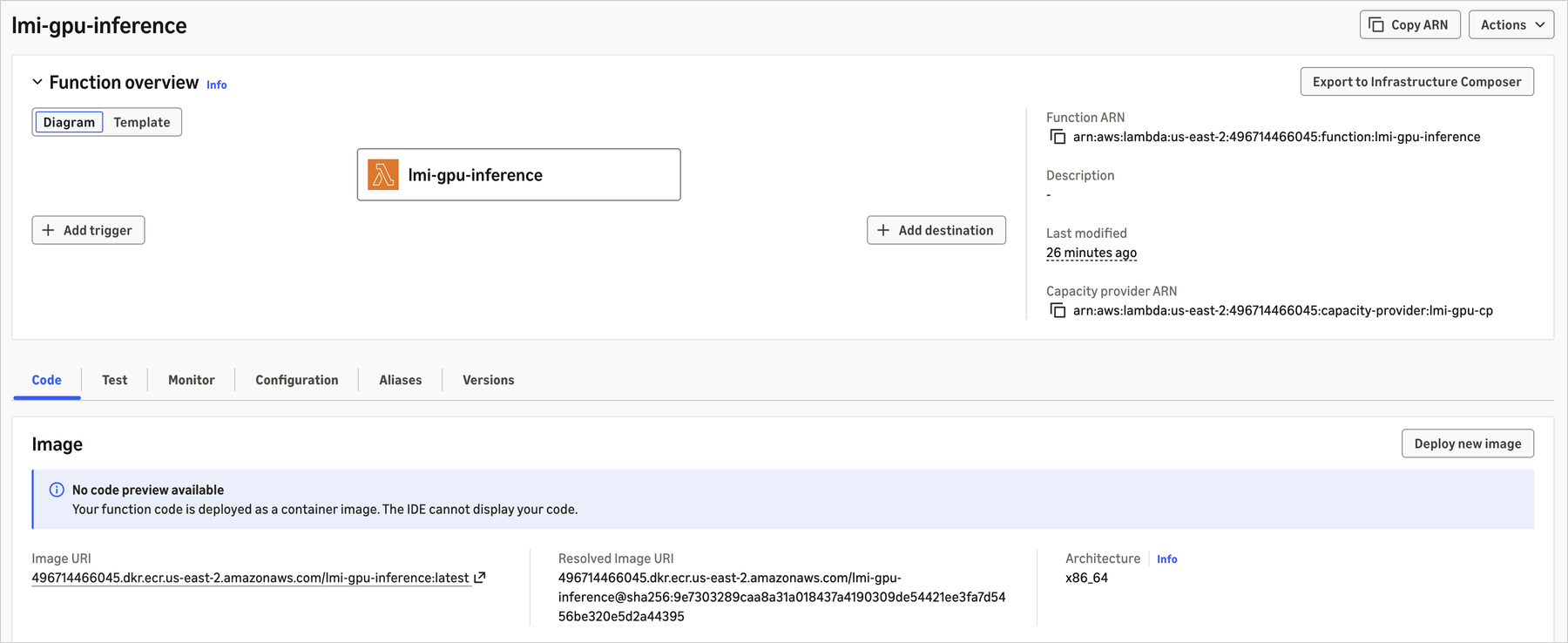
In a practical deployment of an open-source instruction-tuned model—specifically Qwen/Qwen2.5-1.5B-Instruct via vLLM—developers can construct a fully operational Dockerfile using a single line referencing the AWS-provided base image. By pushing the container to Amazon Elastic Container Registry (ECR) and pointing the function configuration to a Hugging Face model identifier or Amazon S3 bucket, Lambda automatically handles model downloading, GPU memory management, and request batching.
Step 3: Publishing and Execution
To eliminate runtime latency and cold starts for end-users, functions on Lambda Managed Instances execute from published versions. During the version-publishing phase, the underlying execution environment provisions the hardware, downloads model weights, and warms up the serving engine. Once active, the function can be invoked via standard event payloads, utilizing OpenAI-compatible API schemas for seamless integration into existing application architectures.
Supporting Data, Specifications, and Technical Architecture
The underlying architecture of GPU-accelerated Lambda Managed Instances has been engineered to handle enterprise-grade throughput while maximizing resource utilization—a critical factor given the high cost of accelerated hardware.
Resource Limits and Performance Constraints
- Function Timeouts: Supports extended function execution windows of up to 90 minutes for asynchronous and event source mapping invocations, accommodating complex batch processing and media rendering jobs.
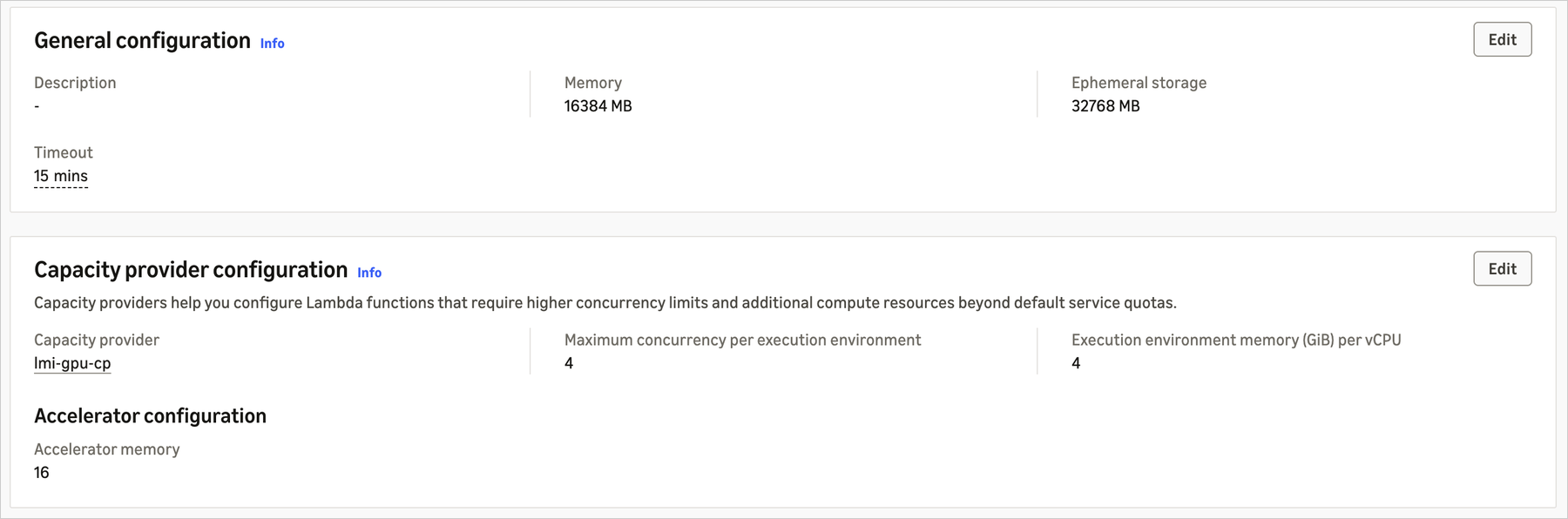
- Storage and Memory: Accommodates container images up to 32 GB (with a 10 GB per file limit), up to 32 GB of NVMe ephemeral storage in
/tmpfor model weights, and 3,072 to 49,152 MB of total memory. - Accelerator Configuration: Offers 3 to 48 GB of dedicated accelerator memory.
- Concurrency: Supports up to 48 concurrent requests per execution environment and scaling up to 15,000 vCPUs per capacity provider.
- Lazy Loading: Leverages Seekable OCI (SOCI) lazy loading to enable functions to begin execution before container images are fully downloaded, cutting startup latency by up to 70%.
Addressing the GPU Utilization Gap
A primary hurdle in cloud economics has been GPU underutilization. Because a single specialized task rarely saturates an entire GPU, organizations frequently pay for idle hardware capacity. Lambda Managed Instances solve this by consolidating multiple concurrent functions onto shared execution environments. The built-in vLLM and SGLang servers batch concurrent requests across a single copy of a model loaded into GPU memory.
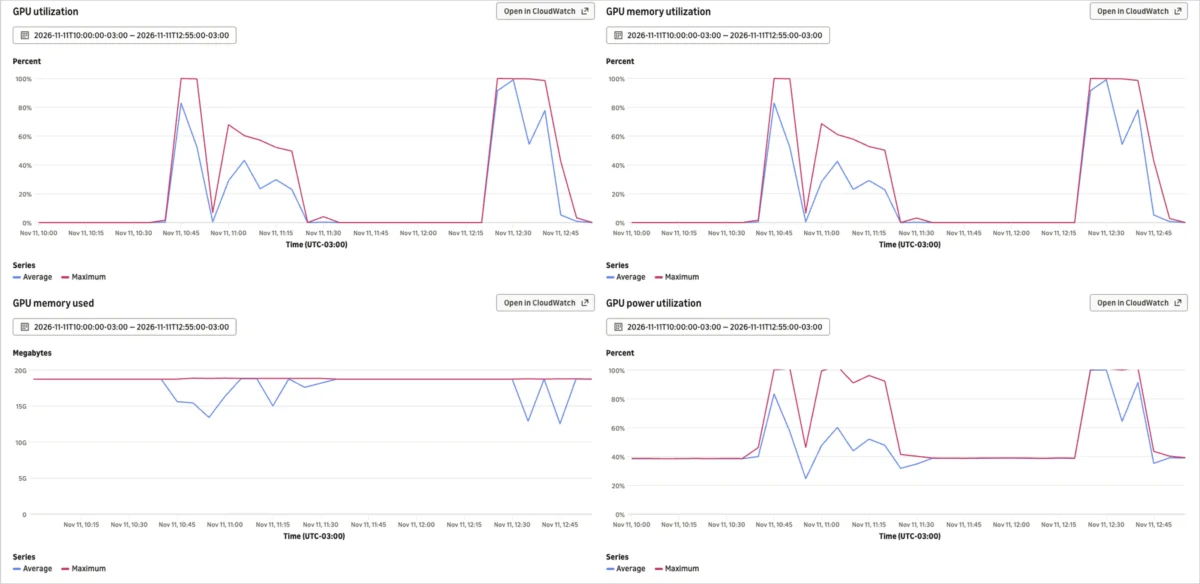
Furthermore, native integration with Amazon CloudWatch provides real-time telemetry out of the box. Developers can monitor GPU utilization, GPU memory utilization, absolute memory consumption, and power draw alongside standard Lambda metrics, providing the precise data needed to fine-tune auto-scaling thresholds and optimize operational expenditures.
Official Perspectives and Ecosystem Integration
AWS leaders emphasize that this release is not merely about adding hardware options, but about harmonizing specialized acceleration with the broader serverless paradigm.
"Customers have consistently asked to run heavy-duty machine learning and data processing workloads with the absolute operational simplicity of serverless," said an AWS engineering lead close to the project. "By embedding GPU acceleration directly into Lambda Managed Instances, we are eliminating the friction of driver management, cluster scaling, and complex networking, allowing builders to focus entirely on their applications."
The GPU-accelerated functions do not operate in a vacuum; they compose naturally with other advanced AWS services:
- Lambda Durable Functions: Orchestrate complex, multi-step, long-running workflows around the GPU execution step, featuring native checkpointing and automatic error recovery.
- Lambda MicroVMs: Isolate untrusted or model-generated code securely on CPUs before handing off heavy inference requests to the GPU-backed functions.
- Event Source Mappings: Allow over 200 native AWS event sources—including Amazon S3, Amazon SQS, Amazon API Gateway, and Amazon EventBridge—to trigger GPU workloads directly without writing integration plumbing.
Enterprise Implications and Future Outlook
The introduction of serverless GPUs fundamentally shifts the calculus for development teams building AI-enabled applications, media processing pipelines, and scientific simulations.
Lowering the Barrier to Entry for Custom AI
While fully managed foundation model services like Amazon Bedrock remain ideal for consuming large, pre-trained commercial models, organizations frequently need to deploy specialized, smaller, or fine-tuned custom models (such as domain-specific LLMs or computer vision models) for tasks like automated document classification, real-time summarization, and local data extraction. Serverless GPUs provide a cost-effective, zero-administration landing zone for these custom artifacts.
Cost and Licensing Economics
From a financial perspective, the pricing model is structured to align flexibility with enterprise predictability. Users pay the baseline Amazon EC2 On-Demand instance fee—which is fully compatible with existing AWS Savings Plans and Reserved Instances—alongside a 9.75 percent management fee for the GPU instances and standard Lambda request fees ($0.20 per million requests). For organizations requiring guaranteed hardware availability, support for EC2 On-Demand Capacity Reservations (ODCR) ensures that serverless scaling remains bound to guaranteed physical capacity.
As the industry moves toward increasingly agentic workflows and real-time multimodal processing, the ability to invoke raw GPU compute with the frictionless scaling of an event-driven function marks a pivotal milestone. Available immediately for EC2 G-series instances—including G4dn, G5, G6, G6f, Gr6, Gr6f, and G6e—AWS has signaled that additional instance families will be added to the lineup in the near future, cementing serverless computing as a viable operational model for the most demanding computational workloads in the cloud.