










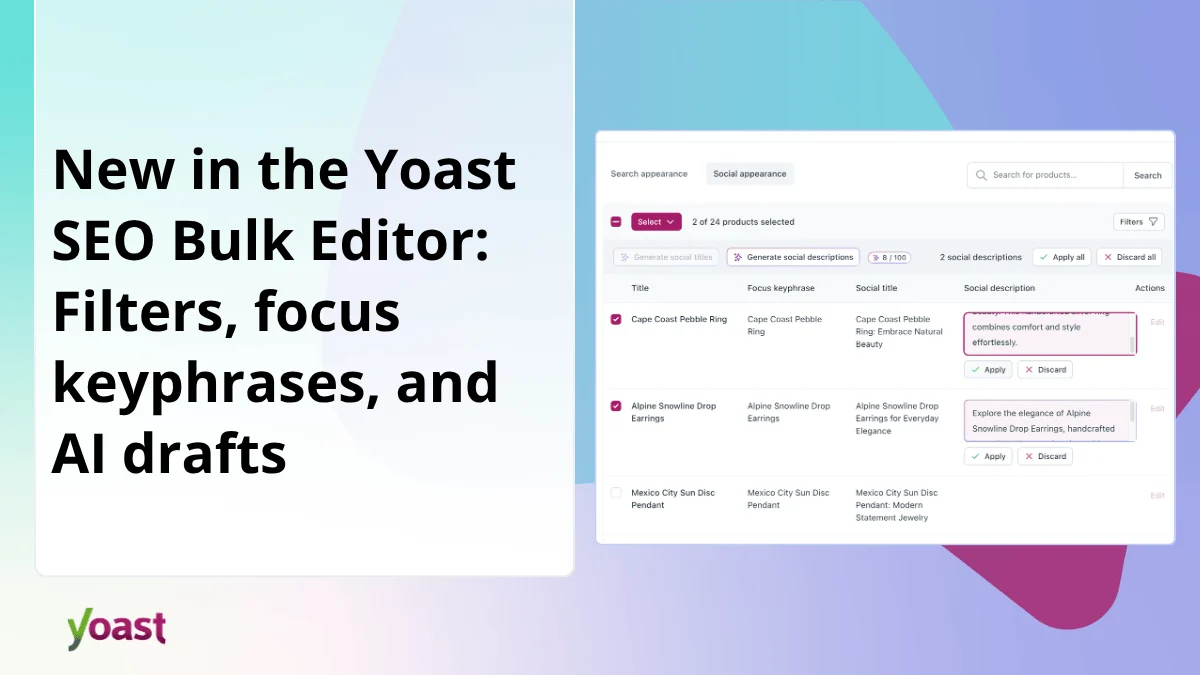
In the rapidly evolving landscape of search engine optimization, the ability to manage content at scale is no longer a luxury—it is a necessity. Yoast, a cornerstone of the WordPress ecosystem, has officially announced a comprehensive redesign and functional expansion of its flagship Bulk Editor tool. This update represents a significant shift from a simple administrative utility to an intelligent, AI-powered command center designed to help site owners, e-commerce managers, and digital agencies optimize thousands of pages in a fraction of the time previously required.
The Main Facts: A New Era for Site Management
The updated Yoast SEO Bulk Editor is designed to address the "SEO debt" that plagues many large-scale websites. By centralizing the management of titles, meta descriptions, and—for the first time—focus keyphrases, the tool allows users to maintain site-wide optimization without navigating through individual page editors.
The core of this release lies in its granular control. Users can now filter by content type, meaning blog posts, landing pages, and product catalogs each have dedicated, uncluttered views. By integrating AI-driven metadata generation into this workflow, Yoast is effectively bridging the gap between manual oversight and automated efficiency. This is not merely an update; it is an infrastructure change intended to transform how publishers approach the daunting task of auditing and updating high-volume content repositories.
Chronology: From Static Editor to Intelligent Assistant
The journey of the Yoast Bulk Editor has been one of gradual maturation. Initially, the tool served as a simple spreadsheet-like interface, providing a bird’s-eye view of meta tags. However, as the digital landscape became more saturated and search intent became more complex, Yoast recognized that users were struggling with the sheer volume of data required for modern SEO.
- Phase 1: The Foundation. The original Bulk Editor provided a centralized dashboard for basic title and description updates, successfully reducing the time needed to click through individual WordPress pages.
- Phase 2: Data-Driven Refinement. Recognizing the need for better organization, Yoast implemented content-type filtering, allowing users to separate blog posts from pages.
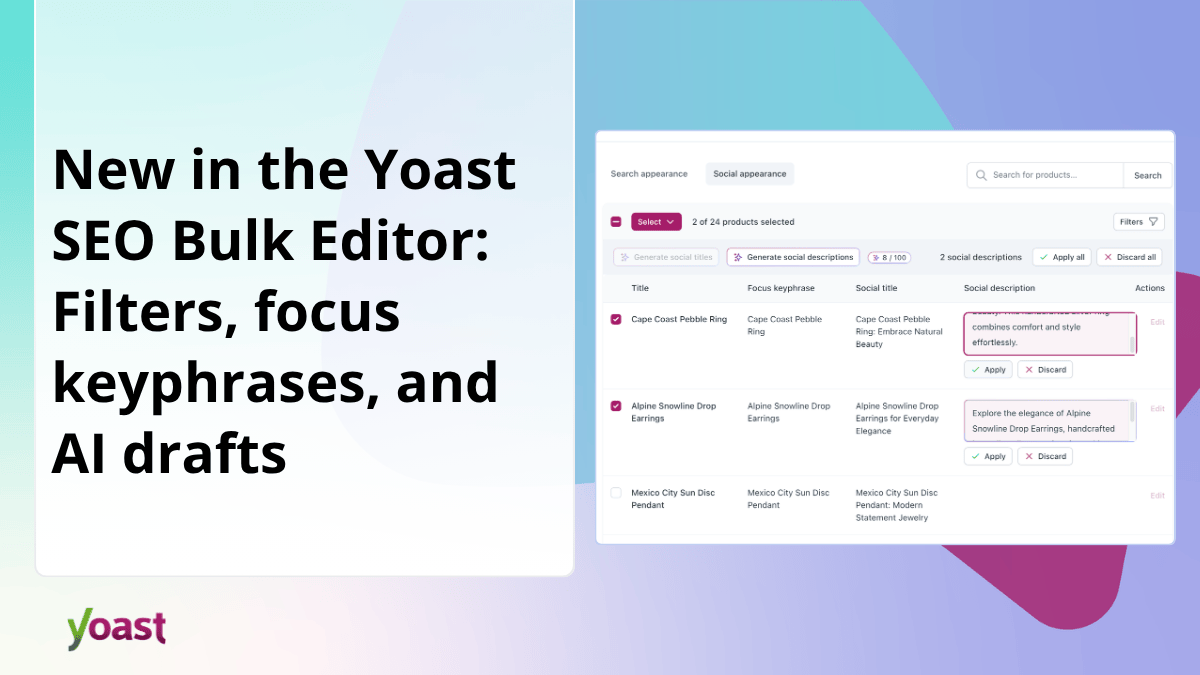
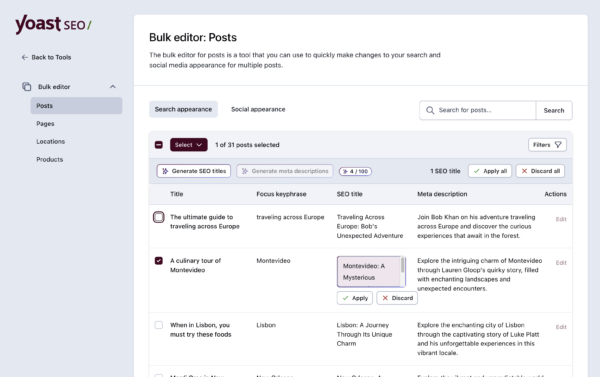
- Phase 3: The AI Integration (The Current Release). This latest milestone introduces the "AI Draft, You Approve" paradigm. By incorporating machine learning into the bulk workflow, Yoast has shifted the user’s role from "writer" to "editor-in-chief," overseeing metadata generated by AI but retaining the final sign-off.
Supporting Data: Why Scale Matters
For the average website owner, the numbers tell a compelling story. A site with 500 pages, each requiring a unique meta description of 150 characters, represents a significant time investment. If a manual update takes approximately three minutes per page, that represents 25 hours of work—roughly three full working days.
By leveraging the new Bulk Editor, users can:
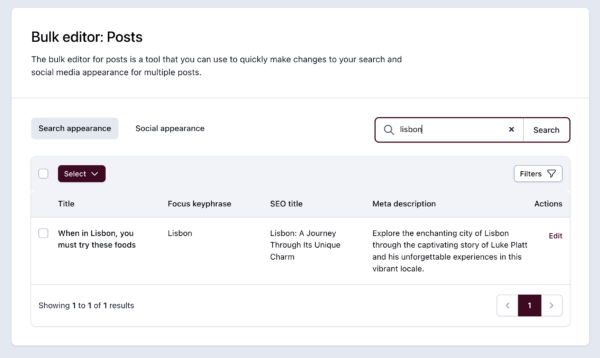
- Reduce Audit Times: With the new status filters (e.g., "missing description"), users can identify "broken" SEO components in seconds.
- Batch Processing: The ability to generate metadata for dozens of pages simultaneously using AI reduces the labor cost of SEO management by an estimated 70–80%.
- Increased Coverage: Data indicates that websites with 100% unique meta descriptions see higher click-through rates (CTR) from search engine results pages (SERPs). Tools like this make it feasible for massive sites to achieve that 100% threshold, which was previously deemed impossible due to manual labor constraints.
Official Responses and Strategic Vision
According to Beth Parker, Product Marketing Manager at Yoast, the update is a response to the "tedious reality" of digital marketing. "Whether you manage 50 pages or 5,000," Parker notes, "the Bulk Editor remains the fastest way to get a site to a solid SEO baseline without starting from scratch."
Yoast’s strategic pivot toward AI-integrated workflows reflects a broader industry trend where the software itself acts as an assistant. The company emphasizes that while the AI is powerful, it is explicitly designed to keep the human in the loop. "Crucially, nothing saves without your permission," the company stated in its release documentation. By providing per-row and batch-apply controls, Yoast is positioning itself as a tool for "responsible AI," ensuring that users never lose control over their site’s brand voice or keyword strategy.
The E-commerce Implication: Scaling the Catalog
Perhaps the most significant impact of this release is felt within the WooCommerce sector. For e-commerce stores, managing thousands of product descriptions is often the primary bottleneck for SEO.
The new update specifically addresses this by allowing store owners to:
- Isolate Product Data: With a dedicated view for products, users can filter by category, stock status, or price point to apply targeted SEO strategies.
- AI-Driven Product Metadata: By utilizing Yoast WooCommerce SEO and Yoast SEO AI+, store owners can generate unique, SEO-friendly descriptions for hundreds of products in minutes.
- Seasonal Agility: During peak shopping seasons, such as Black Friday or holiday sales, the ability to rapidly update metadata for specific product collections provides a massive competitive advantage.
Implications for SEO Professionals and Agencies
For SEO agencies, the tool is a game-changer. Agencies often manage multiple client sites simultaneously, and the "inheritance" of a poorly optimized site is a common pain point. The Bulk Editor allows an agency to ingest a new client site, run a filter to identify missing metadata, and draft high-quality improvements within hours rather than days.
Furthermore, the focus on "focus keyphrases" in the bulk view allows for a more holistic strategy. Professionals can now see exactly which pages are competing for the same keywords across a site, preventing internal keyword cannibalization—a common issue that often goes unnoticed in smaller, page-by-page workflows.
The Future of "Bulk" Management
As AI models continue to advance, the "human-in-the-loop" model championed by Yoast appears to be the most sustainable approach to search engine optimization. The risk of automated, mass-produced content is often low quality and genericism; by forcing a review step, Yoast ensures that the final output maintains the nuance and specificity required to rank in competitive search environments.
The integration of search and status filters also points to a future where site management becomes proactive rather than reactive. Instead of waiting for a manual audit to discover missing meta descriptions, the dashboard serves as a continuous monitoring tool.
Conclusion: Efficiency as a Competitive Advantage
In the digital age, speed is a metric of its own. The overhaul of the Yoast SEO Bulk Editor is a testament to the fact that as websites grow in complexity, the tools used to manage them must evolve to provide higher-level oversight.
By combining powerful filtering, deep content-type organization, and responsible AI implementation, Yoast has delivered a suite that allows users to reclaim their time. Whether you are a small business owner aiming to bolster your local search presence or an e-commerce manager overseeing a catalog of thousands, this update provides the control and the speed necessary to remain competitive in an increasingly crowded digital landscape. As the saying goes, you cannot fix what you cannot see—and with this release, Yoast has ensured that you can see, filter, and optimize your entire digital footprint with unprecedented clarity.