










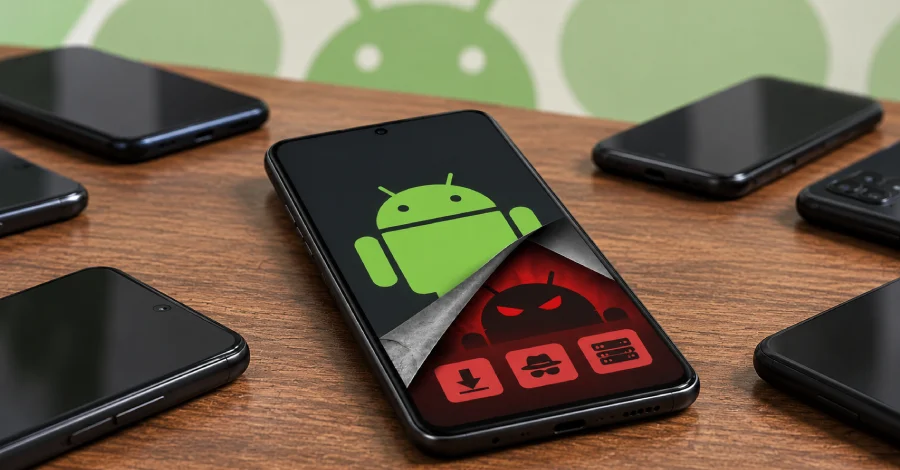
Introduction: A Silent Intruder in the System Partition
In the modern digital landscape, consumers trust that the smartphones they purchase—even budget models—arrive as clean slates, safe for personal communication, banking, and daily organization. However, a sweeping new cybersecurity discovery shatters that fundamental assumption. Cybersecurity researchers at Bitdefender have uncovered a sophisticated, large-scale supply chain attack dubbed Midnight Mimosa.
This persistent threat involves low-cost Android smartphones shipping directly from factories with malicious software hardcoded into the device firmware. Operating with deep system-level privileges, Midnight Mimosa turns unsuspecting users’ phones into tools for ad fraud, unauthorized application deployment, and residential proxy networks. Because the malware resides in the system partition rather than being downloaded via conventional app stores, it bypasses standard user defenses, presenting a uniquely difficult remediation challenge for the cybersecurity community and consumers alike.
Main Facts: Anatomy of the Midnight Mimosa Campaign
The Midnight Mimosa campaign primarily targets budget and white-label Android smartphones built on MediaTek platforms across a variety of lesser-known brands. The core of the operation relies on a preinstalled package identified as com.android.system.lite.
Unlike typical malware that requires social engineering to trick a user into downloading an APK file, Midnight Mimosa is baked directly into the device firmware before the consumer ever opens the box. This grants the malware system-level privileges that allow it to operate entirely outside the normal constraints of the Android operating system.
Key Capabilities of the Malware
- Unrestricted Application Management: The malware can install, update, or uninstall a rotating lineup of at least 32 disguised payloads without requiring user interaction or consent.
- Privilege Escalation: It possesses the ability to autonomously grant itself dangerous permissions, including access to accessibility services, device notifications, and SMS read/write capabilities. It can also assign similar permissions to any other Android app package on the device.
- Remote Code Execution: By fetching remote configurations from external command-and-control (C2) servers, the operators can push arbitrary code, dynamically updating the malware’s capabilities and tailoring infected devices to meet their immediate objectives.
- Ad Fraud and Monetization: The system facilitates aggressive ad and click fraud. While the core firmware component manages the infrastructure, dropper apps masquerading as harmless utility tools load genuine advertisements through legitimate advertising SDKs. These ads are often rendered in invisible windows layered over active applications, generating fraudulent impressions even when the device is idle.
- Residential Proxy Node Conversion: Infected devices are systematically turned into "zombies" within massive botnets, serving as residential proxy relay nodes that route third-party internet traffic through the user’s IP address.
Bitdefender’s analysis revealed that the campaign is not strictly limited to firmware-level preinstallations. Researchers discovered 13 seemingly benign utility apps—such as weather checkers and QR-code scanners—on the Google Play Store that communicated with the same C2 infrastructure. While these apps provided authentic front-end functions, they covertly executed aggressive background ad-display routines. (Though none of these specific applications remain active on the official marketplace, their presence highlights the multi-layered nature of the threat.)
To evade detection by Google Play Protect and other security safeguards, the malware exhibits clever behavioral tricks. Notably, it temporarily disables the official Google Play Store application right before deploying a payload, successfully bypassing security checks before quietly re-enabling the store once execution is complete.

Chronology: Unfolding the Investigation
While the Midnight Mimosa campaign has only recently been brought to light by Bitdefender, telemetry data indicates that this insidious operation has been quietly evolving over a multi-year period.
- Early Operations (2024 – 2025): Telemetry tracking suggests that the infrastructure underpinning Midnight Mimosa has been active for roughly two years, quietly expanding its footprint across global supply chains. During this period, the operators refined their ability to compromise low-cost device manufacturing pipelines without triggering immediate industry alarms.
- January 2026: Doctor Web publishes critical research detailing Android.Phantom, a distinct but structurally related threat bundled into modded games and popular apps to facilitate click fraud. Bitdefender’s subsequent investigations would reveal overlapping infrastructure between Phantom and the newer Midnight Mimosa campaign, pointing toward shared threat actor networks or developer pools.
- Recent Discoveries (Mid-2026): Bitdefender formally uncovers and tracks Midnight Mimosa, isolating the
com.android.system.litepackage and mapping out its communication channels with external C2 servers. Researchers trace the firmware signatures back to specific manufacturing certificates, notably linking some batches to Chinese device manufacturer Shenzhen Zediel Co., Ltd., alongside other unidentified entities. - Public Disclosure: Bitdefender publishes its comprehensive technical breakdown of Midnight Mimosa, alerting the cybersecurity industry, device vendors, and international regulatory bodies to the widespread presence of firmware-level backdoors in budget hardware.
Supporting Data: Geographic Distribution and Device Profiles
The scale of the Midnight Mimosa campaign is truly global, impacting thousands of unique devices spanning more than 150 countries. However, telemetry data highlights clear geographic concentrations of infections.
Geographic Impact
The vast majority of infected devices have been detected in the following nations, listed in descending order of infection volume:
- Mexico
- France
- Italy
- United States
- Germany
- Brazil
- Spain
- United Kingdom
- Canada
- Romania
- Poland
- Thailand
Hardware Profiles and Supply Chain Vulnerabilities
The campaign predominantly affects low-cost, white-label, or counterfeit hardware. Investigators noted that many of the compromised phones are ultra-budget devices sold in developing markets or through online discount storefronts. In several instances, these devices blatantly borrow or mimic the branding of tier-one manufacturers, including counterfeit models bearing the names of popular Samsung Galaxy lines and Apple iPhones.
Furthermore, forensic analysis of the device firmware revealed digital signatures tied to Shenzhen Zediel Co., Ltd., a Chinese Android device manufacturer. At this stage of the investigation, researchers emphasize that it remains unclear whether certificate holders willingly participated in the malware deployment or if their signing keys were stolen, compromised, or abused by intermediary third-party suppliers within the complex electronics manufacturing ecosystem.
Official Responses and Industry Context
The discovery of Midnight Mimosa has sent ripples through the mobile security sector, drawing comparisons to similar supply chain breaches that have plagued the Android ecosystem in recent years.

Security analysts point to Kaspersky’s late-2025 disclosure of Keenadu, another firmware-level backdoor found preinstalled on specific budget Android tablet models primarily engineered to siphon revenue via ad fraud. Similarly, Sophos and other leading threat intelligence firms have repeatedly warned that the white-label device market remains a weak link in global consumer electronics safety.
Industry experts emphasize that preinstalled malware represents an entirely distinct threat classification compared to traditional malware downloaded from malicious links or unverified app stores.
"Preinstalled malware is a different threat class," Bitdefender stated in its technical advisory. "Every user-facing defense assumes the owner is in the loop at installation: the install prompt, the store review, Play Protect, and the ability to uninstall afterwards."
Because standard consumer protections rely heavily on the user’s ability to vet and remove applications, malware baked directly into the system partition effectively strips away the user’s agency, rendering standard troubleshooting steps useless.
Implications: The Hard Truth About Supply Chain Security
The implications of the Midnight Mimosa campaign extend far beyond localized ad fraud or minor network congestion. They strike at the heart of global technology supply chain integrity and consumer trust.
Why Standard Remediation Fails
For the average consumer, removing a malicious app is as simple as holding down an icon and tapping "Uninstall." However, when malware is embedded in the system partition of a smartphone’s firmware, normal uninstallation routes are blocked.

Clearing a device infected by Midnight Mimosa requires advanced technical interventions, such as executing complex commands via Android Debug Bridge (ADB) to disable the rogue components, or performing a low-level firmware reflash. For the vast majority of consumers who purchase inexpensive, unbranded, or white-label phones, these technical remedies are entirely unrealistic.
Shifting the Burden of Responsibility
Bitdefender and other cybersecurity authorities agree that the burden of remediation cannot fall on the end-user. Budget-conscious consumers—many of whom rely on affordable smartphones as their primary or sole gateway to the digital economy—should not be expected to audit firmware integrity.
Instead, the durable fix must come from device vendors, original equipment manufacturers (OEMs), and digital marketplaces. Regulatory bodies may need to step up enforcement, holding importers and white-label distributors strictly accountable for the security hygiene of the firmware shipped inside consumer electronics.
As long as complex global supply chains allow third-party components to be integrated without rigorous security validation, campaigns like Midnight Mimosa will continue to thrive, turning affordable communication tools into covert tools for cybercrime.



