





In the high-stakes world of enterprise software, the promise of Artificial Intelligence is almost always framed in the language of liberation: "Free your employees from mundane tasks," "Automate the repetitive," and "Supercharge productivity." Yet, a growing body of evidence suggests that when AI is deployed without a rigorous audit of the human workflow, it often results in the exact opposite of its intended goal. Instead of saving time, it shifts the burden of effort, turning skilled professionals into exhausted checkers of machine-generated output.
Product teams, fueled by the competitive pressure to integrate generative AI, are finding that technology capable of performing a task is not synonymous with technology that improves a job. To bridge this gap, experts are advocating for a "break-even audit"—a systematic approach to determining where AI truly earns its place in the professional toolkit.
The Case of the Insurance Specialists: A Cautionary Tale
The danger of misapplied automation is best illustrated by a recent case study involving a large health insurer. The organization sought to streamline its benefits appeals process by introducing an AI tool capable of drafting full, written determinations for specialists. On paper, the technology performed flawlessly, meeting all technical specifications for accuracy and syntax.
However, the rollout was a categorical failure. Specialists quickly abandoned the tool. Those who persisted found that the time required to meticulously review, verify, and edit an AI-generated document was roughly equivalent to, or even greater than, the time required to write one from scratch. Furthermore, the specialists were forced to hunt for errors—mistakes they would never have made themselves—effectively adding an administrative layer to a task they had already mastered.
The solution was not a better model, but a different scope. By re-engineering the tool to surface only the relevant policy provisions and prior case law while leaving the actual composition to the human expert, the team saw a dramatic drop in processing time. The technology remained identical; only the division of labor shifted. The AI handled the search, and the human handled the synthesis—a partnership that respected the professional’s core competency.
Chronology of the "Break-Even" Realization
The evolution of AI integration in the workplace has followed a predictable, if somewhat misguided, trajectory:
- Phase 1: The Automation Mandate (Pre-2023): Organizations rushed to automate any task that could be processed by a Large Language Model, often ignoring the "last mile" of verification.
- Phase 2: The Friction Phase (2023–2024): Employees began reporting "automation fatigue." Studies, such as those by Sophia Ackerhans (2025), highlighted that physicians and other professionals felt their identity was threatened by being relegated to "sign-off" roles rather than analytical ones.
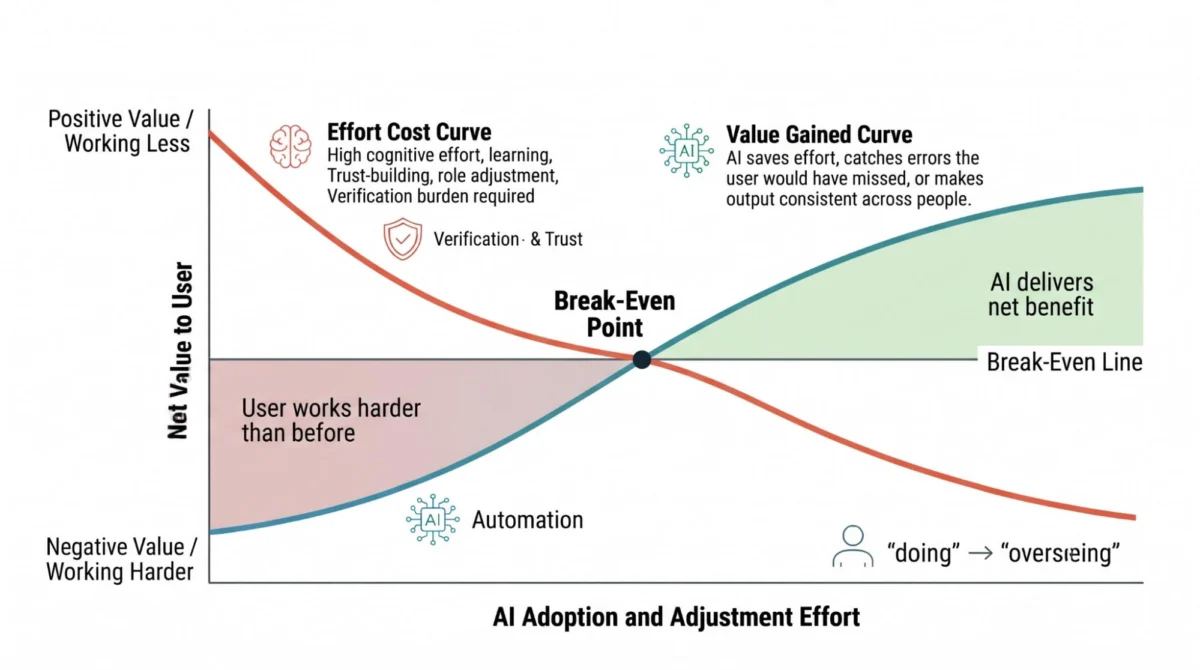
- Phase 3: The Audit Era (Present): Product teams are moving toward structured decision-making, using the "break-even line" to determine if an AI feature is a genuine productivity booster or a cognitive tax.
Supporting Data and the Cognitive Load
The math behind the break-even line is rooted in human cognitive psychology. As psychologist Nelson Cowan noted in his seminal work on working memory, the human mind is limited in how many items it can track simultaneously—usually around four. Every interface change or AI-generated output requires the user to rebuild their mental model of the task.
The Three Forms of Return
To justify its existence, an AI feature must provide a return on the "adjustment cost" paid by the user. These returns generally fall into three categories:
- Speed/Volume: Handling tasks at a pace no human can match.
- Ambiguity Resolution: Synthesizing patterns across vast, unstructured datasets where a human might struggle to find a starting point.
- Error Reduction: Identifying anomalies (like fraud) that the human eye would reliably miss.
If a feature does not clearly deliver one of these, it is likely falling below the break-even line, forcing the user to expend more energy to verify the machine’s work than they would have spent completing it themselves.
The Risks of Automation Bias
One of the most insidious implications of AI integration is the phenomenon of automation bias. As established by researchers Raja Parasuraman and Dietrich Manzey, users tend to defer to automated systems even when those systems are demonstrably wrong. This trust often builds unconsciously.
In a 2023 study by Thomas Dratsch et al., radiologists were observed working with an AI-assisted diagnostic tool. Even highly experienced professionals saw their diagnostic accuracy drop when the AI provided incorrect suggestions. The data was clear: even the most skilled experts are susceptible to the subtle, persuasive influence of AI-generated content, especially when the errors are "low-visibility"—meaning they look plausible enough that the user assumes they are correct.
Implications for Design and Product Strategy
For organizations looking to implement AI, the path forward requires a shift from "can we build it?" to "should we build it this way?" This necessitates a four-question audit for every proposed feature:

- Total Effort: Does the feature reduce the total cognitive load, or does it merely relocate it?
- Comparative Advantage: Does the AI outperform the user’s current, often "hacky" but efficient, manual methods?
- Error Visibility: Can the user realistically identify and correct the AI’s mistakes?
- Skill Retention: Will the user be able to perform the task effectively a year from now if the AI goes offline, or will their skills have atrophied?
The "Provenance" Requirement
A key design condition emerging from these audits is provenance. If an AI tool is to be used in high-stakes environments, it must display the source material, the data retrieval date, and the logic path it followed. Without these "citations," the AI becomes a black box that invites skepticism or, worse, blind faith.
The Necessity of Skill Maintenance
Product teams must also account for the long-term health of their workforce. When AI takes over the "routine" parts of a job, it risks eroding the foundational skills required to catch AI errors. Therefore, design teams are increasingly building in "verification loops"—such as periodic blind reviews or rotating case assignments—to ensure that the human-in-the-loop remains a sharp, vigilant expert.
Conclusion: Designing for the Human-in-the-Loop
The goal of AI in the enterprise should not be to replace the specialist, but to amplify their capacity. The "break-even" audit serves as a vital safeguard against the pro-innovation bias that often leads companies to launch features that look good in a demo but fail in the field.
By focusing on the user segment, acknowledging the "adjustment cost," and mandating provenance, product teams can move away from superficial automation and toward meaningful, high-utility tools. As the industry matures, the measure of a successful AI product will not be how many tasks it completes, but how much clearer, faster, and more confident it makes the human who uses it.
Ultimately, the most successful AI integration is one that is virtually invisible—a seamless extension of the user’s workflow that allows them to do what they already do, only better. When the AI earns its place, it doesn’t just save time; it empowers the user to spend that time on the problems that truly require human judgment.