







SAN FRANCISCO — In the modern enterprise, the allure of the turnkey enterprise software solution is nearly irresistible. When executive leadership commits to a modernization initiative, the playbook is almost universally the same: license the platform, procure the cloud infrastructure, assemble a delivery team, and draft an aggressive timeline.
Yet, beneath the glossy architecture diagrams and executive roadmap slides lies an uncomfortable reality. According to industry veterans, roughly 99% of technology projects—and a vast majority of Data 36
0 deployments—stumble not from a lack of technical capability, but from a fundamental sequencing error: organizations are implementing complex data platforms long before they have decided what business outcomes those platforms are actually meant to support.
The phenomenon is so widespread that experienced enterprise consultants can practically time it.
"I’ve seen this pattern so many times that I recognize it right away," notes one veteran implementation architect. "Leadership picks Data 360 as the centerpiece of a modernization effort, licenses get bought, a team gets staffed, delivery plans get written. Then, around sprint six, someone finally asks: ‘But what are we actually using this for?’"
That question is free on day one. By day one hundred, however, answering it becomes exponentially expensive.
Chronology of a Misguided Deployment: Anatomy of a Telecom Failure
To understand how technology-first implementations unravel, one need only examine the trajectory of a typical enterprise deployment. While corporate names are often shielded by non-disclosure agreements, the lifecycle of a failed initiative follows a predictable, cautionary timeline.
Months 1 to 3: The Infrastructure Trap
The project begins with enthusiasm and urgency. The decision to adopt a unified data architecture is made at the executive level, driven by the need to stay competitive and leverage emerging capabilities like real-time AI context engines (such as Salesforce’s Agentforce).
Because software licenses are tangible, have clear budget lines, and fit neatly onto a steering committee presentation slide, procurement takes precedence. However, because deployment dates are set before anyone has thoroughly assessed what the project actually entails, there is virtually no time allocated for foundational strategy conversations. Defining a data strategy forces uncomfortable organizational decisions about ownership and competing priorities—conversations that most stakeholders prefer to avoid.
Months 4 to 6: The Ingestion of Noise
With the platform live and connectors readily available, the technical team defaults to the path of least resistance: ingesting entire source systems simply because the pipelines exist.
Without a governance framework or a defined business need, data flows into the platform indiscriminately. Three sprints in, engineering teams find themselves spending valuable cycles untangling duplicate customer records that no one ever verified were necessary. Departments quietly maintain incompatible, legacy definitions of core metrics—such as what constitutes an "active customer"—inside the exact same modern platform, because no one forced the alignment conversation early on.
A textbook example of this occurred at a major telecommunications firm that implemented a Customer Data Platform (CDP) as a purely IT-led initiative, completely devoid of initial business use cases or assigned data owners.
By month four, a critical regional marketing campaign stalled for two full weeks simply because the marketing and billing departments could not agree on which customer list was authoritative. By month seven, the multi-million-dollar platform had degenerated into an underused data lake. Billing and CRM remained starkly siloed, data quality accountability was nonexistent, and the marketing department remained incapable of activating a single cohesive audience segment.
The project was ultimately rescued only after a newly appointed Director intervened, hitting the brakes on all technical work for a mandatory two-month pause to define five priority use cases.
Months 12 to 24: The Cost of Retroactive Strategy
When projects are initiated without a guiding strategy, the bill inevitably comes due later—and it is paid with heavy interest.
Between months 12 and 18, organizations frequently find themselves proposing sweeping overhauls to "redo the data model." By month 24, a parallel data quality remediation program is inevitably launched.

Industry benchmarks suggest that roughly 8% of an enterprise data workforce ultimately ends up assigned to work that adds zero value to the business—a direct, measurable tax paid for postponing foundational strategy decisions. By this stage, the fixes are astronomically expensive because live production flows, deployed automated agents, and bewildered end-users are already dependent on a data architecture that is being dismantled from underneath them.
Supporting Data and the Cost of Inverting the Order
The friction points in modern data integrations are rarely computational; they are semantic and organizational. When organizations invert the order of adoption—deploying the tool before defining the strategy—they create systemic inefficiencies that ripple across the entire enterprise.
According to enterprise workflow audits, the primary symptoms of strategy-deficient data projects include:
- The Semantic Divide: Disagreements over basic definitions (e.g., active churn, resolved service cases, qualified leads) that surface only after data model objects (DMOs) have been deployed in production.
- Orphaned Datasets: Up to 30% of ingested data lakes consist of unmapped or underutilized schemas brought in purely because out-of-the-box connectors made ingestion frictionless.
- The Workforce Tax: Approximately 8% of data engineering hours are wasted on cleaning up structural redundancies that could have been avoided with an upfront data dictionary.
The tool itself is rarely at fault. Platforms like Data 360 excel at unifying disparate data silos, federating information without redundant copying, feeding real-time context to autonomous AI agents, and activating precise audience segments across omnichannel touchpoints. However, no software platform can inherently divine what data an organization should unify, why they are unifying it, or who is ultimately responsible for its integrity.
Official Perspectives: What a True Data Strategy Entails
Enterprise architects and Chief Data Officers who have successfully navigated large-scale modernizations emphasize that a true data strategy is not a technical architecture diagram, a governance policy manual, or a cloud migration roadmap.
Instead, a robust data strategy consists of definitive business choices regarding which data matters, who owns it, what quality thresholds are required, and where commercial value is captured.
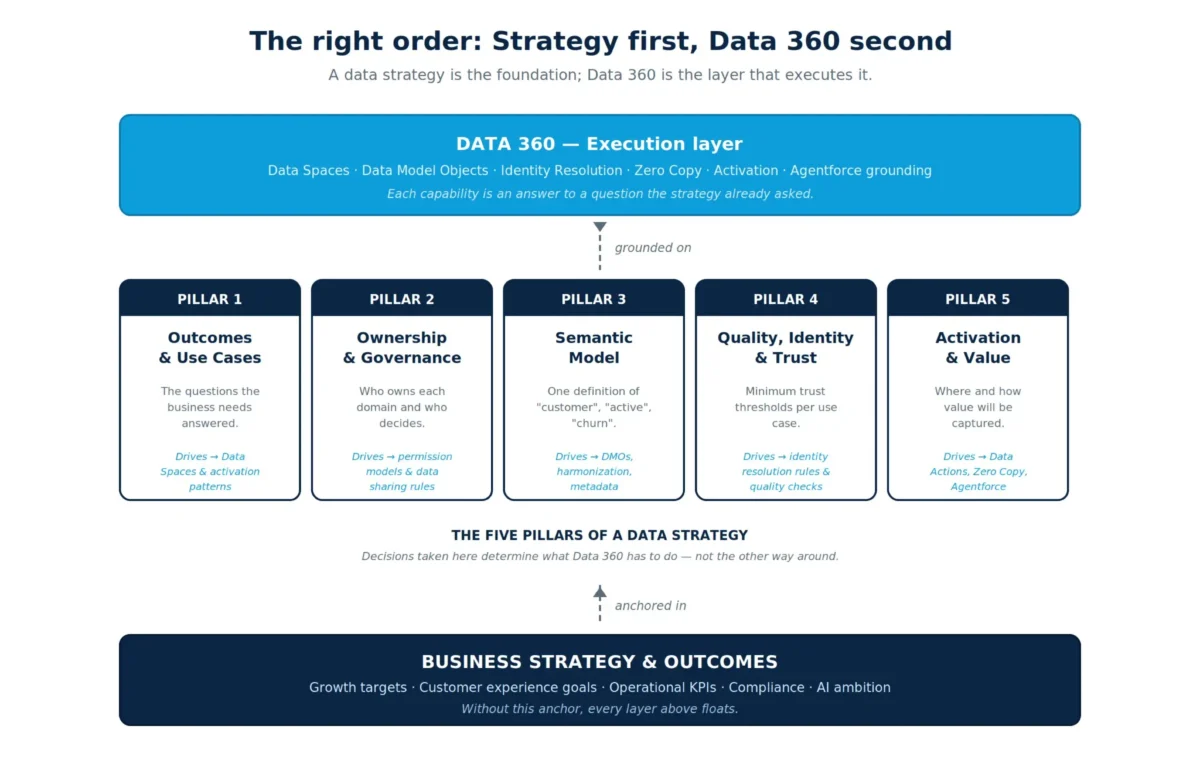
According to advisory frameworks used by top-tier technical consultants, a resilient data strategy must definitively answer five foundational, non-technical questions:
1. Which business outcomes are we prioritizing?
A strategy must clearly articulate what decisions or customer experiences are desired that are currently impossible. Organizations must prioritize between five and ten specific use cases—fully quantified, owned by a business unit, and instrumented—ranked strictly by impact and technical feasibility. Without this filter, a data platform inevitably becomes an expensive repository where data enters endlessly but is never activated.
2. Who actually owns the data?
A single diagnostic question can reveal an organization’s data maturity within minutes: Who owns "customer" data?
In immature organizations, the question is met with silence, or conflicting answers ("the CRM system," "compliance," "core IT systems"). Mature organizations designate a functional domain owner with real authority over ingestion rules and access permissions. Without a clear owner, internal platform governance degrades into a meaningless audit checkbox.
3. Do we share the same semantic meaning?
Semantic models establish shared business definitions. While departments rarely argue over the definition of a physical human customer, they frequently clash over transactional milestones: when does a customer officially become "active"? When does account inactivity cross the line into "churn"? When is a support ticket legally "resolved"? Data platforms can harmonize data objects, but they cannot arbitrate business disagreements; they merely make those disagreements visible in a live production environment.
4. What are our quality and identity thresholds?
Not every business application demands the same degree of data hygiene. A mass-market propensity scoring model can easily tolerate a margin of error in legacy records. Conversely, an autonomous AI agent interacting directly with an individual client in real time cannot afford ambiguous identity resolution. Strategy must dictate the minimum acceptable quality thresholds per use case before pipelines are built, rather than leaving engineering teams to guess how much error the business is willing to absorb.
5. How are we capturing value?
Strategy concludes where activation begins. Organizations must explicitly map where unified segments are routed—whether to marketing automation channels, automated customer service flows, real-time AI agents, or external partner platforms—and designate who is responsible for measuring ROI.
Implications: The 90-Day Path to Strategic Alignment
Transitioning from a technology-first mindset to a strategy-first discipline does not require endless multi-year consulting engagements. With authentic executive sponsorship, organizations can establish a rock-solid foundation within a structured 90-day window.
When strategy precedes software implementation, the entire trajectory of the project shifts:
- Prioritization ceases to be a recurring political debate because use cases are pre-ranked.
- Data spaces are architected in days rather than months because data ownership and semantic definitions were settled in advance.
- Quality thresholds are established before the first pipeline executes, eliminating post-production crises.
- AI and automation initiatives—such as context-aware agentic workflows—succeed on their first deployment because foundational terms like "active customer" are no longer ambiguous.
The lesson for enterprise leaders embarking on modernization is starkly simple. Data platforms are powerful engines of execution, but they cannot substitute for executive decision-making.
Strategy first, platform second. It is a simple mandate—and arguably the hardest discipline to enforce in the modern corporate boardroom.