








By Industry Technology Desk
At Microsoft Ignite 2026, a significant milestone in the evolution of enterprise computing was reached as Oracle and Microsoft announced a deeper integration of agentic AI into the fabric of business operations. By combining the transactional power of the Oracle AI Database with the contextual intelligence of Microsoft’s ecosystem, the two companies are effectively bridging the long-standing divide between structured operational data and unstructured business communications.
This initiative, spearheaded by Arpan Shah, SVP of Oracle Databases, and Muneer Mirza, VP of Multicloud at Oracle Cloud Infrastructure (OCI), promises to bring "AI into the flow of work." For the modern enterprise, this means that AI agents can now reason across Oracle’s business-critical datasets—spanning finance, supply chain, HR, and customer operations—while simultaneously leveraging the context provided by Microsoft Work IQ across emails, Teams, and documents.
The Core Strategic Shift: Why This Matters Now
For years, enterprises have struggled with the "silo problem." Financial data lived in secure Oracle databases, while the daily "work context"—the conversations, project planning, and document drafting—lived in Microsoft 365. These two worlds rarely intersected in real-time, forcing analysts to manually export data or rely on outdated dashboards.
The integration announced at Ignite changes this dynamic. By utilizing Oracle AI Database@Azure, businesses can now treat their database not just as a storage vessel, but as an active participant in an AI-driven workflow. This is not merely a chatbot addition; it is an architectural integration that enables AI agents to access, query, and synthesize enterprise data without moving it out of the secure, governed Oracle environment.
A Chronology of the Partnership
- Early 2024: The formal launch of Oracle Database@Azure, designed to bring Oracle’s Exadata power directly into Azure data centers to reduce latency and increase architectural agility.
- Oracle AI World 2026: Oracle announced major advancements, including Proximity Placement Groups (PPGs) which cut VM-to-Exadata network round-trip latency by roughly 50%. The company also teased FedRAMP Class D certification for government workloads.
- Microsoft Ignite 2026: The current expansion, marking the shift from infrastructure connectivity to agentic AI orchestration. The introduction of Azure Workload Center for Oracle and deep plugin support for Excel signals a move toward user-centric, autonomous enterprise tasks.
Supporting Data and Technical Architecture
The backbone of this integration is the Managed Model Context Protocol (MCP). This allows AI agents to interact with Oracle databases through strictly defined, governed SQL and PL/SQL operations.
Performance and Reliability Metrics
The technical advancements supporting this integration are substantial. The introduction of Proximity Placement Groups (PPGs) has proven to be a game-changer for high-frequency trading, real-time supply chain monitoring, and other latency-sensitive applications. By placing the application logic closer to the physical storage, the 50% reduction in latency ensures that when an AI agent queries a database, the response is near-instantaneous.
Furthermore, the scale of the deployment is unmatched. Oracle AI Database@Azure now spans 33 Azure regions globally, offering a level of geographic redundancy and compliance that no other hyperscaler currently provides for Oracle workloads.
Governance and Security
A major hurdle for AI adoption in the enterprise has been "data leakage." Oracle and Microsoft have addressed this through:
- Entra ID Integration: Utilizing Microsoft’s robust identity management, agents are restricted to the existing permissions of the human user.
- Oracle Deep Data Security: Even when an agent is performing a task, it cannot access data that the human user is not authorized to see.
- Auditable Trails: All database calls made by agents are captured and logged, ensuring that every AI-driven action is transparent and reversible for IT compliance teams.
For IT Operations: Monitoring and Trust at Every Layer
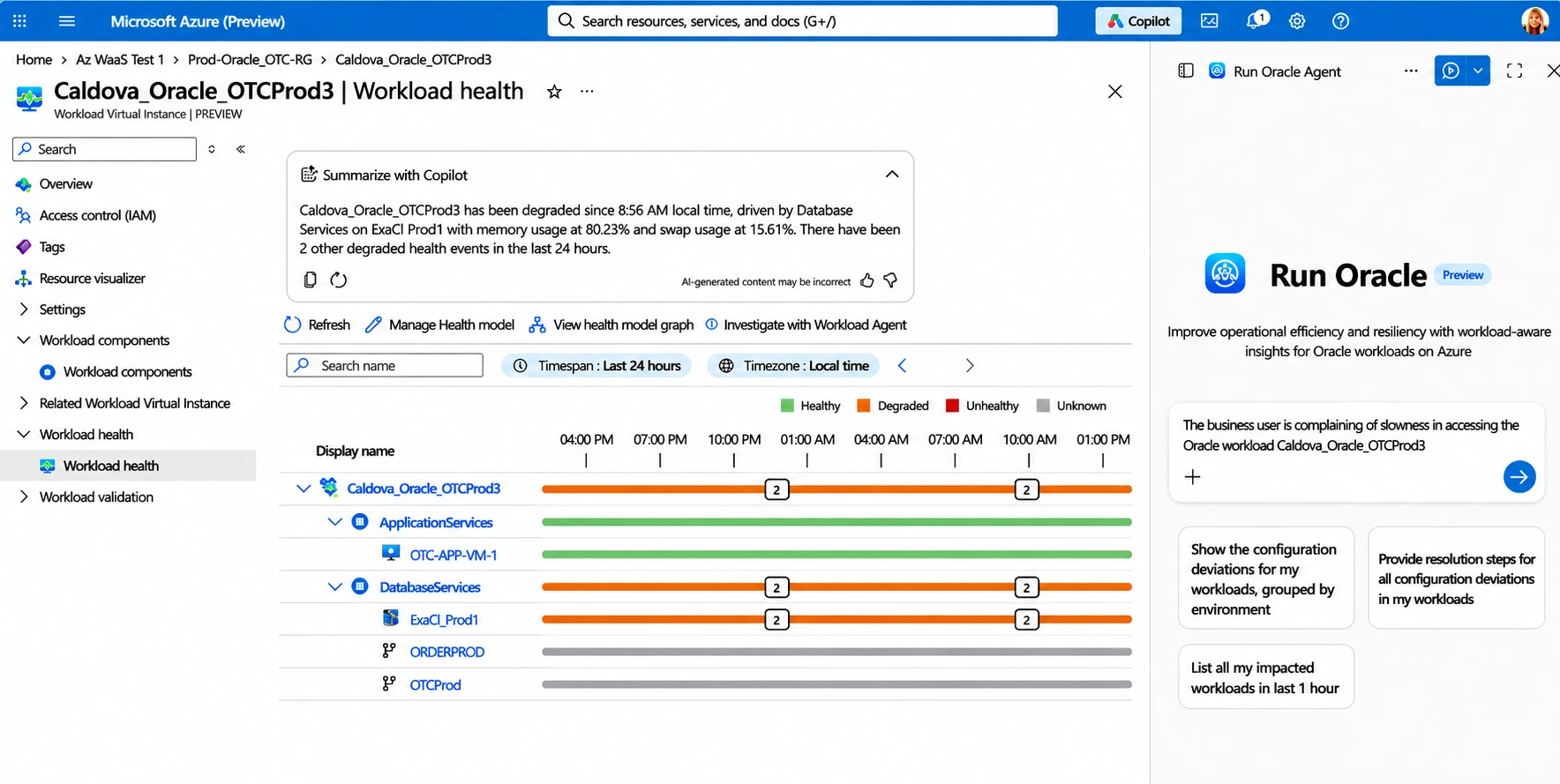
The complexity of managing hybrid cloud environments has long been a pain point for CIOs. The Azure Workload Center for Oracle, currently in limited preview, introduces the "Workload Virtual Instance" (WVI).
A WVI acts as a single pane of glass, grouping together the architecture, resources, and dependencies of a specific business application. When a performance degradation occurs, an administrator no longer needs to hunt through disconnected logs from the network, the database, and the application. Instead, they can use the Microsoft Azure Copilot Run Oracle agent.
This agent provides a unified view, correlating signals across all layers. If a database service begins to throttle, the Copilot identifies the impact on the application immediately and provides the admin with suggested resolution paths. This moves IT operations from a "reactive" state—spending hours diagnosing issues—to a "proactive" state, where AI handles the correlation, leaving the human expert to make the final executive decision.
For End Users: Eliminating the "Export" Tax
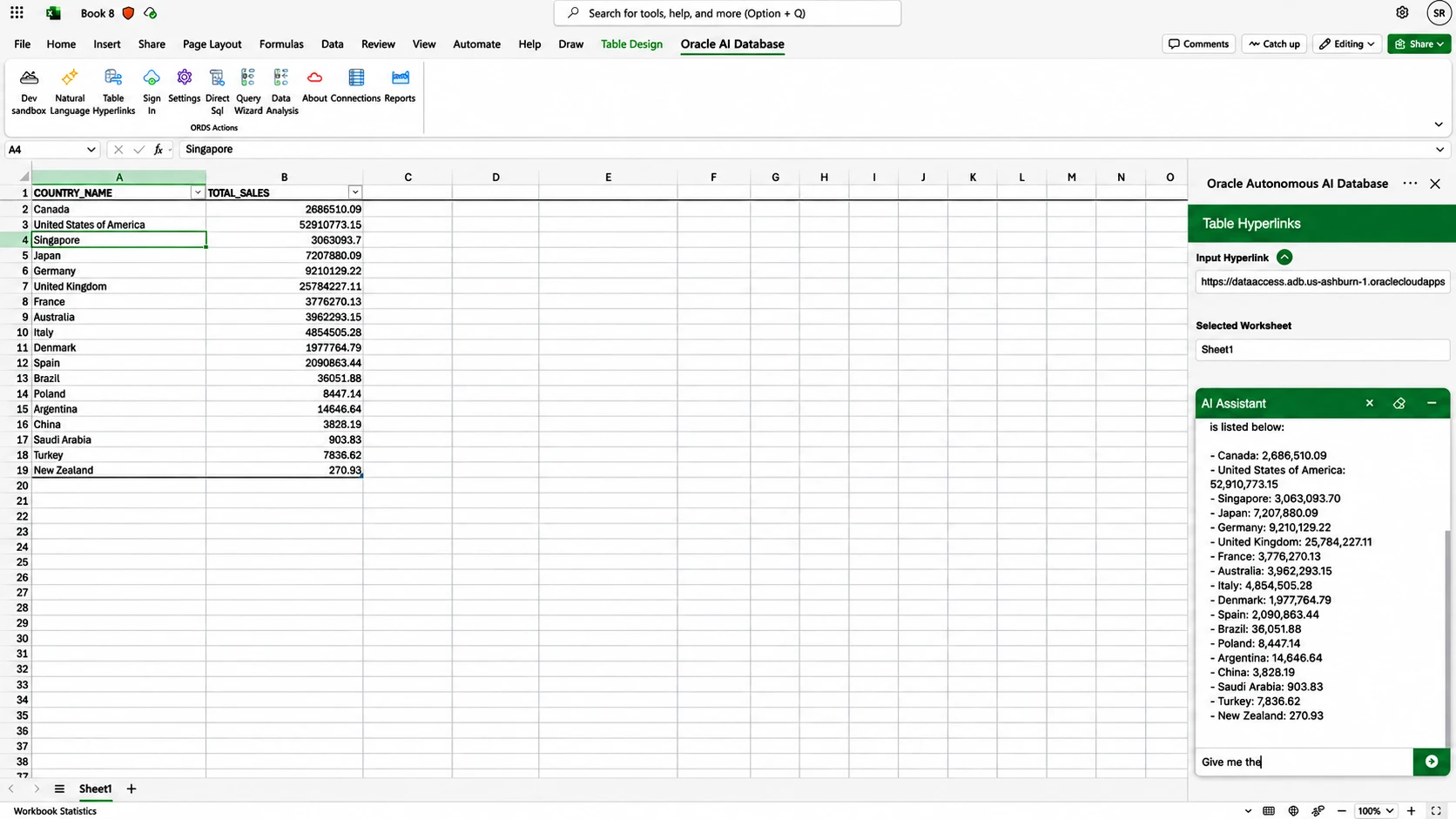
The most visible impact for the average knowledge worker is the new Oracle AI Database plug-in for Excel. Historically, if a financial analyst wanted to cross-reference real-time sales data with market trends discussed in their emails, they would be required to export CSVs, cleanse data, and build complex pivot tables.
With the new plug-in, the Excel sheet effectively becomes a live interface to the Oracle Database. Analysts can query the database directly from the spreadsheet using natural language. When combined with Copilot’s ability to pull in context from Work IQ, the user can ask: "Why did our margins drop in the EMEA region last month?"
The system then:
- Queries the Oracle transaction data for margin trends.
- Analyzes meeting transcripts and emails from the sales team regarding regional supply chain disruptions.
- Synthesizes the findings into a coherent, evidence-based answer within the Excel workspace.
This is the end of the "disconnected dashboard" era. Insights are no longer something you visit; they are something that arrives within the tools where work is already happening.
Implications for Developers: From Prototype to Production
While many companies have successfully built AI "proof-of-concepts," moving those agents to production has been notoriously difficult due to hallucinations and lack of access to "grounded" enterprise data.
By using Microsoft Foundry in conjunction with Managed MCP servers, developers now have a standardized path to build "trusted agents." These agents operate with clear boundaries. They don’t "copy" the data to a new repository; instead, they act as an interface to the existing system of record.
Developers can chain multiple specialized agents—a "Finance Agent," a "Supply Chain Agent," and a "Customer Service Agent"—to work in concert. Because these agents are governed by A2A (Agent-to-Agent) protocols and anchored to the Oracle AI Database, the business can finally rely on the accuracy of the AI’s output. When a customer service agent provides a policy answer, it is backed by citations from the database, not just probabilistic text generation.
Looking Ahead: The Future of the Enterprise AI Stack
The partnership between Oracle and Microsoft represents a shift in power. For years, the enterprise AI market was dominated by general-purpose models that struggled with deep domain knowledge. By integrating Oracle’s transactional depth with Microsoft’s conversational interface, the two companies are creating a "system of intelligence" that is as reliable as the underlying "system of record."
For enterprises, the implication is clear: the era of manual data wrangling is coming to a close. As businesses prepare for 2027, the focus will shift from if they should adopt agentic AI to how they can best integrate their existing Oracle estates into these new, intelligent frameworks.
For those attending Microsoft Ignite, the message is to move beyond the hype. By visiting booth #6163 or attending the breakout sessions on workload intelligence, organizations can begin mapping their own migration paths. The technology is no longer a promise for the future—it is currently being deployed in production environments, proving that when trust, performance, and intelligence are unified, the result is a more resilient and agile enterprise.