



In the modern retail landscape, the moment a customer hands over their mobile number at checkout, a subtle but significant transaction occurs. It is often dismissed as a routine administrative task—a box ticked, a transaction completed, a customer moving on with their day. Yet, for the modern founder, that digital handshake is far more consequential. By providing a phone number, the customer has granted access to their most personal digital domain: the screen that sits on their nightstand, accompanies them into high-stakes board meetings, and occupies their focus during personal downtime.
While an email inbox functions as a public corridor where anyone can leave a message, a mobile phone is a private front room. Despite this stark difference in intimacy, many brands treat these two channels with a lack of strategic nuance. They either blast the same content across both pipes, creating redundant noise, or they prioritize one while allowing the other to atrophy. The result is a missed opportunity to build brand equity and maximize conversion. True omnichannel marketing isn’t about sending more messages; it is about sending the right message to the right place at the right time, ensuring that the brand’s presence is earned rather than imposed.
The Structural Divide: Why One Channel is Never Enough
To understand the modern marketing ecosystem, one must first recognize the distinct "shapes" of email and SMS.
Email is the medium of depth. It provides the space to build a narrative, showcase products in context, and offer personalized recommendations based on historical purchase data. It is a cost-effective, familiar environment for storytelling. However, it suffers from the "inbox paralysis" phenomenon. A marketing email is often one of dozens—or hundreds—of unread messages vying for attention. It sits in a queue, waiting for the user to engage, which may happen tonight, next week, or never.
SMS, conversely, is the medium of immediacy. It boasts open rates that are the envy of every marketer, typically resulting in engagement within seconds of delivery. It cuts through the digital clutter with surgical precision. However, this power comes with strict limitations. Brands have roughly a line and a half of text to convey their value. There is no room for nuance, and every message incurs a direct cost. Because of this, SMS is a high-stakes channel; lean on it too heavily, and you risk transforming a helpful notification into a persistent nuisance.
The strategic imperative, therefore, is to leverage the inherent strengths of each to compensate for the weaknesses of the other.
The "Expiry" Test: A Framework for Channel Selection
The primary challenge for marketing teams is determining which message belongs in which "room." The most effective litmus test is a simple question: Does this message expire?
The Case for Email: The "Evergreen" Content
If a message remains relevant regardless of when it is opened, it belongs in the inbox. This includes founder’s notes, deep-dive product education, long-form storytelling, and slow-nurture sequences designed to warm up a cold list. These communications are not compromised by a two-hour delay in reading. They demand the room to breathe, be parsed, and be reflected upon.
The Case for SMS: The "Clock-Driven" Content
If a message has a shelf life, it belongs on the mobile screen. Flash sales ending at midnight, real-time alerts for back-in-stock items, or abandoned cart reminders sent while the intent to purchase is still "warm"—these are the lifeblood of SMS marketing. If these messages arrive the next morning, they have lost their utility. SMS is the tool for urgency; it is the gentle tap on the shoulder that signifies something truly cannot wait.
Chronology of Execution: The Power of Sequential Automation
The most common error in modern marketing is "simultaneous bombardment." Firing an email and a text message at the exact same moment for the same trigger is not omnichannel—it is simply redundant. It uses two valuable communication credits to do the work of one.
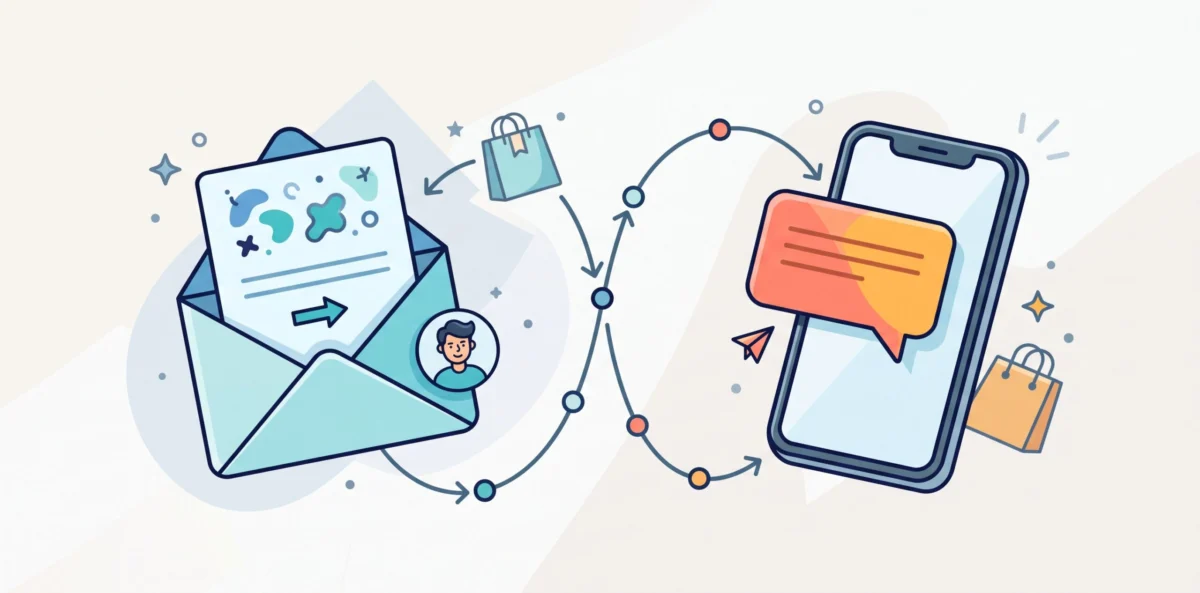
Instead, sophisticated brands rely on sequential staggering. Consider the "Welcome Flow":
- The Introduction: An email is sent first. It provides the space to introduce the brand, share the origin story, and deliver the welcome discount code.
- The Nudge: If, after 24 to 48 hours, the customer has not converted, a single, concise text message is sent to bridge the gap.
This logic applies to other critical touchpoints:
- Abandoned Cart: The email does the heavy lifting, providing a clear path back to the cart. If the items remain unpurchased after a few hours, the SMS serves as a timely reminder while the customer’s interest is still piqued.
- Shipping Updates: A text message provides the immediate hit of reassurance ("Your order is on the way"), while the full tracking details reside in an email for the customer to reference when they have the time to review the logistics.
- Back-in-Stock: This is the rare scenario where SMS can lead. If a customer has explicitly requested a notification for a specific product, the text is the most respectful way to honor that intent the moment it becomes available.
Strategic Implications: Restraint as a Competitive Advantage
Perhaps the most vital lesson for founders is that the channel you choose not to abuse is your greatest asset. Email is remarkably forgiving regarding frequency; users have been conditioned to ignore excess marketing noise in their inbox. The mobile phone, however, is a protected space.
A text message that interrupts a customer at 11:00 PM, or the third promotional text in a single week, does not just result in a deleted message—it results in an opt-out. Once a customer opts out of SMS, the brand has lost its most effective tool for immediate communication.
The Principles of Respectful Engagement
- Explicit Consent: Never assume permission. Ensure the opt-in process is clear and intentional.
- Easy Opt-Out: Keep the ability to unsubscribe simple and immediate. A brand that makes it hard to leave is a brand that has already lost trust.
- Mind the Clock: Always respect time zones. If you are sending a text, you are a guest in their front room; act accordingly.
- Restraint is Strategy: A smaller, highly engaged SMS list is significantly more valuable than a bloated list that has learned to fear the "buzz" of your notifications.
The Role of Unified Technology
For omnichannel strategies to be effective, they must be cohesive. Using disjointed platforms to manage email and SMS leads to "guessing" games where the channels operate in silos.
Platforms like Omnisend have emerged as the industry standard for this exact reason. By unifying email, SMS, and web push notifications within a single automation view, brands can ensure that a customer’s journey is seamless. When a welcome flow or abandoned cart sequence can hand off from email to text within one workflow, the messaging remains coherent. Data gathered from browsing behavior and past purchases feeds into both channels simultaneously, ensuring that the brand is always speaking to the customer’s current reality.
The Path Forward: Starting with the Fundamentals
For brands looking to implement these strategies, the advice is simple: Start with two flows, not ten.
Attempting to overhaul an entire marketing stack at once is a recipe for failure. Focus on the two automations that offer the highest return on investment: the Welcome Flow and the Abandoned Cart sequence. Build these as an email-first flow with an SMS backup, and allow them to run for several weeks. Once these are optimized and humming, move on to back-in-stock alerts.
The goal is to move away from the chaotic "spray and pray" approach and toward a disciplined, rhythmic communication style. By letting each channel handle the work it is best suited for, brands can transform their marketing from a series of interruptions into a helpful, anticipated, and highly effective service.
As we approach high-traffic periods like Black Friday and Cyber Monday (BFCM), the importance of this rhythm becomes magnified. During these periods, email should carry the campaign’s weight—the storytelling, the buildup, and the offer details. SMS should be reserved exclusively for time-critical beats: the moment the doors open and the final hours before they close.
In the final analysis, omnichannel marketing is not about volume. It is a quiet, rigorous discipline. When executed with precision, it creates a scenario where the same customer who skims your emails will act on your texts—simply because you have only ever messaged them when it truly counted.
For those looking to refine their strategy, Omnisend offers the tools necessary to integrate these channels into a single, cohesive workflow. As an exclusive offer for Foundr readers, you can receive 50% off your first three months by using code FOUNDR50 upon signup. Now is the ideal time to calibrate your automations before the holiday rush, ensuring that when the season arrives, your brand is positioned to engage, not annoy.