









In the modern digital economy, the consumer journey does not conclude at the virtual checkout. For the growing ranks of European e-commerce merchants, the "last mile" of a transaction is increasingly defined by what happens after the package arrives. Returns management, or reverse logistics, has evolved from a back-office administrative burden into a critical strategic pillar that defines brand loyalty, operational profitability, and environmental footprint.
As Europe remains one of the world’s most sophisticated and demanding e-commerce markets, understanding the mechanics of returns is no longer optional—it is a prerequisite for survival.
1. The Anatomy of European Returns: An Overview
The European e-commerce landscape is not a monolith; it is a tapestry of diverse consumer behaviors, regulatory frameworks, and logistical hurdles. While the ease of online shopping has driven unprecedented growth, it has also fostered a culture of "trial at home," where consumers frequently order multiple sizes or variations with the explicit intent of returning the items that do not meet their expectations.
Statistical Reality: The Scale of the Challenge
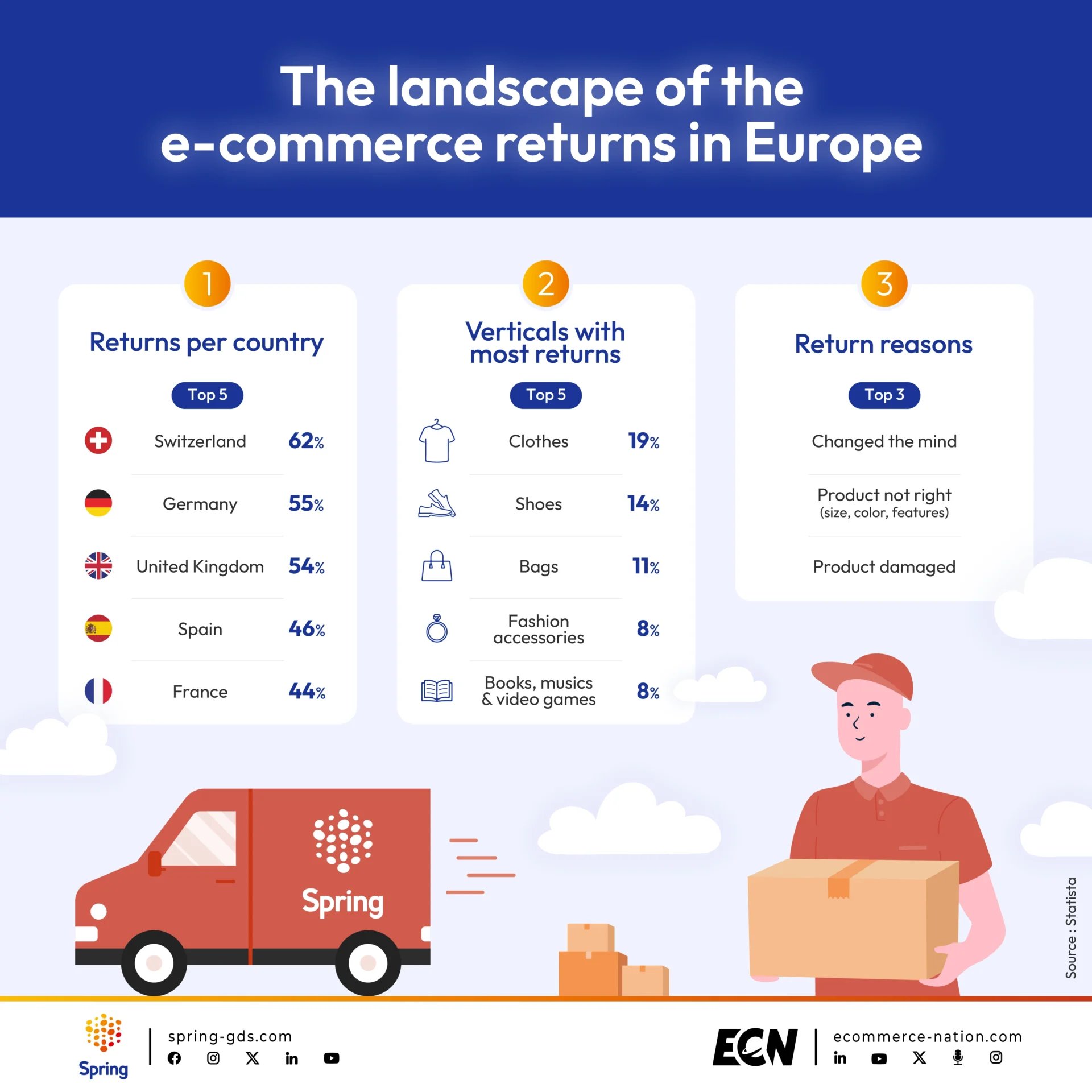
Current data indicates that the average return rate in Europe fluctuates between 30% and 40%, though this figure masks significant regional volatility. According to recent industry analysis, Switzerland leads the continent with a staggering 62% return rate per online buyer. Germany and the United Kingdom follow closely, with 55% and 54% respectively. These figures suggest that in mature markets, the "return" is effectively a standard feature of the purchasing experience rather than an exception.
The Profitability Paradox
For retailers, every return represents a "profitability leak." The costs are multi-layered:
- Processing Fees: The labor cost of inspecting, cleaning, and re-packaging goods.
- Logistics: The cost of reverse shipping, often subsidized by the merchant.
- Revenue Erosion: Products that cannot be sold as "new" must be discounted or liquidated, significantly impacting margins.
Conversely, a restrictive return policy is a major deterrent to conversion. Data consistently shows that shoppers are less likely to finalize a purchase if they perceive the return process as opaque or prohibitively expensive.
2. Chronology of the "Return Revolution"
The shift in returns management has occurred in distinct phases over the last decade:
- 2014–2017: The Era of "Free Everything." To capture market share, e-commerce giants and startups alike introduced "no-questions-asked" free returns as a competitive advantage. This normalized the habit of over-ordering.
- 2018–2021: The Efficiency Wake-up Call. As volume skyrocketed, the hidden costs of reverse logistics became impossible to ignore. Retailers began to see the strain on warehouse operations and the negative impact on the bottom line.
- 2022–Present: The Strategic Pivot. Facing economic headwinds and sustainability mandates, the industry has entered a phase of "calculated friction." Major retailers have begun charging for returns, shortening return windows, and investing heavily in data-driven decision-making to mitigate the volume of returns before they even happen.
3. Sector-Specific Vulnerabilities
Not all products are created equal when it comes to return rates. The fashion and apparel industry remains the primary driver of reverse logistics volume. Because clothing relies on subjective fit and aesthetic preference, return rates in this sector often exceed 50%.
Electronics and home goods also face significant hurdles. While these items have lower inherent return rates than apparel (often hovering around 6–10%), the cost of processing them is higher due to the need for technical inspection, data wiping, and refurbishment. A faulty toaster or a malfunctioning smartphone creates a far more complex logistical chain than a returned t-shirt.
4. The Challenges: Logistics, Law, and Ecology
Logistical Complexity
Cross-border trade is the backbone of the European Single Market, yet it is the primary obstacle for efficient reverse logistics. A retailer based in France selling to a customer in Poland faces a logistical nightmare: the return must travel back across borders, often involving different carriers, varied customs requirements (for non-EU shipments), and varying parcel tracking standards.
The Regulatory Landscape
The European Union has a robust framework protecting consumer rights, such as the 14-day "right of withdrawal." While this builds consumer trust, it creates a rigid environment for merchants. Furthermore, individual member states have nuances in tax and VAT regulations that can complicate the financial reconciliation of a returned item, particularly when dealing with import duties.
The Ecological Footprint
Perhaps the most pressing challenge is the environmental impact. The "return loop" effectively doubles the carbon footprint of a product. From the extra kilometers traveled by delivery vans to the excessive plastic, bubble wrap, and adhesive tape used in re-packaging, the environmental cost is significant. There is also the "dark side" of returns: the reality that some large retailers, when faced with high processing costs, have historically opted to destroy returned goods rather than reintegrate them into inventory—a practice increasingly under scrutiny by EU regulators.
5. Strategic Recommendations for Optimization
To turn reverse logistics from a cost center into a competitive advantage, retailers must adopt a multi-faceted approach.
Advanced Data Analytics
Merchants must leverage data to move from reactive to proactive management. By analyzing the "why" behind returns, retailers can take corrective action:
- Size and Fit Tech: Integrating AI-driven size advisors on product pages to reduce fit-related returns.
- Visual Transparency: Using high-resolution video and 360-degree photography to ensure the customer’s expectations match reality.
- Predictive Quality Control: If data shows a specific batch of electronics has a high defect rate, the system should flag this, allowing the retailer to halt sales before the product reaches the customer.
Technological Integration
Automation is essential. Modern returns management systems (RMS) should allow for:
- Self-Service Portals: Giving customers an intuitive interface to print labels and track their refund status, which reduces customer support overhead.
- Dynamic Routing: Automatically directing returns to the nearest processing center or, in some cases, allowing the customer to keep the item (if the value is low) to save on shipping costs.
The "Green" Pivot
Sustainability is no longer just a marketing buzzword; it is a business imperative.
- Consolidated Shipping: Encouraging customers to return items via "drop-off points" rather than door-to-door courier pickups. This reduces the number of stops and optimizes the transport route.
- Sustainable Packaging: Transitioning to reusable shipping bags or circular packaging solutions that can withstand the return journey without additional plastic waste.
- Second-Life Programs: Building a "pre-loved" or refurbished marketplace within the brand’s own ecosystem allows for the resale of returned goods, recapturing value rather than losing it to liquidation.
6. Implications for the Future
The "return-everything" era is drawing to a close. As we look ahead, the European market will likely see a shift toward more sustainable, transparent, and financially sound return policies.
Retailers that succeed will be those that manage to balance the friction of a return with the necessity of customer satisfaction. By investing in better product descriptions, sizing technology, and localized return infrastructure, merchants can foster loyalty without sacrificing their margins.
Ultimately, the future of e-commerce in Europe depends on the ability to treat the return not as a failure of the sale, but as a critical part of the customer relationship. The brands that master this delicate balance will not only reduce their operational costs but will also establish themselves as leaders in a more responsible, efficient, and customer-centric digital economy.