

In the high-stakes world of digital advertising, the gap between "media strategy" and "creative execution" has long been the industry’s silent profit killer. For years, brands have operated in fragmented silos: buying inventory on YouTube, JioHotstar, and smart-TV platforms as isolated events, while creative teams struggled to iterate based on performance data that was often a week old.
Social Beat, a prominent digital agency recently acquired by Cheil South West Asia, is looking to dismantle these silos. With the launch of the updated version of its AI-first programmatic solution, PRISM (Programmatic Reach and Impact Solution for Marketers), the agency is betting on a future where media buying and creative intelligence function as a single, unified organism.
The Problem: The High Cost of Fragmentation
The current digital advertising landscape is plagued by what Social Beat identifies as "auction blindness." When a brand buys YouTube, OTT platforms, and open exchange inventory through separate channels, each auction treats the same household as a unique, first-time viewer.
The result is massive inefficiency. Social Beat’s internal data revealed a staggering reality: before moving accounts onto a unified plan, the average user in an Indian video campaign was exposed to the same ad roughly 15 times. According to the agency’s benchmarks, six exposures are sufficient to drive impact. The remaining nine exposures were not just redundant—they were a waste of capital, effectively doubling the cost per reach for brands.
This operational friction extends to the creative workflow. Traditionally, if a media team identifies a failing ad on a Wednesday, the creative team may not be alerted until the following Monday. By the time a new variant is briefed, produced, and shipped—usually ten days later—the campaign flight has often already moved on. While both teams are typically comprised of highly competent professionals, the workflow itself is fundamentally broken. PRISM aims to solve this by creating a single, reconciled layer that sits above DSPs (Demand Side Platforms) and ad servers.
Chronology: Building the "Brain"
The development of PRISM represents a multi-year evolution in how Social Beat manages programmatic operations.
- Foundation: The initial phases focused on unifying media buying across diverse platforms, including YouTube, Samsung Ads, Google Display, JioHotstar, Amazon Prime, and programmatic out-of-home (OOH).
- The Cheil Catalyst: Following the acquisition of Social Beat by Cheil South West Asia in November 2025, the agency gained direct, chain-free access to Samsung connected-TV inventory, significantly bolstering its premium reach capabilities.
- System Integration: The core innovation was the integration of two previously distinct engines—Media Brain (the optimization engine) and SB Studio (the generative creative suite)—into one ecosystem.
- Current State: PRISM now functions as the primary "buying, intelligence, and creative layer," managing one audience taxonomy, one frequency cap, and one measurement frame across all platforms.
Supporting Data: The Proof in the Performance
The efficacy of the PRISM model is best demonstrated through the results of its early adopters. By consolidating budgets and enforcing a strict frequency cap, Social Beat has consistently delivered lower costs and higher reach.
Key Case Study Performance Metrics
| Client Sector | Strategy Shift | Key Result |
|---|---|---|
| Large FMCG | Consolidated three video platforms into one plan | 372,000+ incremental unique users; 17% cost savings |
| Life Insurance | Unified YouTube, CTV, and Display | 14% incremental reach; +7.7% ad recall |
| D2C Health | CTV-led deduplication + quick-commerce cohorts | 82M+ incremental reach; 106% lift in branded search |
| Jewellery Retail | 50+ line items under one frequency cap | 61.7M reach vs. 38.1M planned; 14% reduction in CPM |
Across the board, migrated accounts have seen average media savings of 14%, with frequency levels dropping from an average of 15 exposures down to six.
The Three Pillars of PRISM
PRISM is not a DSP, nor does it aim to be one. It serves as an orchestration layer that ensures premium DSPs and publisher relationships behave as a single entity. The platform rests on three interconnected pillars:
1. Unified Media Buying
By using one ad server across DSPs, YouTube, and publisher-direct deals, PRISM achieves true deduplication. A user is counted once, transforming "deduplicated reach" from an estimate into a verifiable metric. The audience layer is equally sophisticated, moving away from broad interest categories to observed commerce behavior, pulling intelligence from partners like PayU, Razorpay, Zepto, and Swiggy.
2. Media Brain: The AI Optimization Engine
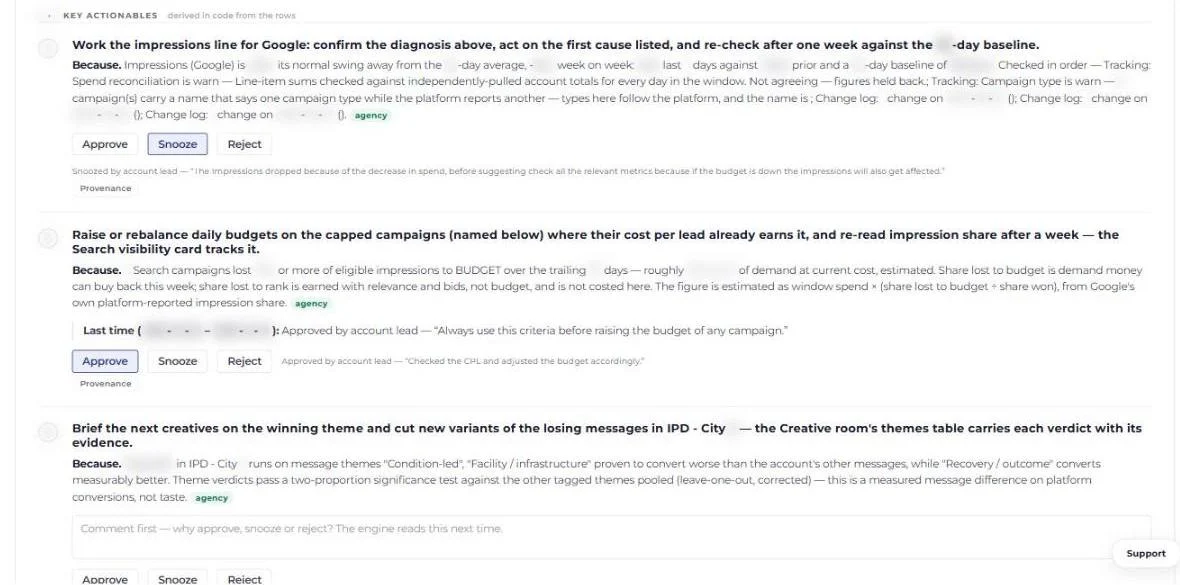
Media Brain acts as the daily tuning engine. It reconciles spend data from ad platforms with conversion data from the client’s CRM every night at 02:00 IST. This allows the system to identify not just which campaigns are performing, but which are producing leads that the sales team actually values.
The system is designed with rigorous guardrails:
- Data Verification: If data from a window does not reconcile, the system refuses to show the figure, avoiding the use of "demo" or "sample" data.
- Human-in-the-Loop: Every recommendation requires human approval. Rejected ideas are logged for future learning, ensuring the system evolves with the brand’s specific context.
- Ask PRISM: A conversational copilot allows stakeholders to query their own reconciled data, providing instant, verifiable insights into campaign performance.
3. SB Studio: Creative at Scale
The third pillar, SB Studio, removes the creative bottleneck. By meshing creative best practices with the "Brand Brain"—a repository of a brand’s tone, rules, and past performance—SB Studio generates static and video assets at high volume.
The system uses creative intelligence to score ads based on bottom-of-funnel performance. If an ad is underperforming, the Media Brain identifies the attribute (e.g., "hook is too slow"), and SB Studio regenerates the variant automatically. This loop effectively eliminates the traditional ten-day creative turnaround time.
Official Perspectives and Industry Implications
The implications of this shift are profound for the agency model. Social Beat’s leadership argues that traditional agency structures are incentivized to keep creative and media separate, often leading to fragmented reporting.
"The moment creative intelligence lands in a spreadsheet, it dies," notes the agency. By resisting the temptation to sell these tools as separate products, Social Beat has created a closed-loop system where media decisions and creative decisions are made on the same evidence, in the same hour.
The industry has taken note. At the Programmatic Asia Awards 2026, Social Beat secured 18 awards, including Programmatic Agency Innovation of the Year. Furthermore, Google has validated the approach by publishing two of the agency’s campaigns as external case studies, marking a significant stamp of approval for the PRISM methodology.
The Path Forward: AI-Native Governance
Looking ahead, Social Beat is focusing on expanding the real-time capabilities of PRISM. Upcoming features include:
- Hourly WhatsApp Alerts: Real-time flagging of campaign disruptions.
- Upper-Funnel Growth Reads: Correlating brand-level spend with long-term growth.
- Machine-Readable Access: Enabling a brand’s own martech stack to query PRISM data directly.
Governance remains a cornerstone of this expansion. With three permission tiers and an enforcing content security policy, the agency ensures that while the system is AI-first, it remains enterprise-grade secure.
As Social Beat continues its "AI Level Up Journey," the message to the market is clear: the era of manual, siloed media planning is ending. By treating media and creative as a singular, data-driven workflow, PRISM is not merely an optimization tool—it is a blueprint for the next generation of programmatic advertising. For brands, the benefit is not just in the 14% media savings, but in the ability to finally speak to their audience with a coherent, unified voice.