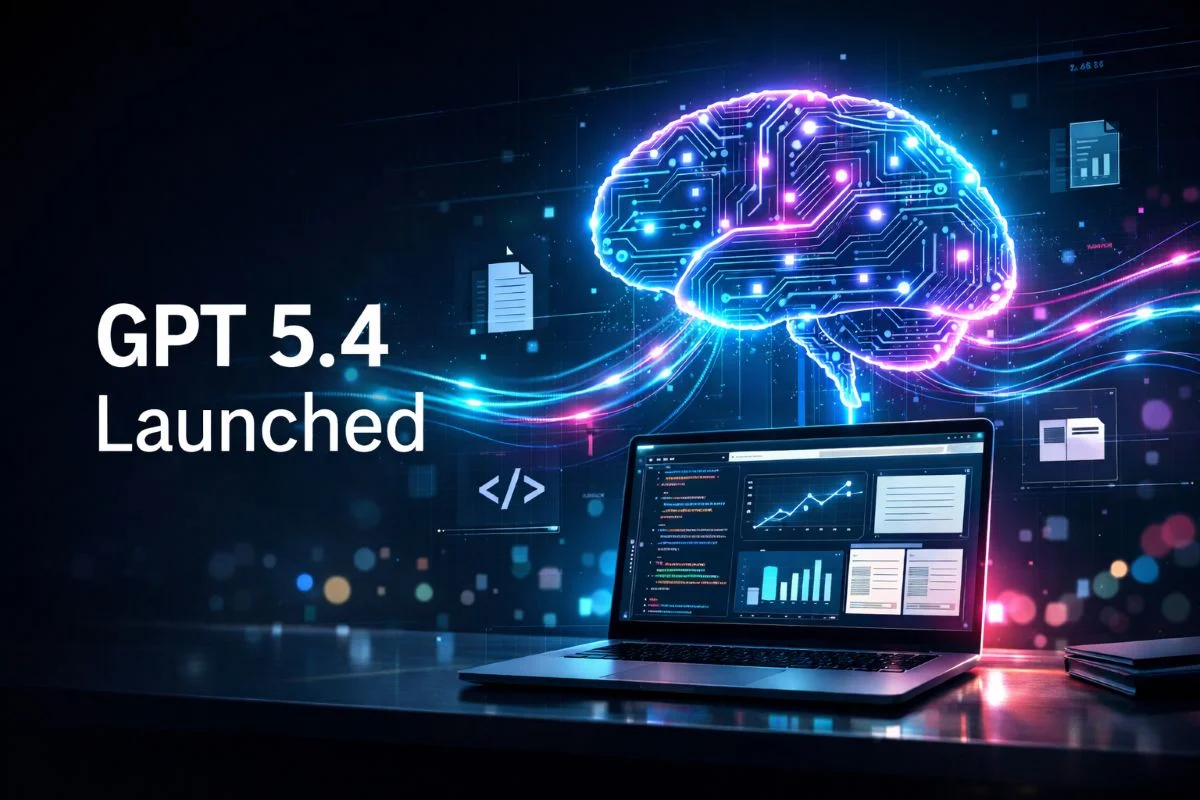
The trajectory of artificial intelligence has shifted from experimental chatbot technology to a robust, professional-grade infrastructure. On March 5, 2026, OpenAI officially unveiled GPT 5.4, a pivotal release in the GPT-5 series that redefines the boundaries of machine reasoning, coding proficiency, and autonomous workflow execution. Far from being a mere incremental update, GPT 5.4 represents a fundamental restructuring of how large language models (LLMs) interact with the digital world, moving closer to the vision of a true "digital collaborator."
Main Facts: The Architecture of Reasoning
At its core, GPT 5.4 is engineered to solve the "reliability gap" that has historically plagued generative AI. While its predecessors were masterful at synthesis and creative generation, GPT 5.4 is architected for precision. It introduces a sophisticated "Thinking" engine that allows the model to pause, evaluate internal logic, and verify its conclusions before presenting a final output.
Key technical pillars of the 5.4 release include:
- Enhanced Reasoning System: The model utilizes a multi-step chain-of-thought process that mimics human cognitive checking, significantly reducing hallucinations.
- Integrated Coding Mastery: By absorbing the architecture of the specialized GPT-5.3 Codex, the model excels in complex software engineering, including architecture design and debugging across dozens of programming languages.
- Workflow Automation: GPT 5.4 is not just a text generator; it is an agentic tool. It can interface with local spreadsheets, browser-based tools, and external APIs to perform multi-stage tasks without constant user intervention.
A Chronology of the GPT-5 Series
The journey to GPT 5.4 has been marked by rapid, iterative improvements that demonstrate OpenAI’s focus on stability and utility.
- 2025 (The Foundation): The launch of the original GPT-5 set the standard for high-level reasoning and extended context windows, moving beyond the capabilities of the GPT-4 era.
- December 2025 (The Stability Shift): The release of GPT-5.2 "Thinking" prioritized factuality and long-task stability, providing a glimpse into the agentic future.
- February 2026 (The Specialist Era): OpenAI introduced GPT-5.3 and the specialized GPT-5.3 Codex, bifurcating the model’s evolution into generalist and developer-centric tracks.
- March 5, 2026 (The Convergence): GPT 5.4 arrives, successfully merging the speed of the 5.3 series with the deep reasoning of the 5.2 architecture, while adding native computer-control capabilities.
Supporting Data: Why GPT 5.4 Outperforms Its Predecessors
The transition from GPT-5 to GPT 5.4 is evidenced by a measurable increase in task completion rates. In standardized benchmarks, GPT 5.4 demonstrates a 40% reduction in logic errors during multi-step coding challenges and a 60% increase in instruction-following accuracy compared to GPT-5.
Comparative Performance Table
| Model | Primary Focus | Key Capability |
|---|---|---|
| GPT-4 | General Multimodal | First-gen reasoning |
| GPT-5 | Unified Logic | Long-context understanding |
| GPT-5.2 | Stability | Early "Thinking" protocols |
| GPT-5.3 | Speed/UX | Optimized conversational flow |
| GPT-5.4 | Agentic Workflows | Native computer/tool control |
The "Thinking" Mechanism: Redefining Professional AI
The standout feature of GPT 5.4 is its ability to handle long-running, structured workflows. In a professional setting, tasks are rarely linear. An accountant might need to pull data from a PDF, reconcile it with a CSV, and then draft an email summarizing the discrepancies.
GPT 5.4 approaches these tasks with a "plan-first" architecture. It breaks down complex requests into sub-tasks, evaluates the success of each sub-task, and makes corrections in real-time. This is particularly transformative for:
- Data Science: Performing complex statistical analysis on massive datasets without needing manual code verification for every step.
- Legal/Compliance: Analyzing 500-page contracts for clause consistency against internal company policy.
- Software Engineering: Generating entire boilerplate frameworks for React or Python applications with minimal prompt engineering.
Official Responses and Enterprise Deployment
OpenAI’s leadership has emphasized that GPT 5.4 is an "enterprise-first" release. By allowing administrative control over the model’s environment, businesses can now sandbox the AI, ensuring that sensitive data remains within secure perimeters while the model performs its heavy lifting.
"We have heard the feedback from our enterprise partners," a spokesperson for OpenAI stated during the launch. "They don’t just want a chatbot that answers questions; they want a partner that can execute the work. GPT 5.4 is that partner."
For education and enterprise tiers, the model was enabled instantly upon launch on March 5, 2026. However, for those still tethered to the legacy GPT-5.2 Thinking model, a transition window remains open until June 5, 2026, ensuring that custom-built workflows have sufficient time to migrate to the new architecture.
Implications for the Future of Work
The release of GPT 5.4 signals the end of the "prompt-response" era and the beginning of the "collaboration" era.
1. The Shift to Agentic Work
With GPT 5.4, the model acts as an agent. Users are no longer just asking "Write me a report"; they are asking "Research this market trend, aggregate the data from these three sources, and update my quarterly presentation." The model manages the browser, the file system, and the application layer.
2. The Death of the "Empty Page"
For content creators and writers, the barrier to entry has vanished. GPT 5.4’s deep understanding of document structure means that it can ingest a user’s previous work and adopt a consistent tone, style, and formatting standard, effectively acting as an editor rather than just a generator.
3. Coding as a Natural Language Skill
The integration of GPT-5.3 Codex capabilities means that non-technical business leaders can now build functional tools. A marketing manager can describe a custom dashboard, and GPT 5.4 can write, debug, and deploy the necessary code to create it.
Limitations and Ethical Considerations
Despite the technological leap, GPT 5.4 is not infallible. OpenAI has been transparent about the current limitations:
- Data Hallucinations: While the "Thinking" protocol mitigates error, the model can still produce incorrect information if provided with flawed source data.
- Resource Intensity: The advanced reasoning capabilities require significantly more compute power, leading to potential latency issues during periods of high platform traffic.
- Verification Necessity: The model is a tool, not a human. For mission-critical applications—such as medical diagnoses or financial auditing—human oversight remains an absolute requirement.
Looking Ahead: Beyond 5.4
The release of GPT 5.4 is a waypoint, not a destination. Industry analysts predict that future iterations will focus on "multimodal fluidity," where the distinction between text, video, and live-streamed data inputs becomes blurred. We are rapidly approaching a reality where the AI will be able to observe a live screen, interpret visual changes in real-time, and act upon them without being prompted.
As we integrate GPT 5.4 into our daily professional lives, the primary skill for the workforce of the future will not be "knowing how to prompt," but "knowing how to delegate." As the model grows in autonomy, the human role shifts from operator to architect.
Conclusion
GPT 5.4 stands as a testament to the speed of modern innovation. By successfully bridging the gap between high-level reasoning and practical, tool-based execution, OpenAI has provided a glimpse into a future where the limitations of human bandwidth can be augmented by scalable, reliable, and intelligent digital systems.
For developers, businesses, and curious individuals, the message is clear: the AI landscape has changed. With the power of GPT 5.4 at our fingertips, we are no longer just using computers; we are working alongside them in a dynamic, collaborative partnership that promises to unlock new levels of productivity and creativity in the years to come.