




In the evolving landscape of digital marketing, images are far more than mere aesthetic flourishes. They are powerful vehicles for engagement, conversion, and information. However, as search engines and artificial intelligence models become increasingly visual-centric, the way we describe these images has moved from a "best practice" to a fundamental requirement for online visibility.
Whether you are running a boutique blog or managing a massive e-commerce catalog, your images serve as a bridge between your content and the machines that index it. Understanding the nuances of alt text and title attributes is no longer just a technical task for web developers; it is a core competency for every content creator in the age of AI-powered search.
Main Facts: Defining the Anatomy of an Image Attribute
At the heart of web accessibility and search engine optimization (SEO) lie the alt and title attributes within an HTML image tag. A standard, well-structured image tag looks like this:
<img src="product-photo.jpg" alt="A pair of red waterproof running shoes on a wooden surface" title="View our running shoe collection">
While often colloquially referred to as "tags," these are technically attributes. The alt attribute (or alt text) is the most critical of the two. Its primary purpose is to provide a text-based alternative to the image for those who cannot see it—specifically, users relying on screen readers. Beyond accessibility, search engine crawlers use this text to understand the context of the visual content.

Conversely, the title attribute is used to provide a tooltip that appears when a user hovers their mouse over an image. In modern web standards, the title attribute is largely redundant for accessibility purposes and is often ignored by screen readers. For the vast majority of web use cases, the alt attribute is where your focus must remain.
Chronology: From Keyword Stuffing to AI-Powered Context
The history of image optimization has been a rocky one. In the early days of SEO, many webmasters viewed the alt attribute as a playground for "keyword stuffing." By packing irrelevant, high-volume keywords into image tags, site owners attempted to trick search engines into ranking their images for unrelated terms.
This practice proved detrimental, leading to a poor user experience and, eventually, strict penalties from search giants like Google. Today, the focus has shifted entirely toward utility and user-centricity.
- The Early Era: Simple, descriptive filenames were neglected; alt text was either missing or exploited for spam.
- The Accessibility Shift: Legal and ethical mandates prioritized screen reader compatibility, forcing developers to write meaningful descriptions.
- The AI Integration: With the advent of computer vision, Google Lens, and AI-powered search overviews, alt text has become a data-labeling tool. We are now "teaching" AI models how to categorize products and visual elements by providing clear, descriptive alt metadata.
Supporting Data: Why "Decorative" vs. "Informative" Matters
Not all images require the same level of detail. Understanding the difference between a purely decorative image and an informative one is a cornerstone of professional web management.
- Informative Images: These are images that convey meaning—product photos, infographics, charts, or screenshots of processes. These must have descriptive, high-quality alt text that summarizes the visual data.
- Decorative Images: These are elements like background patterns, icons that don’t add new information, or purely aesthetic dividers. These should not clutter screen readers. If an image is purely decorative, it should be placed in the site’s CSS, not the HTML. If that is impossible, it should be given an empty alt attribute:
alt="". This instructs screen readers to skip the image entirely, preventing the user from being interrupted by useless information.
Research indicates that properly labeled images are significantly more likely to appear in "Visual Search" results. When a user points their smartphone camera at a product in the real world using Google Lens, the AI cross-references the visual input with the metadata provided on the web. If your alt text contains specific identifiers like product names, SKUs, and material types, your chances of being the "result" that Google presents to the shopper skyrocket.
Official Responses and Best Practices
Google’s official guidelines regarding image optimization are clear: focus on information-rich, context-aware descriptions. Google explicitly warns against keyword stuffing, noting that it degrades the user experience and can lead to a site being flagged as spam.
How to Craft the Perfect Alt Text
- Be Specific: Instead of "shoe," use "red waterproof running shoe, size 10, breathable mesh upper."
- Be Concise: Keep it descriptive but brief. A full paragraph is rarely necessary.
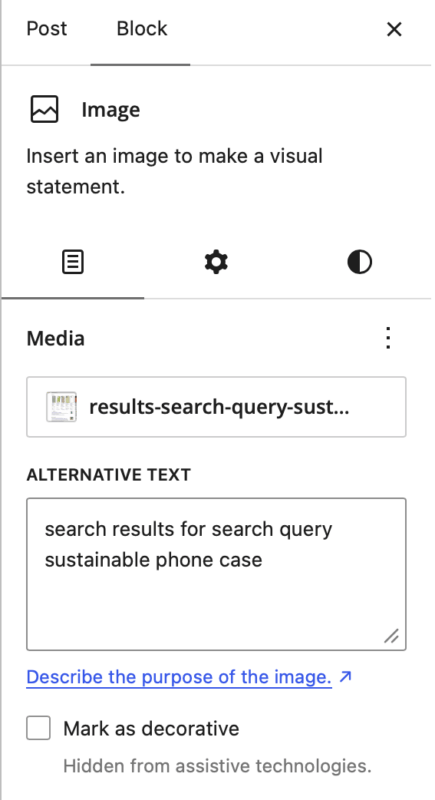
- Contextualize: If the image is a screenshot, describe the specific action or data point being shown.
- Use Proper Filenames: Before you even upload the image, rename the file.
IMG_001.jpgtells a search engine nothing.red-waterproof-running-shoe.jpgtells them everything.
Implications for E-commerce and AI Integration
For large-scale e-commerce platforms, the manual task of writing unique alt text for thousands of items is a daunting logistical hurdle. This is where Artificial Intelligence is transforming the industry.
Advanced tools now allow for the automated generation of alt text by reading product database information. By syncing the SKU, product title, and category metadata, AI can generate a draft description that is accurate and SEO-friendly.
The Human-in-the-Loop Imperative
However, the rise of AI does not mean the end of human oversight. Generic AI tools often fail to distinguish between subtle product variations—such as whether a shirt is "navy" or "royal blue"—or whether an image is intended to convey a specific marketing emotion rather than just a product feature.
The Golden Rule for AI implementation:
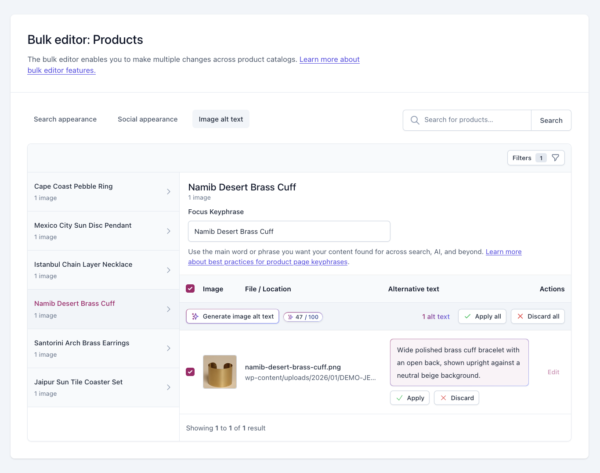
- Use AI for volume: Let the technology handle the bulk generation of descriptions for your massive inventory.
- Review for quality: Never publish AI-generated alt text without a human sanity check.
- Prioritize the Hero: Spend your manual effort on the most important images—your homepage banners, landing page features, and complex infographics. These are the visuals that define your brand identity and require a human touch to describe effectively.
Conclusion: The Future is Visible
The digital landscape is becoming increasingly visual. As we move toward a future defined by multimodal AI—where search engines "see" content as much as they read it—the importance of image metadata will only continue to grow.
By treating alt text as a crucial component of your SEO strategy rather than an afterthought, you achieve two goals simultaneously: you make your website a more inclusive space for users with visual impairments, and you provide the essential data that search engines need to surface your content in an AI-driven world.
Remember, you are not just writing for a search engine algorithm; you are helping machines interpret your world for the benefit of the human user. Invest the time to write, review, and refine your image descriptions, and your site will reap the rewards in both traffic and accessibility.