







By Global Tech Desk
Published: October 24, 2026
Main Facts
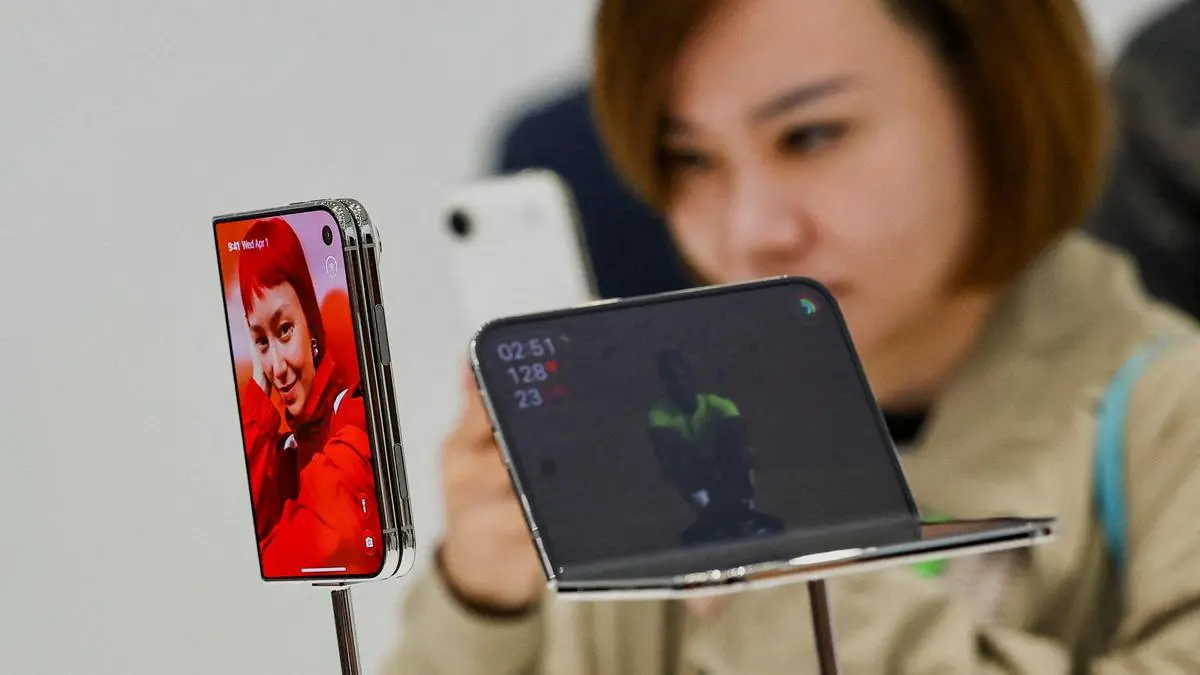
Apple Inc.’s most radical reinvention in the iPhone’s nearly two-decade history has officially hit the market, reviving a retail phenomenon not seen in years: overnight queues, packed flagship stores, and immediate stock depletion. The device, christened the iPhone Duo, represents Apple’s high-stakes entry into the foldable smartphone category—a market that, despite existing for several years through competitors like Samsung, Xiaomi, and Oppo, has largely remained a high-end niche.
Priced at a staggering starting point of $1,999 for the 256-gigabyte model and scaling up to $3,199 for the ultra-premium 2-terabyte configuration, the Duo is easily one of the most expensive mainstream consumer smartphones ever commercialized. Despite the prohibitive price tag, initial consumer demand completely overwhelmed available in-store inventory. Within hours of opening doors on Friday, Apple stores across global epicenters—from New York and Los Angeles to London, Beijing, and Singapore—had entirely exhausted their walk-in allocations.
The launch serves as a crucial referendum on Apple’s ability to inject fresh excitement into its core product lineup. Generating roughly half of the corporation’s total annual revenue, the iPhone remains Apple’s undisputed financial engine. By introducing a seamless foldable screen devoid of the prominent central crease that has historically plagued competitor devices, Apple is betting that its signature polish can finally transition foldable technology from a gadget-lover’s curiosity into a mass-market phenomenon.
Chronology of a Global Launch
The rollout of the iPhone Duo unfolded across time zones in a whirlwind of international excitement, harkening back to the classic, high-octane product releases of the Steve Jobs era—a stark contrast to the subdued, appointment-driven store pickups that have characterized Apple launches in recent years.
Pre-Dawn Anticipation and Midnight Vigils
The journey to launch day began well before store gates opened on Friday morning. In Singapore, a dedicated family of seven from Myanmar camped outside the flagship store overnight to secure their spot at the front of the queue. Similar scenes played out outside the iconic Fifth Avenue Apple Store in New York, where lines wrapped multiple blocks by 5:00 a.m.—three hours ahead of the official 8:00 a.m. opening time.
Executive Sightings and Storefront Energy
Apple’s senior leadership turned out in full force to witness the historic launch. Newly minted Chief Executive Officer John Ternus greeted eager consumers at the Domain Northside Apple Store in Austin, Texas. Meanwhile, at Fifth Avenue, Apple’s Senior Vice President of Marketing Greg Joswiak and Vice President of Retail Stores Vanessa Trigub welcomed the surging crowds.
Rapid Inventory Depletion
For walk-in customers hoping to bypass the digital queue, the window of opportunity was remarkably narrow. U.S. retail locations received highly constrained allocations, averaging roughly 50 to 200 units per store.
- Los Angeles: Walk-in inventory was entirely depleted by 6:30 a.m.
- Lawrence Township, New Jersey: Located roughly 40 miles outside Philadelphia, this suburban hub sold out of its entire 256GB and 512GB stock within the first 30 minutes of business, leaving only the ultra-expensive 1TB and 2TB tiers available for latecomers.
Digital Backlogs and Extended Shipping Delays
For consumers unable to secure a physical unit on launch morning, Apple’s online storefront offered little immediate relief. Digital orders placed on Friday were immediately backordered, with standard delivery estimates stretching out to late January. Though minor logistical adjustments saw some shipping dates pull forward to November or December for select buyers, the backlog represents some of the longest wait times for a primary Apple product release in the company’s modern era.
Supporting Data and Market Dynamics
To understand the scale of the iPhone Duo launch, analysts are looking closely at supply chain constraints, pricing models, and shifting consumer habits within the premium mobile sector.
| Metric / Category | Details & Figures |
|---|---|
| Starting Price | $1,999 (256GB configuration, Star White model most popular) |
| Maximum Price | $3,199 (2nd-generation 2TB storage tier) |
| Store Allocations | 50 to 200+ units per U.S. retail location |
| Online Backlog | Delivery windows pushed from launch day to late January (with some moving to Nov/Dec) |
| Revenue Impact | iPhone division generates ~50% of Apple’s total corporate revenue |
| Manufacturing Hubs | Restricted to a limited number of specialized facilities in China due to complex hinge and display assembly |
Manufacturing Complexities
Unlike traditional slab iPhones—production of which Apple has increasingly diversified into regions like India to optimize its supply chain—the iPhone Duo demands hyper-specialized manufacturing processes. The complex mechanics of the zero-crease hinge and next-generation foldable display technology mean that the Duo is currently restricted to a select few advanced facilities in China. These supply bottlenecks explain the severe shortage of units and the lengthy digital queue times.
Component Costs and General Inflation
While the $1,999 baseline sets a new record for consumer hesitation, Apple is not operating in a vacuum. Persistent global shortages of high-end memory chips, specialized processors, and advanced display components have driven up baseline production costs across the consumer electronics sector. Industry rivals including Samsung, Xiaomi, and Oppo have similarly adjusted their pricing structures upward for flagship hardware, conditioning consumers to accept higher price points for cutting-edge engineering.
Official Responses and Consumer Perspectives
Reactions to the iPhone Duo run the gamut from ecstatic praise for Apple’s engineering prowess to pragmatic skepticism regarding the long-term durability of foldable mechanics.
The Innovation Narrative
For many consumers who felt fatigued by years of iterative, minor updates to the traditional iPhone slate design, the Duo represents a genuine paradigm shift.
"This is the first true innovation Apple have had in years," noted Peter Ingram, a chief technology officer and London resident visiting the UK after inspecting a demo model. "It is expensive. But I tried it out, played with it in the store. It’s incredible how it’s got no crease."
Skepticism and Practical Considerations
Not all early adopters are blind to the risks of entering unchartered hardware territory. At the New Jersey Apple Store, local shopper Victor Osorio expressed mixed feelings while waiting with his partner, Victoria.
"Apple always does something different and adds extra spice to it," Osorio remarked. "I’m not nervous about the form factor, but I am about the hinge. I don’t want it to get in the way, but it looks OK so far." Victoria noted she was drawn specifically to the device’s enhanced multitasking capabilities when unfolded.
Meanwhile, frequent trade-in consumer Naveed Abubacker adopted a pragmatic view of Apple’s delayed entry into the space: "Foldable technology has been around for a while, and Apple is late to the gate, but I’m ready for it. If it doesn’t work out for me, I’ll return it."
International Variations: The China Market
In contrast to the frantic scenes in Western markets and Singapore, the launch across mainland China—specifically in Beijing and Shanghai—was characterized by a more moderate, highly organized turnout. Because many buyers were required to pre-register their purchases digitally, chaotic walk-in lines were largely avoided.
Andy Shen, speaking outside the Sanlitun Apple Store in Beijing, highlighted the trade-offs driving consumer decisions in Asia:
"It will take some getting used to. I chose the Duo mainly because it opens up to a bigger screen to enable a better experience with videos, though its other functions are not measuring up to earlier generations, like the camera."
Implications for Apple and the Industry
The triumphant rollout of the iPhone Duo carries profound financial, strategic, and structural implications for Apple as it closes out the final quarter of fiscal 2026.
Avoiding the Vision Pro Trap
Industry watchers have been quick to compare the launch trajectory of the iPhone Duo with the lukewarm commercial debut of Apple’s Vision Pro spatial computer three years prior. While the Vision Pro quickly settled into a specialized developer and enthusiast niche due to high costs and limited practical software use cases, the iPhone Duo is tapping directly into an existing, highly monetized ecosystem. By leveraging the foundational familiarity of iOS within an entirely new physical envelope, Apple has successfully avoided the demand stagnation that plagued its headset venture.
Shifting Release Schedules
The timing of the iPhone Duo launch coincides with a broader strategic pivot in Apple’s product release calendar. Historically, the company clustered nearly all major hardware announcements into the September-to-October window. However, according to reports from Bloomberg News, upcoming iterations—such as entry-level iPhones and an anticipated ultra-slim Air model—will be staggered into next year. This deliberate spacing aims to smooth out corporate revenue generation across all four fiscal quarters rather than relying entirely on a massive Q4 holiday spike.
Financial Outlook
Apple is scheduled to report its quarterly earnings results on November 2. Financial analysts note that this upcoming report will not capture the financial impact of the iPhone Duo, as the fiscal period concluded at the end of September—prior to the device’s October release. Instead, the upcoming earnings call will reflect early sales figures for the traditional iPhone 18 Pro and Pro Max models, which debuted on September 18. The financial weight of the iPhone Duo will not be fully realized until Apple’s Q1 fiscal report early next year.
The Bottom Line
Ultimately, the iPhone Duo has proven that Apple’s brand equity remains robust enough to command luxury-tier pricing even during periods of broader economic caution. By successfully commercializing a crease-free foldable device, Apple has not only validated a previously stuttering technological category but has also cemented its ability to redefine consumer expectations when it matters most. As global factories race to replenish depleted stocks, the iPhone Duo has definitively set a new high-water mark for the modern mobile industry.