







As artificial intelligence (AI) rapidly evolves from a passive search tool into an active, decision-making participant in our daily lives, the retail sector is undergoing a profound transformation. Walmart, the world’s largest retailer, is positioning itself at the vanguard of this shift, unveiling a comprehensive framework designed to integrate "agentic commerce" into its ecosystem while ensuring that human shoppers remain firmly in the driver’s seat.
On Wednesday, October 21, Walmart announced a suite of new tools and protocols intended to govern how AI agents—software programs capable of executing tasks autonomously—interact with its retail platform. This move marks a critical evolution in how the company approaches the "Sparky" AI shopping agent and its integrations with third-party platforms like OpenAI’s ChatGPT, Google’s Gemini, and Meta’s Muse.
The Core Strategy: Maintaining the "Human-in-the-Loop"
The primary hurdle for widespread AI adoption in commerce is not technological capability, but consumer trust. According to research from NMI published in August, only 11% of U.S. adults have utilized AI to finalize a transaction, with a staggering 70% of consumers expressing a desire to review or override AI-driven purchasing decisions before money changes hands.
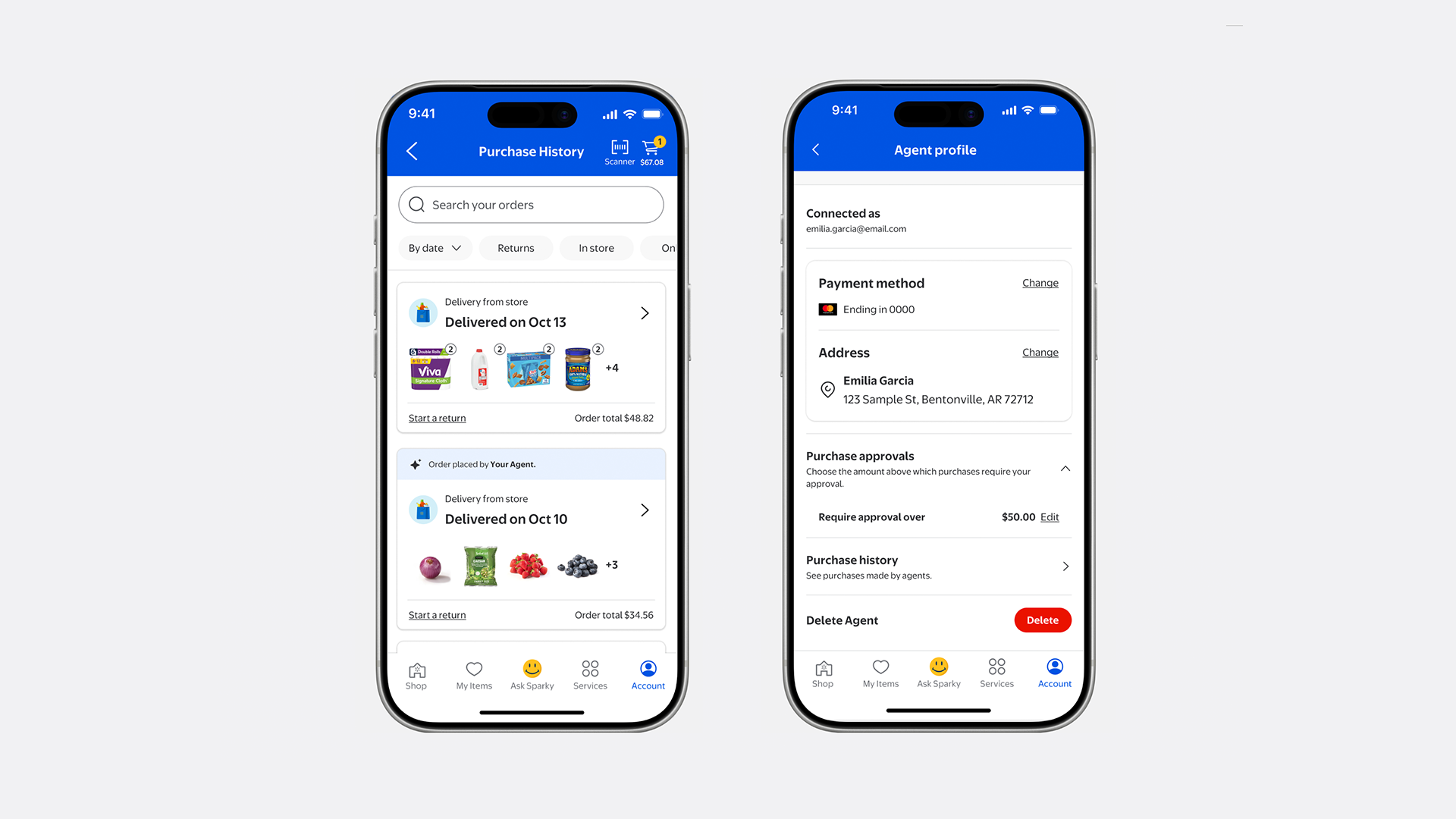
Recognizing this apprehension, Daniel Danker, Walmart’s executive vice president of AI acceleration, product and design, has emphasized that the retailer’s objective is to build the most trusted AI experience in the market. The core of this strategy is the introduction of "Agent Profiles," a feature slated to roll out within the next month.
Bridging the Gap Between Automation and Oversight
Currently, when a shopper uses an AI agent to browse or purchase, those actions are often obscured, appearing as standard entries in a user’s account without distinction. The new Agent Profiles will provide a dedicated digital space for AI-led activities.
Key functionalities of these profiles include:
- Granular Spending Limits: Users can pre-set budgetary constraints for their agents (e.g., $50, $100, or $200), allowing the AI to operate within defined parameters without requiring individual sign-offs for every transaction.
- Approval Gateways: For purchases exceeding set limits or for users who prefer total control, the system will require manual confirmation before the final checkout.
- Visibility and Accountability: Users will be able to clearly identify which items were curated and purchased by an AI agent versus those selected by the human account holder, ensuring transparency in transaction history.
The Chronology of Walmart’s AI Evolution
Walmart’s pivot toward agentic commerce did not happen overnight. It is the result of a multi-year strategy focused on integrating advanced machine learning into its massive supply chain and customer-facing interfaces.
- Early 2025: The industry began witnessing the emergence of "agentic commerce" as a mainstream trend, moving beyond simple chatbots to agents capable of multi-step task completion.
- May 2026: Walmart significantly scaled its internal AI capabilities with "Sparky," an internal agent designed to assist in sales and supply chain management.
- Mid-2026: The retailer solidified partnerships with the leading LLM providers, embedding shopping capabilities directly into external interfaces like ChatGPT and Gemini.
- October 2026: The announcement of the Agent Gateway and Agent Profiles signaled a shift from "experimental" AI to "governed" AI, creating a standardized environment for these agents to operate within the Walmart infrastructure.
Supporting Data: Why "Agentic" Matters
The shift toward agentic commerce is not merely a novelty; it is a response to changing consumer behavior. At the Morgan Stanley Technology, Media and Telecom Conference in March, Daniel Danker highlighted that users were increasingly using AI to solve "need-based" problems. For example, vitamin and protein supplements became the top-purchased categories through ChatGPT integrations, as these purchases often stem from conversational health queries rather than direct product searches.
This represents a departure from traditional "search-and-buy" behavior. Consumers are now using AI to synthesize information, compare attributes, and make recommendations. By facilitating these conversations, Walmart is positioning itself to capture demand at the point of intent rather than the point of purchase.
Technical Infrastructure: The Agent Gateway and MCP
One of the most significant technical hurdles identified by Walmart is the inefficiency of current AI browsing. Historically, AI agents have been forced to navigate the web like humans—by "reading" browser pages, clicking buttons, and scrolling. This method is slow, prone to errors, and often results in "hallucinations" or broken checkout flows.

To solve this, Walmart is developing the Agent Gateway, a system that bypasses the traditional user interface in favor of a direct, API-like connection. By leveraging the Model Context Protocol (MCP)—an open standard pioneered by Anthropic—Walmart is allowing AI systems to communicate directly with its inventory and order systems.
This allows the AI to perform tasks like:
- Discovery: Finding the specific brand or SKU a customer prefers without needing to navigate the entire catalog.
- Order Tracking: Providing real-time updates on shipments without the user needing to log in to the Walmart app.
- Privacy-First Data Access: The gateway allows agents to access a customer’s "preferred items" (e.g., their favorite brand of milk) without granting the AI access to the customer’s broader, sensitive purchase history or full financial profile.
Implications for the Marketplace Ecosystem
The rise of agentic commerce presents both a threat and a massive opportunity for the thousands of third-party sellers on the Walmart Marketplace.
Raising the Bar for Quality
Manish Joneja, senior vice president of Walmart Global Marketplace and Walmart Fulfillment Services, noted that as agents become the primary interface for shopping, the traditional rules of SEO (Search Engine Optimization) are changing. Agents prioritize "data hygiene." If a product listing is missing key dimensions, accurate descriptions, or high-quality images, an AI agent will likely skip that product in favor of one with better-structured data.
"Agentic commerce creates more opportunities for sellers to put the right products in front of the right customers," Joneja stated, "including brands and products that may not have broad awareness." However, he warned that this raises the bar for accuracy. Sellers must now ensure that their product information is optimized not just for human eyeballs, but for the logical processing power of AI models.
Privacy and Security Protocols
Walmart’s new terms of service for agents are stringent. To mitigate the risks associated with autonomous systems, the company has implemented the following safeguards:
- Access Limitations: Agents are explicitly barred from accessing or storing payment card details.
- Instruction Adherence: Agents cannot deviate from a shopper’s explicit instructions; any attempt to "upsell" or deviate from the user’s criteria will result in the agent being blocked.
- Third-Party Boundaries: While Walmart provides the infrastructure, any data shared by the user directly with a third-party AI provider remains governed by that provider’s privacy policy. Walmart is positioning its own tools as a "safe harbor" by ensuring that its internal agents operate under its own, more rigid, privacy standards.
The Future of Retail: A Collaborative Ecosystem
As we look toward the end of 2026 and into 2027, the retail landscape is clearly moving toward a hybrid model. The goal is no longer to replace the human shopper with an AI bot, but to create a collaborative relationship where the AI handles the friction—the searching, the comparing, and the logistical tracking—while the human retains final authority.
Walmart’s investment in the Agent Gateway and the introduction of Agent Profiles suggests a belief that the future of retail is "conversational and autonomous." By standardizing how these agents interact with its platform, Walmart is not only protecting its customers but is also creating a predictable, high-speed environment for the next generation of digital commerce.
For the retail industry, the message is clear: the era of the passive website is coming to an end. The era of the active, intelligent agent has begun. Whether this technology will be adopted at scale remains to be seen, but with the backing of the world’s largest retailer, the transition to agentic commerce is no longer a question of "if," but "how soon."