






Introduction: The Growing Burden of Asset Management
In the modern digital ecosystem, the gravity of web applications is defined by their assets. From high-resolution media and dynamic front-end bundles to massive datasets fueling machine learning models, the volume and size of files are growing at an exponential rate. As applications scale, developers face a compounding crisis: the "Cloud Tax." Managing assets via legacy hyperscalers—namely AWS S3, Google Cloud Storage, and Azure Blob Storage—often leads to bloated operational costs, rigid vendor lock-in, and an increasingly complex web of proprietary APIs and hidden egress fees.
Enter STRG, a rising contender in the cloud infrastructure space that promises to disrupt the status quo. By providing a modern, S3-compatible object storage platform, STRG is positioning itself not just as a cheaper alternative, but as a more developer-friendly ecosystem designed for the next generation of web applications and AI-driven workflows.
Main Facts: What is STRG?
At its core, STRG is a high-performance cloud object storage service engineered for compatibility and efficiency. The platform is designed to act as a drop-in replacement for the industry-standard S3 protocol. This compatibility is its greatest strength; developers who have spent years building infrastructure around the AWS SDKs can transition to STRG without refactoring their entire codebase.
Key Features of the STRG Ecosystem:
- S3-Compatibility: Full support for existing S3-based tools, CLI commands, and SDKs.
- Regional Flexibility: STRG offers multi-region support, allowing developers to keep assets closer to their end-users to reduce latency.
- Granular Control: The platform supports advanced features including custom lifecycle policies, CORS rules, object locking, and refined access control lists (ACLs).
- AI Integration: A standout feature is its native Model Context Protocol (MCP) support, allowing AI agents to interface directly with stored assets.
Chronology: The Evolution of Cloud Storage
The history of cloud storage can be divided into three distinct eras:
- The Primitive Era (Pre-2006): Developers were responsible for managing physical servers and local storage arrays. Reliability was low, and scalability was a manual, painstaking process.
- The Hyperscaler Era (2006–2020): With the launch of AWS S3, the industry shifted to the cloud. This era saw massive innovation but led to a "walled garden" effect. As businesses became reliant on these platforms, pricing power shifted entirely to the providers, and egress fees became a major pain point for developers.
- The Modern, Interoperable Era (2021–Present): This is where STRG fits in. The focus has shifted from mere storage to utility and portability. Today’s developers demand storage solutions that are not only durable but also cost-transparent, API-agnostic, and compatible with the booming field of AI-agentic workflows. STRG represents the maturation of this third wave.
Supporting Data: Why Costs and Complexity Matter
Industry reports indicate that cloud infrastructure spending is one of the largest line items in engineering budgets. For many startups, storage and bandwidth costs often scale linearly with growth, creating a "success penalty" where the more popular an app becomes, the less profitable it is to host.
The Cost-Benefit Equation
Hyperscalers often hide complexity within tiered pricing models. By contrast, STRG adopts a streamlined approach. By leveraging a leaner infrastructure footprint and modern storage architecture, STRG reduces the overhead that typically leads to inflated invoices. Furthermore, the ability to use the standard AWS CLI or JavaScript SDKs means that development teams do not need to undergo a steep learning curve or hire specialists to manage a new, proprietary storage system.
Technical Deep Dive: Implementing STRG
Using the CLI
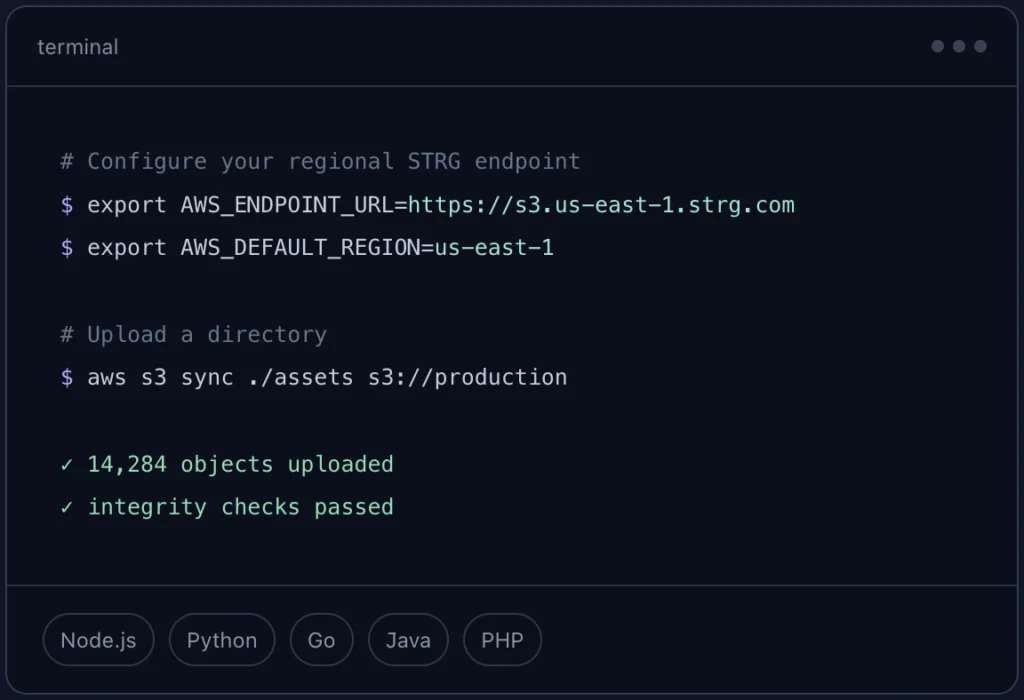
For developers who prefer a command-line interface, STRG integrates seamlessly with the existing AWS CLI ecosystem.
# Configure your STRG profile
aws configure --profile strg

# Interacting with buckets
aws s3 ls --profile strg --endpoint-url https://s3.eu-central-1.strg.com
aws s3 cp ./data-asset.zip s3://production-bucket/data-asset.zip --profile strg --endpoint-url https://s3.eu-central-1.strg.com
The JavaScript Implementation
The true power of STRG is revealed in its compatibility with the standard AWS SDK for JavaScript. This allows for a clean transition.
import  S3Client, PutObjectCommand  from "@aws-sdk/client-s3";

const s3 = new S3Client(
  endpoint: "https://s3.eu-central-1.strg.com",
  region: "eu-central-1",
);

await s3.send(
  new PutObjectCommand(
    Bucket: "user-assets",
    Key: "profile-image.png",
    Body: fileBuffer
  )
);
This simplicity ensures that the barrier to entry is minimal, allowing teams to move their infrastructure in hours rather than months.
The AI Frontier: STRG and Agentic Workflows
The most innovative aspect of the STRG platform is its integration with the Model Context Protocol (MCP). As we move toward a future where AI agents perform complex tasks—such as automated data analysis, asset organization, and retrieval—these agents need a secure, reliable way to interact with storage.
By adding STRG to an AI agent’s configuration, developers grant their models the ability to browse, read, and manage storage buckets with the same permissions as a human operator:
claude mcp add --transport http strg https://mcp.strg.com/mcpThis ensures that the AI can act as an extension of the development team, automating asset lifecycle management without needing constant human intervention. Because STRG respects the access keys provided, the AI operates within a secure "sandbox," ensuring that sensitive data remains protected.
Implications: The Strategic Shift
The emergence of platforms like STRG signals a fundamental shift in how businesses view cloud infrastructure. It is no longer enough to offer "durable storage"; providers must now offer "strategic storage."
1. The Death of Vendor Lock-in
By sticking to the S3 standard, STRG ensures that developers remain the owners of their architecture. If a project outgrows a specific provider, moving to another S3-compatible service is a matter of updating an endpoint URL, not rewriting the application logic.
2. Operational Efficiency
For CTOs and Lead Architects, the ability to standardize on one API (S3) while choosing multiple back-end providers based on cost, performance, or region is a massive win for architectural agility.
3. Future-Proofing for AI
As AI becomes the primary way we interact with software, the storage layer must be as "agent-friendly" as it is "human-friendly." STRG’s focus on MCP is a preemptive strike against the siloed nature of traditional storage, effectively turning a file bucket into an intelligent data source for LLMs.
Official Perspective and Future Outlook
While representatives from larger providers often argue that their "integrated ecosystems" offer more value, the developer community is increasingly voting with their feet. The preference for specialized, high-quality services (the "Best of Breed" approach) is overtaking the desire for "all-in-one" suites that charge a premium for bundled services the user may not need.
As STRG continues to expand its regional footprint, the primary challenge will be maintaining the same level of performance and security that users expect from incumbents. However, given their current trajectory, the platform appears well-positioned to become a backbone for modern, cost-conscious, and AI-enabled web development.
Conclusion: Getting the Foundation Right
In software engineering, the cost of a poor decision at the infrastructure level is often paid over the course of years. Choosing a storage provider is a foundational decision that impacts everything from latency and budget to the ease of future AI integration.
STRG offers a compelling case for those looking to optimize their stack. By combining the familiar, battle-tested S3 protocol with the agility of a modern cloud platform, they have stripped away the complexity of legacy providers while adding the necessary hooks for the AI era. Whether you are a solo developer managing a small portfolio of assets or an enterprise architect looking to trim cloud spending, STRG provides the tools to build faster, cheaper, and smarter.
The era of bloated, opaque cloud storage is coming to an end. It is time to modernize your stack.