In an era where the internet serves as the primary gateway for commerce, healthcare, and social interaction, the promise of a "universal web" remains ironically elusive for millions. Despite the rapid advancement of digital technology, a significant portion of the global population—roughly 1.3 billion people living with disabilities—finds itself marginalized by inaccessible websites and applications.
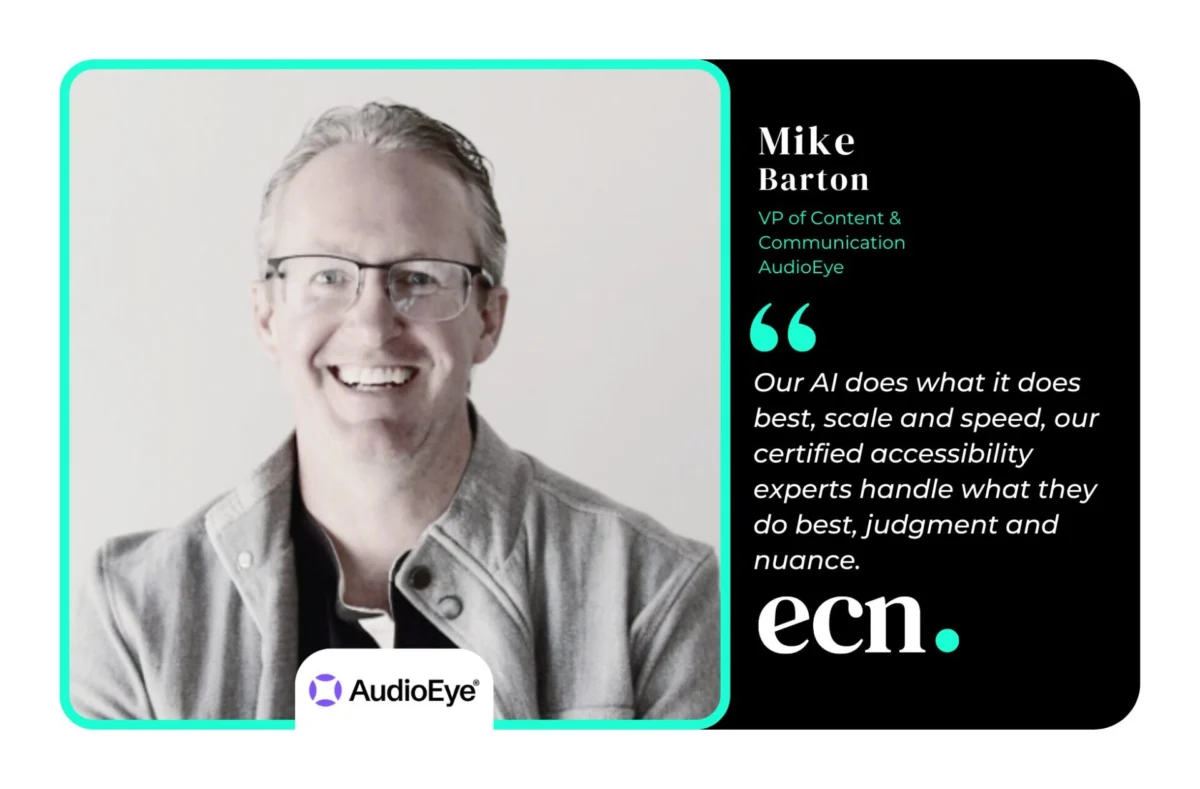
As regulatory landscapes shift and the integration of Artificial Intelligence transforms how we navigate the digital space, the mission of companies like AudioEye has moved from a niche compliance concern to a critical business imperative. Mike Barton, VP at AudioEye, frames the challenge with stark clarity: "Our vision is a digital world where accessibility isn’t an afterthought or a legal scramble, but the default."
Main Facts: The Intersection of Automation and Human Expertise
AudioEye operates as a leading digital accessibility platform, currently trusted by over 127,000 organizations. The company’s core value proposition lies in a hybrid approach: leveraging high-speed AI automation to handle the sheer volume of web content while employing certified human experts to navigate the nuanced, "gray areas" of user experience.
The platform functions by integrating a single line of JavaScript—similar to common cookie consent banners—which enables 24/7 monitoring and real-time automated fixes. According to independent studies, this automated layer detects up to 2.5 times more issues than competing tools. However, AudioEye maintains that software alone is insufficient. By coupling AI-driven remediation with manual audits performed by accessibility specialists (many of whom have lived experience with disabilities), the company ensures that the complex, subjective barriers to entry are effectively dismantled.
Chronology: From Niche Concern to Global Standard
The history of digital accessibility tracks the evolution of the internet itself. Nearly two decades ago, when AudioEye was founded, accessibility was widely treated as a "checkbox" exercise or, more frequently, ignored entirely by developers and executives.
- The Early Years: Accessibility was largely seen as a philanthropic or peripheral effort, lacking strong enforcement mechanisms.
- The Regulatory Shift (2015–2020): As web dependency grew, so did the litigation landscape. The number of U.S. accessibility lawsuits began to climb, signaling that companies could no longer afford to view the issue as a "nice-to-have."
- The AI Acceleration (2020–2024): The rise of generative AI began to fundamentally alter both web creation and user discovery. AudioEye pivoted to integrate these tools, recognizing that AI could scale accessibility efforts at a pace previously impossible.
- The Global Era (2025 and Beyond): With the introduction of the European Accessibility Act (EAA), the mandate has gone global. Accessibility is no longer a localized US legal hurdle but a borderless requirement for any organization serving EU citizens.
Supporting Data: The Economic and Legal Case
For businesses, the argument for accessibility has shifted from a moral obligation to a robust economic strategy. The statistics provided by AudioEye underscore the severity of the status quo:
- The Spending Power: People with disabilities represent a staggering $18 trillion in global spending power.
- The Bounce Rate: 70% to 83% of users with disabilities will leave a website if it does not work for them, effectively signaling that an inaccessible site is a leaking revenue bucket.
- The Legal Risk: U.S. accessibility lawsuits have doubled since 2020. With the EAA now in force, the exposure for international brands has increased exponentially.
- The Protection Gap: AudioEye reports that its hybrid methodology provides 300% more legal protection than standard "fix-at-source" consulting and 400% more than automation-only widgets.
Official Responses: Insights from the Frontline
In a recent dialogue regarding the company’s evolution, Mike Barton highlighted the changing philosophy of digital design. "We’ve never bought into the idea that AI alone is enough," Barton noted. "The most complex accessibility issues still require human judgment, context, and lived experience. So as we’ve leaned further into AI, we’ve leaned just as hard into the experts who validate it."
This sentiment addresses the core frustration of many Chief Technology Officers: how to implement accessibility without crippling engineering velocity. By offloading the burden of remediation to AudioEye’s platform—which handles roughly 97% of issues before a developer needs to intervene—teams can focus on core product development while maintaining compliance.
Implications: The AI-Accessibility Paradox
As we look toward the future, the relationship between AI and accessibility is becoming increasingly complex. We are entering a period defined by an "AI-Accessibility Paradox."
The Double-Edged Sword of AI
On one hand, AI is the engine that allows for the scaling of accessibility. Without machine learning, it would be impossible to monitor thousands of pages in real time. On the other hand, general-purpose AI coding tools are currently generating a more inaccessible internet than ever before. Because these models are trained on legacy web data—much of which was inherently inaccessible—the code they produce often contains the same old errors, propagated at lightning speed.
The Rise of AI Discovery
A critical, often overlooked implication is the role of AI agents in web discovery. "AI agents are starting to navigate the web on behalf of users, and they read your site’s accessibility tree to do it," Barton explains. "If your site isn’t accessible, you’re invisible to one of the fastest-growing discovery channels online."
In the near future, search engine optimization (SEO) and accessibility will likely merge. An "accessibility tree"—the technical map that allows screen readers to interpret a site—will become the primary way AI bots "see" and "rank" content. Brands that neglect accessibility will not only face legal risks; they will become ghosts to the next generation of AI-powered search engines.
Conclusion: The Path Forward
The evolution of digital accessibility is moving toward a future where "universal design" is the baseline expectation rather than an add-on. AudioEye’s strategy serves as a blueprint for this transition: recognize the scale of the web, accept the limitations of raw technology, and prioritize human context.
As regulation tightens globally and the digital economy continues to favor businesses that can serve the widest possible audience, accessibility is set to become a core pillar of brand integrity. For companies looking to future-proof their digital assets, the message is clear: accessibility is no longer a cost of doing business—it is a competitive advantage that defines who will lead in the next phase of the digital era. The internet is meant to be a public square, and for 1.3 billion people, the work to open those doors is only just beginning.