









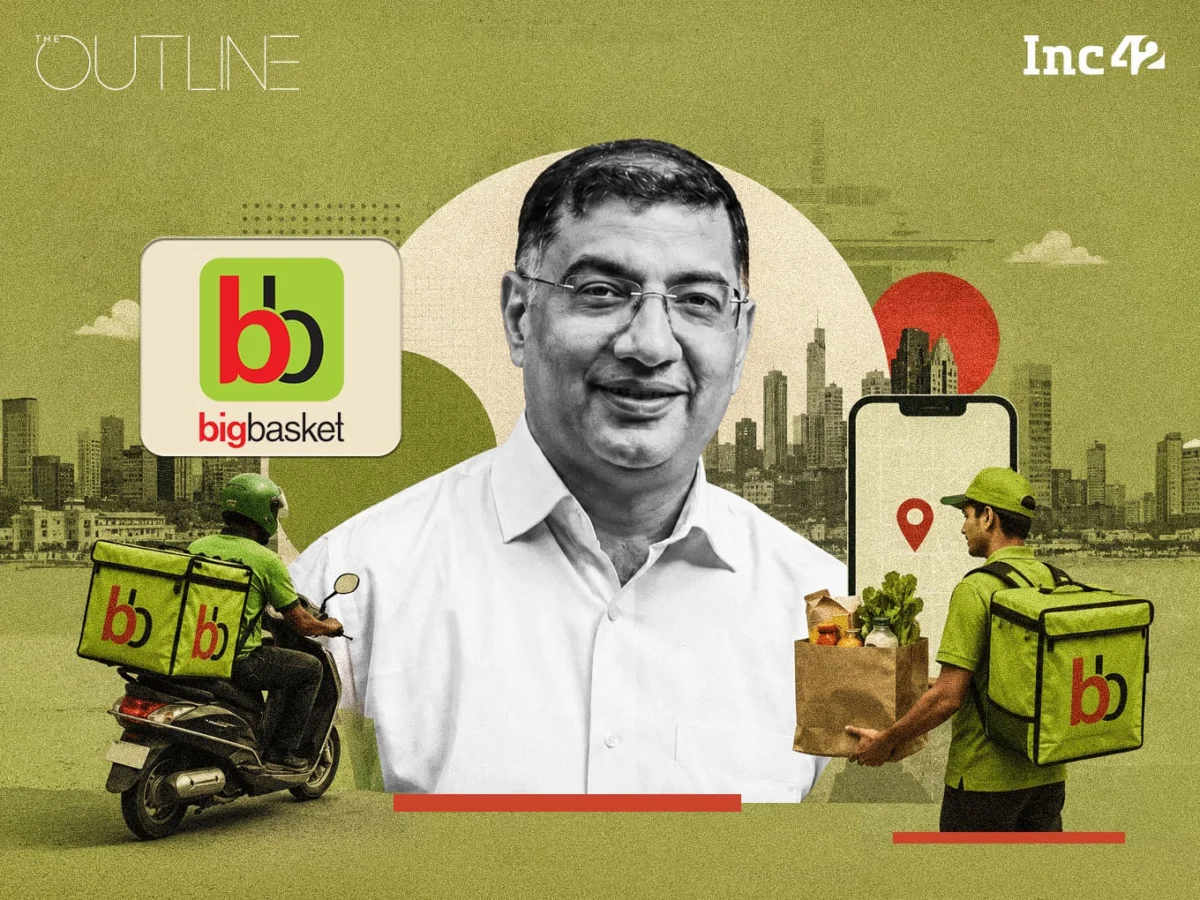
For 15 years, BigBasket stood as the undisputed titan of India’s online grocery sector. It was the company that taught the nation how to order weekly supplies via an app, pioneering a sophisticated, integrated supply chain that connected farmers directly to urban doorsteps. Yet, as co-founder Hari Menon stepped down last month, his farewell message on LinkedIn served as a poignant reflection of a changing era: “I was in denial of the idea of quick commerce. Back then, if you had asked 100 people whether they wanted groceries in 10 minutes, most of them would’ve said no.”
Menon’s departure marks the end of a foundational chapter for the Tata-backed giant. As the company transitions under the leadership of new CEO Amit Nanda, it faces a stark reality: the era of "growth at all costs" is over. In its place, the company is undertaking a strategic overhaul that could see it retreat from nearly half of its operational footprint to focus on sustainable profitability, signaling a massive shift in India’s hyper-competitive e-grocery landscape.
The Strategic Pivot: Scaling Back to Move Forward
Within weeks of Menon’s exit, reports emerged suggesting that Tata Digital is pushing for a drastic consolidation of BigBasket’s operations. The mandate is clear: move from 76 cities to approximately 40, prioritizing high-density, profitable urban clusters over nationwide expansion.
While BigBasket has officially refuted these claims, labeling the figures as "speculative" and insisting they "do not reflect the current on-ground reality," industry insiders tell a different story. Analysts suggest that what is occurring within the corridors of the Tata-owned entity is not merely a routine cost-cutting exercise. It is a fundamental "rethinking of the model."
Under the guidance of Amit Nanda, a former Amazon executive, the company is pivoting toward a strategy of capital discipline. The goal is to maximize order density—the lifeblood of profitability in a business where logistics costs can quickly erode margins. By concentrating on Tier-1 cities where the customer base is accustomed to high-frequency, premium-segment purchases, BigBasket hopes to stabilize its balance sheet.
A Chronology of Disruption: From Scheduled Baskets to Instant Gratification
To understand BigBasket’s current predicament, one must look at the evolution of the Indian consumer’s shopping habits.
- 2011–2018 (The Era of the Weekly Basket): BigBasket defined the market. Consumers were encouraged to plan their grocery needs for the week, resulting in large, high-value baskets (often ₹1,200–₹1,300). The company’s success was built on inventory management, massive warehouses, and deep integration with agricultural suppliers.
- 2019–2022 (The Quick Commerce Wave): Startups like Blinkit (formerly Grofers), Zepto, and Swiggy Instamart emerged, shifting the consumer focus from "value" to "velocity." The 10-to-20-minute delivery promise transformed grocery from a planned chore into an impulse-driven habit.
- 2023–2024 (The Competitive Squeeze): Rivals began burning billions in venture capital to subsidize rapid expansion, dense dark-store networks, and aggressive discounts. BigBasket, constrained by the Tata Group’s inherent financial discipline, found it increasingly difficult to match the "burn-rate" of its competitors.
- 2025 (The Reckoning): Parent entity Supermarket Grocery Supplies reports a 42% jump in consolidated net losses to ₹2,006.8 Cr. With customer acquisition costs skyrocketing, the company begins its transition from a founder-led visionary firm to a professionally managed, profit-focused organization.
The Financial Burden: Why Tata is Tightening the Reins
The urgency of this restructuring is rooted in the financial performance of the wider Tata Digital portfolio. Despite an infusion of nearly ₹3,000 Cr by Tata Sons in April 2025, the group is clearly concerned about the long-term outlook.
The valuation of Tata Digital, currently hovering around $10.3 Bn, reflects a cooling of investor sentiment. With cumulative losses across its consumer businesses projected to hit a staggering ₹9,000 Cr over the next three years, the Tata Group is no longer willing to subsidize market share gains that do not translate into a clear path toward the black.
For BigBasket, the numbers are sobering. The consumer business saw losses widen by 47% to ₹1,851 Cr in the last fiscal year, while operating revenue saw a marginal decline of 2%. In a market where competitors are fueled by endless capital, BigBasket’s inability to outspend its rivals has forced it to play a game of "defensive consolidation."
The "Nanda" Doctrine: Efficiency Over Expansion
Amit Nanda’s appointment is a clear signal that the "experimentation phase" is over. Nanda, a veteran of the highly efficient Amazon ecosystem, is tasked with a singular mission: restoring financial health.
Unlike his predecessor, whose legacy was built on scaling the supply chain, Nanda is focused on operational execution. His playbook involves:

- Urban Concentration: Exit low-margin, low-density Tier-2 and Tier-3 markets to focus capital on high-velocity urban clusters.
- Private Label Leverage: Capitalizing on the brand equity of Fresho and BB Royal to maintain margins that third-party brands cannot offer.
- Assortment Differentiation: Moving beyond basic groceries to include electronics via Croma and other lifestyle categories, attempting to capture a larger "share of wallet" per customer.
However, this shift is not without its risks. By retreating from smaller markets, BigBasket effectively concedes ground to rivals like Zepto and Blinkit, who are aggressively capturing the next generation of online shoppers in those very regions.
The Competitive Landscape: Is BigBasket Losing the War?
The scale of the challenge is evident in the market share data. Blinkit alone operates more than 2,200 dark stores—nearly double BigBasket’s footprint—and processes over 2.5 million orders daily. When combined, Zepto and Swiggy Instamart hold over 53% of the market.
BigBasket, which expanded its dark store network to nearly 1,000 locations to support its "BB Now" service, finds itself in a classic dilemma: it is too big to be a niche, but currently not fast or subsidized enough to be a dominant "quick commerce" leader.
Industry experts suggest that BigBasket’s greatest challenge is the "instinctive consumer." Younger users today open Blinkit or Zepto out of habit, leaving BigBasket to compete for the "leftover" or "planned" shopping trips. Reversing this behavioral trend requires significant marketing spend, which conflicts with the current mandate for fiscal prudence.
Implications: The Future of Grocery Tech in India
The restructuring of BigBasket serves as a case study for the entire Indian startup ecosystem. It marks the transition from the "growth-at-all-costs" era—funded by easy venture capital—to an era of sustainable unit economics.
1. The End of Irrational Discounting: As investors demand profits, the era of "free delivery" and deep discounts is likely to taper off. BigBasket’s pivot is likely to be followed by other players as they realize that the cost of acquiring a customer must be lower than the lifetime value of that customer.
2. The Return of the "Super-App" Strategy: Tata Digital’s continued support of BigBasket suggests they still view it as a key pillar in their ecosystem. If BigBasket can successfully integrate its loyalty program with the wider Tata Neu app, it may create a unique moat that pure-play quick commerce players lack.
3. Quality vs. Speed: BigBasket’s long-term bet is that consumers will eventually tire of the "10-minute" promise if it comes at the cost of product quality and assortment. By focusing on private labels and a wider variety of goods, the company is betting that it can win the "value" segment, even if it loses the "urgency" segment.
Conclusion: A Delicate Balancing Act
BigBasket is currently walking a tightrope. On one side lies the pressure to satisfy Tata Group’s demand for profitability; on the other lies the existential threat of losing market relevance to faster, more aggressive rivals.
Amit Nanda’s new playbook is undeniably the logical choice for a company that can no longer afford to burn cash. However, history is replete with examples of companies that optimized their way to profitability only to find that they had shrunk their business into insignificance.
Whether the "Great Retreat" leads to a leaner, more resilient BigBasket or serves as the beginning of a slow decline will depend on one thing: whether the Indian consumer is truly ready to trade instant gratification for the reliability and quality that BigBasket built its name upon. For now, the entire retail industry is watching, waiting to see if the pioneer of online grocery can reinvent itself for the second time in fifteen years.